
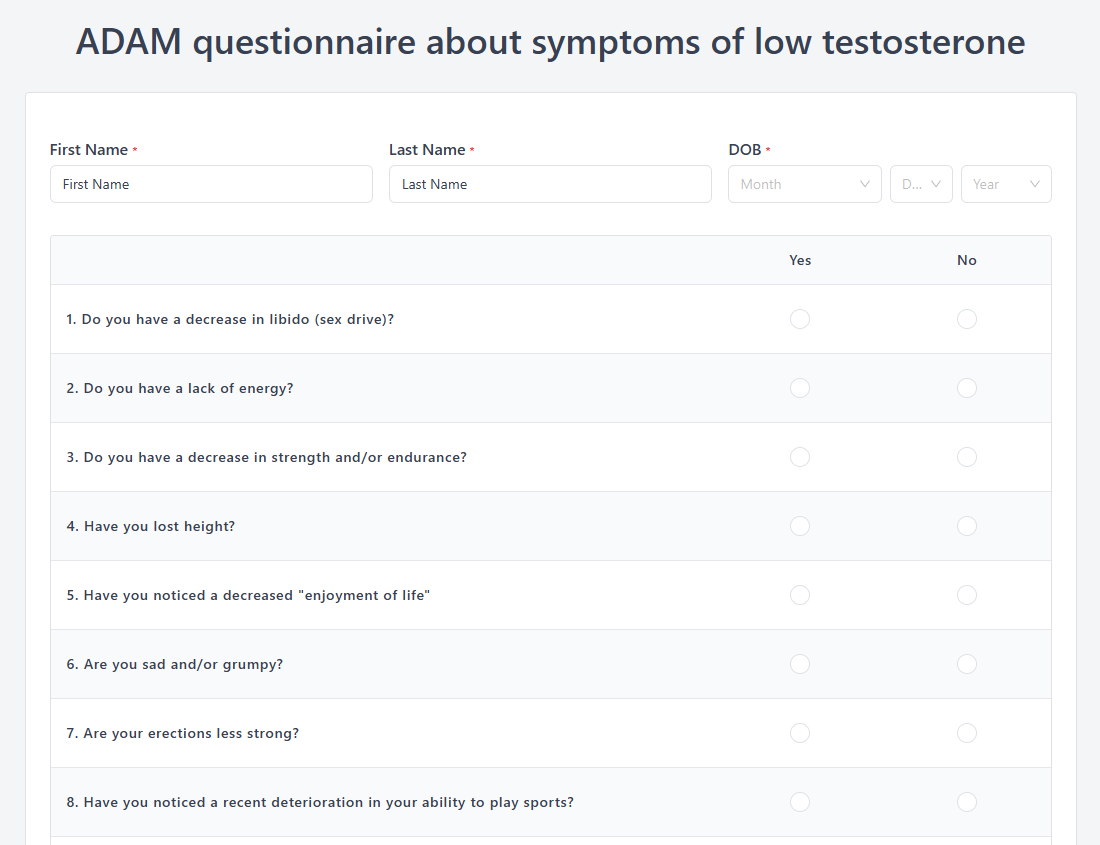

The ADAM (Androgen Deficiency in the Aging Male) questionnaire is a 10-item yes/no screening tool developed by John E. Morley and colleagues at Saint Louis University to identify men at risk for androgen deficiency and late-onset hypogonadism. Published in 2000, it screens for symptoms including decreased libido, erectile dysfunction, fatigue, decreased muscle strength, mood changes, and loss of height (Morley et al., Metabolism, 2000). The ADAM is considered positive if the patient answers "Yes" to question 1 (decreased libido) or question 7 (decreased erections), or "Yes" to any 3 of the remaining questions. The questionnaire demonstrates 88% sensitivity and 60% specificity for detecting low bioavailable testosterone. Zentake's digital version allows clinicians to administer and auto-score the ADAM in a HIPAA-compliant environment.
The ADAM questionnaire uses a criterion-based scoring method rather than a simple summative score. Each of the 10 items is answered "Yes" or "No." The questionnaire is scored as positive (suggestive of androgen deficiency) if any of the following conditions are met (Morley et al., Metabolism, 2000):
A positive result indicates the patient may have low testosterone and should undergo biochemical confirmation with serum total and free testosterone levels. The ADAM is a screening tool only and is not sufficient for diagnosis without laboratory confirmation. In the original validation study of 316 Canadian physicians aged 40–62, 25% had low bioavailable testosterone levels. Zentake automatically evaluates all scoring criteria upon form submission and flags positive results for clinical follow-up.
Step 1: Identify eligible patients. The ADAM questionnaire is designed for men aged 40 and older who may be experiencing symptoms of testosterone deficiency. Zentake can trigger the ADAM automatically as part of a men's health intake workflow.
Step 2: Present the 10 questions. Each question asks the patient to answer "Yes" or "No" about specific symptoms related to androgen deficiency. Zentake displays the questions in a clear, patient-friendly format optimized for self-completion on any device.
Step 3: Collect responses. The patient completes all 10 items. Zentake's digital form ensures all questions are answered before submission, preventing incomplete screenings.
Step 4: Review the auto-scored result. Zentake instantly evaluates whether the scoring criteria are met (positive on Q1, Q7, or any 3 others) and displays the result as "Positive" or "Negative" for androgen deficiency screening. Positive results are flagged automatically.
Step 5: Order confirmatory labs if positive. For patients with a positive ADAM result, Zentake can include a recommendation to order serum total testosterone and free testosterone levels. Results are sent directly to your EMR for documentation and lab ordering.
Scoring: Paper ADAM forms require the clinician to manually check whether Q1, Q7, or any 3 other questions are positive — a multi-step logic that is easy to misapply. Zentake auto-evaluates all criteria instantly.
Completion: Paper forms take 2–3 minutes. Zentake's digital version completes in under 2 minutes with a streamlined mobile-friendly interface.
Delivery: Paper forms must be handed to the patient in the office. Zentake can send the ADAM via email, text, or patient portal before the appointment.
Data Storage: Paper forms are filed in charts and difficult to retrieve. Zentake stores all submissions in encrypted, HIPAA-compliant cloud storage.
Longitudinal Tracking: Comparing paper ADAM results before and after testosterone replacement therapy requires manual chart review. Zentake displays results over time in a dashboard to track treatment response.
Security: Paper forms containing sensitive men's health data risk loss or unauthorized access. Zentake uses end-to-end encryption and role-based access controls.
Integration: Paper results must be manually transcribed into the EMR. Zentake integrates directly with systems like Elation, automatically sending results and flagged positives.
Cost: Paper forms require printing and storage. Zentake eliminates these costs with unlimited digital submissions.
What does the ADAM questionnaire measure?
The ADAM questionnaire screens for symptoms of androgen deficiency (low testosterone) in aging men. It assesses 10 symptom domains including decreased libido, erectile dysfunction, fatigue, decreased muscle strength, mood changes, decreased enjoyment of life, sadness, deteriorating sports performance, falling asleep after dinner, and deteriorating work performance. Zentake's digital version captures all responses and auto-evaluates them against the validated scoring criteria.
How do you score the ADAM questionnaire?
The ADAM is positive if the patient answers "Yes" to question 1 (decreased sex drive) or question 7 (weaker erections), or answers "Yes" to any 3 of the remaining 8 questions. Unlike simple summative scores, the ADAM uses criterion-based logic. Zentake handles this multi-criteria evaluation automatically.
How long does the ADAM take to complete?
The ADAM questionnaire takes approximately 2–3 minutes to complete. All 10 questions require simple yes/no answers, making it one of the fastest testosterone screening tools available. Zentake's digital version can be completed on any device before or during the appointment.
Is the ADAM questionnaire free to use?
Yes, the ADAM questionnaire is freely available for clinical use. It was published in peer-reviewed literature and is widely reproduced in clinical settings. Zentake provides a ready-to-use digital version that you can deploy immediately with a free trial.
What age group is the ADAM designed for?
The ADAM was developed for men aged 40 and older. The original validation study was conducted in Canadian physicians aged 40 to 62 (Morley et al., 2000). It is commonly used in men's health clinics for patients aged 40–80+ who present with symptoms suggestive of testosterone deficiency.
Who should administer the ADAM?
The ADAM is designed as a patient self-report questionnaire. It can be administered by primary care physicians, urologists, endocrinologists, nurse practitioners, and physician assistants. No specialized training is required. Zentake makes it easy to send the questionnaire to patients for self-completion before their visit.
How accurate is the ADAM questionnaire?
The ADAM has high sensitivity (88%) but moderate specificity (60%) in the original validation study. This means it is good at identifying men who may have low testosterone but will also flag some men who do not. A positive ADAM result should always be confirmed with serum testosterone testing. Some studies have reported specificity as low as 24% in certain populations, reinforcing the importance of biochemical confirmation.
Can the ADAM track treatment response?
Yes. In the original validation study, 18 of 21 patients (86%) treated with testosterone showed improvement on the ADAM questionnaire (P = .002). Zentake enables longitudinal tracking of ADAM results to monitor symptom changes before and after testosterone replacement therapy.
1. Morley JE, Charlton E, Patrick P, et al. Validation of a screening questionnaire for androgen deficiency in aging males. Metabolism. 2000;49(9):1239-1242.
2. Mohamed O, Freundlich RE, Engel SK, et al. The quantitative ADAM questionnaire: a new tool in quantifying the severity of hypogonadism. International Journal of Impotence Research. 2010;22(1):20-24.
3. Chueh KS, Huang SP, Lee YC, et al. The comparison of the Aging Male Symptoms (AMS) Scale and Androgen Deficiency in the Aging Male (ADAM) Questionnaire to detect androgen deficiency in middle-aged men. Journal of Andrology. 2012;33(5):817-823.
Last updated: March 2026

The leading patient intake platform. HIPAA compliant forms for healthcare providers and organizations. Find out what you're missing!


