
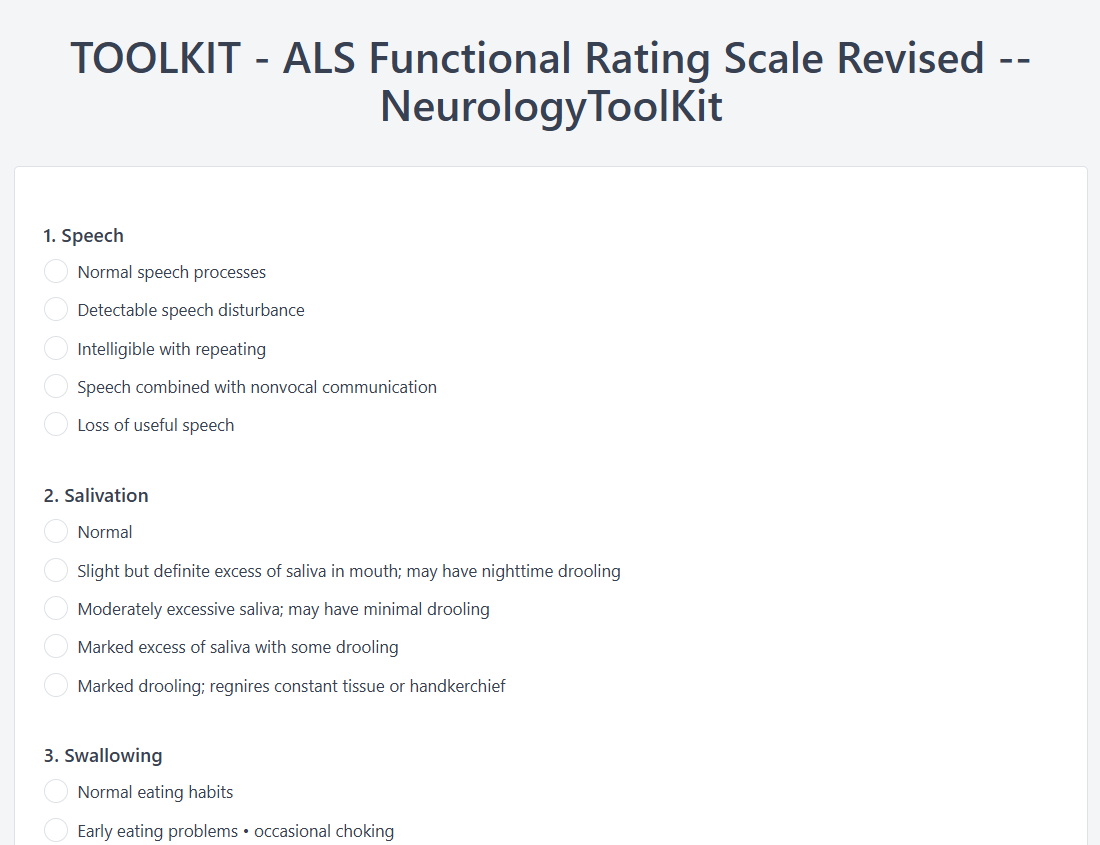

The ALS Functional Rating Scale – Revised (ALSFRS-R) is a 12-item clinician- or patient-administered questionnaire developed by J.M. Cedarbaum and the BDNF ALS Study Group in 1999 to measure functional status and disease progression in individuals with amyotrophic lateral sclerosis (ALS). Each item is rated from 0 (no function) to 4 (normal function), yielding a total score of 0 to 48; higher scores indicate better function. The ALSFRS-R expanded the original ALSFRS by adding three respiratory items — dyspnea, orthopnea, and respiratory insufficiency — to more accurately capture disease burden across bulbar, fine motor, gross motor, and respiratory domains (Cedarbaum et al., 1999). The scale demonstrates strong internal consistency (Cronbach’s alpha 0.85–0.94) and is the gold-standard functional outcome measure in ALS clinical trials worldwide. Zentake’s digital ALSFRS-R enables neurologists and ALS care teams to administer, score, and track the scale efficiently across clinic visits and remote check-ins.
Each of the 12 items is rated from 0 to 4. All item scores are summed to produce a total score from 0 to 48, with higher scores reflecting greater functional ability. Items are organized across four functional domains:
No single clinical cutoff defines disease severity; instead, the ALSFRS-R is used to track the rate of decline over time. A 20% or greater change in total score is generally considered clinically meaningful by ALS specialists (Cedarbaum et al., 1999). Zentake automatically calculates domain subscores and the total ALSFRS-R score upon each submission, and displays longitudinal decline curves to support prognosis and care planning.
Step 1: Select the administration format. The ALSFRS-R can be administered by a clinician in-person, completed by the patient (or caregiver) as a self-report, or conducted by telephone interview. Zentake supports all three modes: clinic tablet, patient-facing digital link, or provider-assisted entry.
Step 2: Walk through each of the 12 items in order. For each item, the patient describes their current ability in that functional domain over the past week. Ratings represent actual current function, not best possible or worst-case performance. Remind patients to rate their status honestly relative to pre-illness baseline.
Step 3: Rate each item 0–4. Use the descriptive anchors provided for each item. For example, Item 1 (Speech): 4 = normal, 3 = detectable speech disturbance, 2 = intelligible with repeating, 1 = speech combined with non-vocal communication, 0 = loss of useful speech.
Step 4: Calculate domain and total scores. Sum all 12 items for the total ALSFRS-R score (max 48). Calculate bulbar, fine motor, gross motor, and respiratory subscores separately for clinical interpretation. Zentake performs all scoring automatically upon submission.
Step 5: Compare to prior scores and document progression. ALSFRS-R is most informative when tracked serially — typically every 3 months in clinical practice or monthly in trials. Zentake generates a longitudinal decline chart at each visit, making disease trajectory visible to both the clinician and multidisciplinary ALS care team.
Scoring: Paper ALSFRS-R requires manual summation across 12 items and calculation of four subscales. Zentake calculates all scores automatically upon submission, eliminating errors.
Completion: Motor and bulbar impairments make paper forms difficult for many ALS patients to complete independently. Zentake’s accessible digital interface supports caregiver-assisted completion and remote submission from home.
Delivery: Paper ALSFRS-R must be printed, handed to the patient, collected, and filed. Zentake delivers the form via secure link before the appointment, reducing in-clinic time burden.
Data Storage: Paper records are siloed and difficult to compare across visits. Zentake stores all ALSFRS-R scores in a structured database, enabling instant retrieval and longitudinal comparison.
Longitudinal Tracking: Tracking disease progression on paper requires manual charting of scores across visits. Zentake automatically generates functional decline curves across all four domains, supporting prognosis and trial reporting.
Security: Paper forms lack audit trails and encryption. Zentake is HIPAA-compliant, with role-based access controls and encrypted data storage.
Integration: Paper scores must be transcribed manually into the EHR. Zentake integrates with EMR platforms to push ALSFRS-R scores directly into the patient record.
Cost: Paper administration involves staff time for distribution, collection, scoring, and filing. Zentake automates this entire workflow at scale.
What does the ALSFRS-R measure?
The ALSFRS-R measures functional status across four domains affected by ALS: bulbar function (speech, swallowing, salivation), fine motor function (handwriting, utensils, dressing), gross motor function (turning in bed, walking, stairs), and respiratory function (dyspnea, orthopnea, ventilatory support). It quantifies overall disability and tracks progression over time. Zentake digitizes the entire administration and scoring workflow for ALS clinics.
How do you score the ALSFRS-R?
Each of the 12 items is rated from 0 (no function) to 4 (normal function), and all item scores are summed for a total ranging from 0 to 48. Domain subscores are calculated by summing the three items in each domain (max 12 per domain). Zentake calculates all scores automatically upon form submission.
Who developed the ALSFRS-R?
The ALSFRS-R was developed by J.M. Cedarbaum and colleagues in the BDNF ALS Study Group and published in 1999. It revised the original ALSFRS to give appropriate weight to respiratory function, which is a critical determinant of survival in ALS.
How long does the ALSFRS-R take to complete?
Most patients or clinicians complete the ALSFRS-R in 5 to 10 minutes. It can be administered in-person, by telephone, or remotely — making it highly practical for patients with limited mobility. Zentake’s digital form is optimized for efficient completion on any device, including caregiver-assisted entries.
What population is the ALSFRS-R designed for?
The ALSFRS-R is designed for adults diagnosed with ALS. It is the most widely used and validated functional outcome measure for this population and is used in clinical practice, longitudinal research, and randomized controlled trials.
Is the ALSFRS-R free to use?
The ALSFRS-R is freely available for clinical and research use. Zentake provides the digital platform for administering, scoring, and tracking the ALSFRS-R as part of its HIPAA-compliant subscription service. Start your free trial at zentake.com.
Who should administer the ALSFRS-R?
The ALSFRS-R can be completed by the patient independently, by a caregiver proxy, by a trained clinical coordinator via telephone interview, or by a clinician during an in-person appointment. Validated telephone and self-report administrations produce equivalent scores to clinician-administered versions in most studies.
How often should the ALSFRS-R be administered?
In clinical practice, the ALSFRS-R is typically administered every 3 months at ALS clinic visits. In clinical trials, monthly administration is standard. Serial measurement is essential — a single score is less meaningful than the rate of decline over time. Zentake automates reminders and form delivery to support consistent longitudinal data collection.
1. Cedarbaum, J. M., Stambler, N., Malta, E., Fuller, C., Hilt, D., Thurmond, B., & Bhatt, A. (1999). The ALSFRS-R: a revised ALS functional rating scale that incorporates assessments of respiratory function. Journal of the Neurological Sciences, 169(1–2), 13–21. https://doi.org/10.1016/S0022-510X(99)00210-5
2. Kaufmann, P., Levy, G., Montes, J., Buchsbaum, R., Barsdorf, A. I., Battista, V., … Mitsumoto, H. (2007). Excellent inter-rater, intra-rater, and telephone-administered reliability of the ALSFRS-R in a multicenter clinical trial. Amyotrophic Lateral Sclerosis, 8(1), 42–46. https://doi.org/10.1080/17482960600888156
3. Kimura, F., Fujimura, C., Ishida, S., Nakajima, H., Furutama, D., Uehara, H., … Hanafusa, T. (2006). Progression rate of ALSFRS-R at time of diagnosis predicts survival time in ALS. Neurology, 66(2), 265–267. https://doi.org/10.1212/01.wnl.0000194316.91908.8a
Last updated: April 2026

The leading patient intake platform. HIPAA compliant forms for healthcare providers and organizations. Find out what you're missing!


