
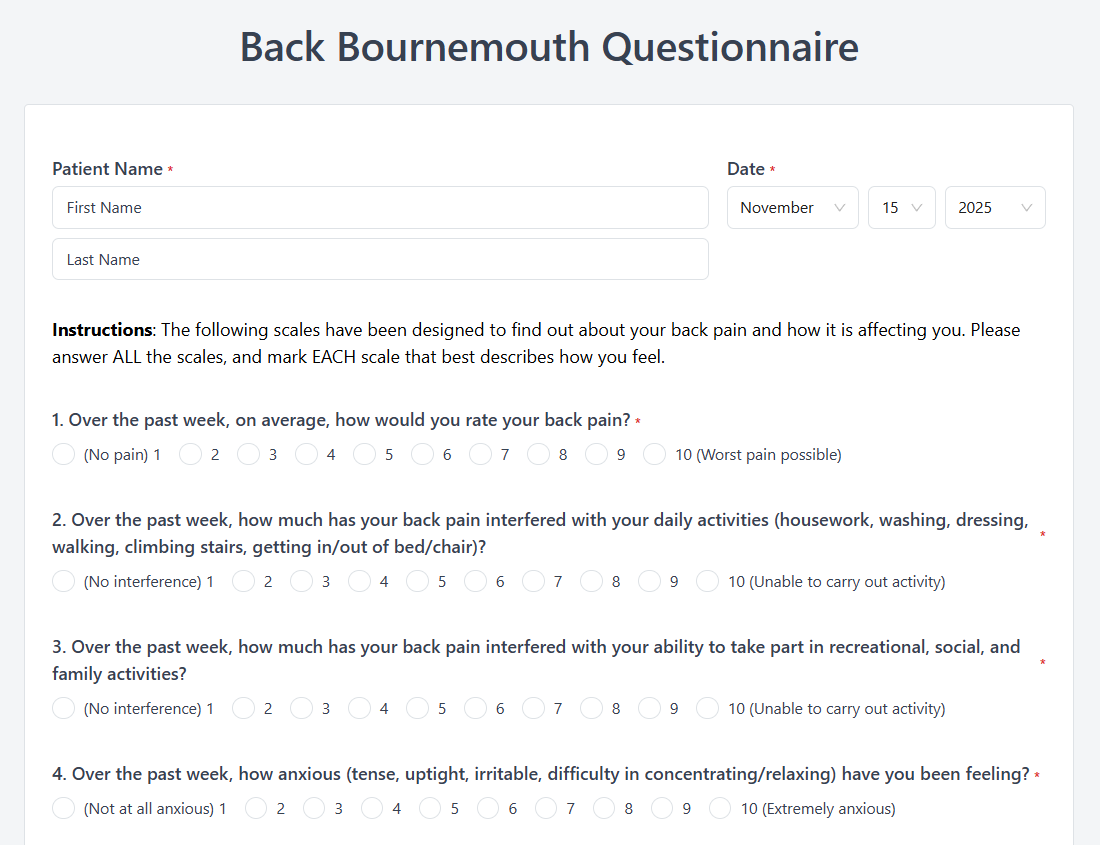

The Back Bournemouth Questionnaire (BBQ) is a 7-item, self-report outcome measure developed by Jennifer E. Bolton and Alan C. Breen at the Anglo-European College of Chiropractic, with psychometric properties in back pain patients published in 1999. It measures seven biopsychosocial dimensions of low back pain on an 11-point numerical rating scale (NRS) from 0 to 10, yielding a total score of 0 to 70; higher scores indicate greater pain and disability. The BBQ uniquely integrates the physical, psychological, and social dimensions of the biopsychosocial pain model into a single short-form instrument, covering pain intensity, activities of daily living, social activities, anxiety, depression, fear-avoidance beliefs, and perceived ability to control pain (Bolton & Breen, 1999). The BBQ demonstrates excellent internal consistency (Cronbach’s alpha = 0.90) and test-retest reliability (ICC = 0.95). Zentake’s digital BBQ enables chiropractors, physical therapists, and spine clinicians to capture comprehensive back pain outcomes efficiently at every appointment.
Each of the 7 items is rated from 0 to 10, with endpoint descriptors anchoring the scale (e.g., “no pain” to “worst pain possible” for the pain item). All item scores are summed to produce a total score ranging from 0 to 70. Higher scores reflect greater pain severity, disability, and psychological distress. The seven domains are:
A clinically meaningful improvement is defined as a total score reduction of 13 points or 36% from baseline in the general back pain population (Bolton, 2004). For acute patients, the minimal clinically important change (MCIC) is 26 points; for subacute/chronic patients, it is 18 points. Zentake automatically calculates BBQ total scores and tracks changes from baseline at each appointment, so clinicians can evaluate treatment response at a glance.
Step 1: Distribute the questionnaire at each visit. The BBQ should be completed by the patient independently at the start of each appointment — before the clinical encounter — to avoid clinician influence on responses. Zentake delivers the BBQ digitally via secure link to patients before they arrive, so scores are ready when the appointment begins.
Step 2: Instruct the patient on the rating scale. Explain that each item is rated from 0 to 10, with different descriptors at each end of the scale. Patients should circle (or, in Zentake, select) the number that best reflects their experience over the past week. Each item typically takes under 30 seconds to complete.
Step 3: Allow independent completion. The BBQ is a self-report measure; patients should complete it without clinician input to ensure accurate baseline and follow-up data. Zentake’s digital format prevents accidental clinician influence by delivering the form to the patient’s own device.
Step 4: Calculate the total score. Sum all 7 item scores for a total from 0 to 70. Zentake performs this automatically upon submission, presenting the scored result to the clinician before or during the appointment.
Step 5: Compare to prior scores and document progress. The BBQ is most valuable when administered at every visit and compared across time. Zentake’s longitudinal tracking dashboard displays score trends across the episode of care, allowing clinicians to objectively demonstrate treatment response to both patients and payers.
Scoring: Paper BBQ requires manual summation of 7 NRS items and comparison to prior visit scores. Zentake calculates the total instantly and surfaces the change from baseline automatically.
Completion: Paper BBQs can be forgotten, mishandled, or incompletely filled out at the front desk. Zentake delivers the form digitally to patients before arrival, increasing completion rates and data quality.
Delivery: Paper forms must be printed, distributed, collected, and manually entered into the patient record. Zentake automates this entire workflow with digital delivery, completion, and score calculation.
Data Storage: Paper BBQ forms accumulate in charts and are difficult to trend across visits. Zentake stores all BBQ data in a structured database, enabling instant longitudinal retrieval.
Longitudinal Tracking: Plotting treatment progress manually on paper is time-consuming and error-prone. Zentake automatically generates outcome trend charts across the episode of care, making it easy to show patients their improvement.
Security: Paper records lack encryption and audit trails. Zentake is HIPAA-compliant, with encrypted cloud storage and role-based access controls.
Integration: Paper scores must be manually transcribed into the EHR. Zentake integrates with EMR platforms to push BBQ scores directly into the patient chart.
Cost: Paper administration involves printing, filing, and staff data-entry overhead. Zentake eliminates these costs with a fully digital workflow.
What does the Back Bournemouth Questionnaire measure?
The BBQ measures seven biopsychosocial dimensions of low back pain: pain intensity, limitation in daily activities, limitation in social activities, anxiety, depression, fear-avoidance beliefs related to work, and the patient’s perceived ability to control their pain. Each dimension is rated on an 11-point NRS scale (0–10), producing a total score from 0 to 70. Zentake digitizes this assessment so clinicians can capture all seven dimensions at every visit without paper forms.
How do you score the Back Bournemouth Questionnaire?
Sum the seven item scores (each rated 0–10) for a total score ranging from 0 to 70. Higher scores reflect greater pain severity and disability. A reduction of 13 points or 36% from baseline is considered a clinically meaningful improvement. Zentake calculates the total score and change from baseline automatically upon each submission.
Who developed the Back Bournemouth Questionnaire?
The Back Bournemouth Questionnaire was developed by Jennifer E. Bolton and Alan C. Breen at the Anglo-European College of Chiropractic. Psychometric properties were first published in the Journal of Manipulative and Physiological Therapeutics in 1999.
How long does the BBQ take to complete?
The BBQ typically takes 2 to 5 minutes to complete, making it practical for routine clinical use at every visit. Zentake’s digital format can be sent to patients before their appointment, so the score is ready when they arrive, saving in-clinic time.
What population is the BBQ designed for?
The BBQ was developed and validated for adult patients with low back pain, including acute, subacute, and chronic presentations. It has been validated for use in chiropractic and physiotherapy settings and has been translated and validated in multiple languages.
Is the Back Bournemouth Questionnaire free to use?
The BBQ is widely used in clinical practice and research and is generally available without licensing restrictions. Zentake provides the digital administration platform for the BBQ with HIPAA-compliant storage, automated scoring, and outcome tracking as part of its subscription plans. Start your free trial at zentake.com.
Who should administer the BBQ?
The BBQ is a patient self-report instrument and should be completed independently by the patient at the start of each appointment. Clinicians should not complete it on the patient’s behalf. Zentake delivers the form directly to patients via a secure link, ensuring independent completion every time.
What is the minimal clinically important change for the BBQ?
A total score improvement of 13 points (or 36% from baseline) is considered clinically meaningful in the general back pain population. For acute patients, the MCIC is approximately 26 points; for subacute/chronic patients, it is approximately 18 points. Zentake automatically calculates and displays the change from baseline at each visit so clinicians can quickly assess whether clinically significant progress has been achieved.
1. Bolton, J. E., & Breen, A. C. (1999). The Bournemouth Questionnaire: A short-form comprehensive outcome measure. I. Psychometric properties in back pain patients. Journal of Manipulative and Physiological Therapeutics, 22(8), 503–510. https://doi.org/10.1016/S0161-4754(99)70001-1
2. Bolton, J. E. (2004). Responsiveness of the Bournemouth Questionnaire in determining minimal clinically important change in subgroups of low back pain patients. Journal of Manipulative and Physiological Therapeutics, 27(2), 100–109. https://doi.org/10.1016/j.jmpt.2003.12.013
3. Gabel, C. P., Burkett, B., & Neller, A. (2010). Can the Bournemouth questionnaire score functional change in chiropractic patients with persistent LBP? Journal of Manipulative and Physiological Therapeutics, 33(7), 501–508.
Last updated: April 2026

The leading patient intake platform. HIPAA compliant forms for healthcare providers and organizations. Find out what you're missing!


