
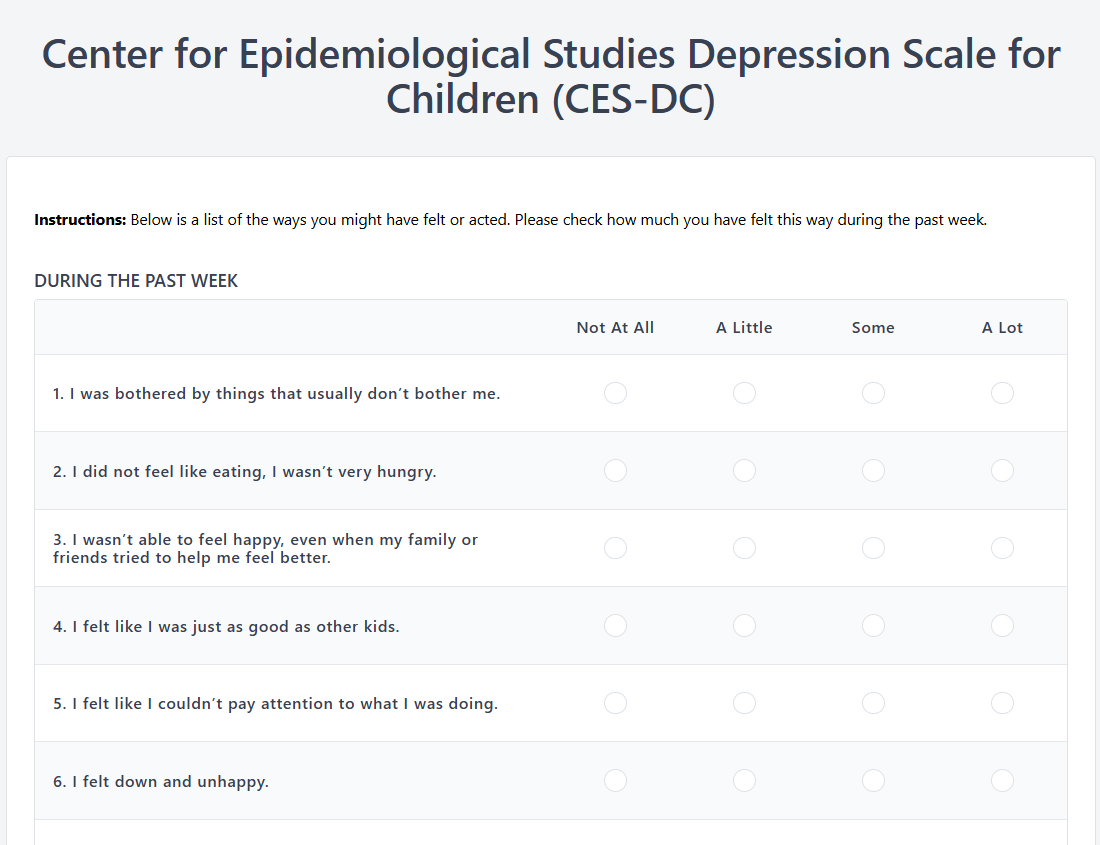

The Center for Epidemiological Studies Depression Scale for Children (CES-DC) is a 20-item self-report instrument developed by Weissman, Orvaschel, and Padian in 1980 to measure the frequency of depressive symptoms in children and adolescents aged 6 to 17. Derived from the adult CES-D, the CES-DC asks respondents to rate each item on a 4-point scale (0 = "not at all" to 3 = "a lot") based on the past week. Total scores range from 0 to 60, with a clinical cutoff score of 15 indicating significant depressive symptomatology. The scale has demonstrated strong psychometric properties, with internal consistency (Cronbach's alpha) ranging from 0.84 to 0.92 across studies, and excellent concurrent validity with the Children's Depression Inventory. Zentake's digital CES-DC enables clinicians to screen for depressive symptoms in young patients quickly, auto-score results, and track symptom changes longitudinally over the course of treatment.
Each of the 20 items is rated by the child or adolescent on a 4-point Likert scale based on the past week:
Four items are reverse-scored (items 4, 8, 12, and 16, the positively worded items). The total score is the sum of all 20 items after reverse-scoring, with a possible range of 0 to 60.
Clinical interpretation thresholds:
Some researchers have proposed a higher cutoff of 30 for greater diagnostic specificity (sensitivity 81.9%, specificity 71.9%). Zentake automatically calculates the CES-DC total score upon form submission and flags scores at or above the clinical threshold for immediate clinician review.
Step 1: Confirm appropriate age range. The CES-DC is validated for children and adolescents aged 6 to 17. For children at the younger end of this range, clinicians should consider whether the child has sufficient reading comprehension to complete the scale independently. Zentake allows clinicians to customize the delivery method by age group.
Step 2: Deliver the form. Send the CES-DC to the patient or guardian via Zentake's secure digital link before or during the appointment. The form can be completed on any device, including smartphones and tablets, in the waiting room or at home.
Step 3: Review completion context. The CES-DC asks about the past seven days. Instruct patients (or parents for younger children) to answer based on how the child has felt or behaved in the past week. Zentake includes customizable instructions on the digital form.
Step 4: Score and interpret results. Zentake automatically sums all 20 items (including reverse-scoring of positive items) and displays the total score with clinical threshold flags immediately upon submission. No manual calculation is required.
Step 5: Document and track over time. Record CES-DC scores in the patient record. Zentake integrates with leading EMR/EHR systems and enables longitudinal tracking so clinicians can monitor depression symptom trajectories across visits and treatment episodes.
Scoring: Paper requires manual item summation and reverse-scoring with risk of error. Zentake auto-scores all 20 items (including reverse-scored items) instantly upon submission.
Completion: Paper forms require in-person distribution. Zentake sends a secure digital link so patients can complete the CES-DC at home before the appointment or on any device in the waiting room.
Delivery: Paper forms are distributed manually. Zentake delivers via SMS, email, or patient portal with automated reminders to ensure completion.
Data Storage: Paper records are stored in physical files. Zentake stores all CES-DC responses in a HIPAA-compliant cloud database with full audit trails and instant clinician access.
Longitudinal Tracking: Paper-based tracking requires manual score comparison. Zentake automatically visualizes CES-DC score trends across all timepoints in a patient's treatment history.
Security: Paper forms risk unauthorized access. Zentake provides end-to-end encryption and role-based access controls compliant with HIPAA.
Integration: Paper scores must be manually entered into EHR. Zentake integrates with EMR/EHR platforms to push CES-DC scores directly into the patient record.
Cost: Paper involves printing, handling, and manual data entry time. Zentake eliminates these administrative burdens.
What does the CES-DC measure?
The CES-DC measures the frequency and severity of depressive symptoms in children and adolescents aged 6 to 17 over the past week. It assesses 20 symptoms including depressed mood, feelings of hopelessness, somatic complaints, and positive affect (reverse-scored). Total scores range from 0 to 60. Zentake auto-scores and flags scores at or above the clinical cutoff of 15.
How do you score the CES-DC?
Sum all 20 items after reverse-scoring the four positively worded items (items 4, 8, 12, and 16). Scores range from 0 to 60. A score of 15 or above indicates elevated depressive symptoms warranting clinical follow-up. Zentake handles all scoring and reverse-scoring automatically upon form submission.
Who developed the CES-DC and when?
The CES-DC was developed by Myrna M. Weissman, Helen Orvaschel, and Nancy Padian in 1980 at the Yale University School of Medicine and the Connecticut Mental Health Center. It was adapted from the adult Center for Epidemiologic Studies Depression Scale (CES-D), originally developed by Lenore Radloff in 1977.
What age range is the CES-DC validated for?
The CES-DC is validated for children and adolescents aged 6 to 17. It has demonstrated stronger psychometric properties in adolescents than in younger children; clinicians should use clinical judgment when interpreting scores for children under age 9.
How long does the CES-DC take to complete?
The CES-DC typically takes 5 to 10 minutes to complete. Zentake's digital format allows children and adolescents to complete it at home before the appointment or on a tablet in the waiting room, minimizing in-clinic administration time.
Who should administer the CES-DC?
The CES-DC is a self-report scale completed by the child or adolescent themselves. For younger children (ages 6 to 9), a parent or clinician may read items aloud. Any trained clinician (psychiatrist, psychologist, pediatrician, or therapist) can interpret the results. Zentake makes it easy to distribute digitally to patients at the appropriate intervals.
What is the clinical cutoff for the CES-DC?
The standard clinical cutoff is 15. Scores at or above 15 indicate significant depressive symptomatology warranting further evaluation. Some research supports a higher cutoff of 30 for greater specificity in certain populations. Zentake flags the standard cutoff of 15 automatically in the clinician dashboard.
Is the CES-DC free to use?
The CES-DC is in the public domain and freely available for clinical and research use. Zentake offers a digital, HIPAA-compliant version that automates scoring, reverse-scoring, and longitudinal tracking. Start a free trial at zentake.com.
1. Weissman MM, Orvaschel H, Padian N. Children's symptom and social functioning self-report scales: comparison of mothers' and children's reports. Journal of Nervous and Mental Disease. 1980;168(12):736-740.
2. Fendrich M, Weissman MM, Warner V. Screening for depressive disorder in children and adolescents: validating the Center for Epidemiologic Studies Depression Scale for Children. American Journal of Epidemiology. 1990;131(3):538-551. PMID: 2301363.
3. Bromand Z, Temur-Erman S, Yesil R, et al. Validating the CES-DC in children and adolescents. European Child and Adolescent Psychiatry. 2012.
4. Rushton JL, Forcier M, Schectman RM. Epidemiology of depressive symptoms in the National Longitudinal Study of Adolescent Health. Journal of the American Academy of Child and Adolescent Psychiatry. 2002;41(2):199-205.
Last updated: March 2026

The leading patient intake platform. HIPAA compliant forms for healthcare providers and organizations. Find out what you're missing!


