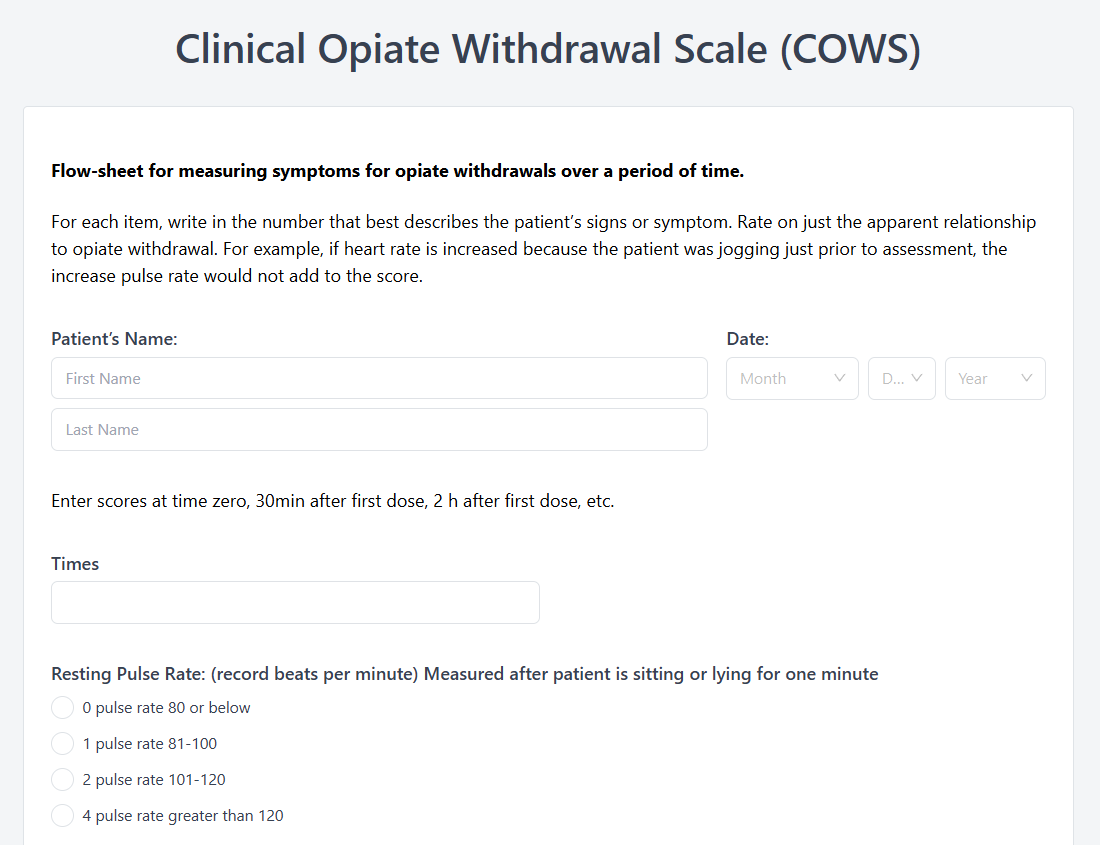
The Clinical Opiate Withdrawal Scale (COWS) becomes faster, more accurate, and fully secure when completed through Zentake’s HIPAA-compliant digital workflow. Healthcare teams can streamline withdrawal monitoring, reduce errors, and deliver consistent, high-quality care in both inpatient and outpatient settings. By digitizing the assessment, clinicians save time on scoring, minimize documentation errors, and gain immediate access to historical patient data. This allows for more informed decision-making, enhanced patient safety, and smoother care transitions between healthcare providers or treatment settings.
What is the Clinical Opiate Withdrawal Scale (COWS)?
The COWS is a widely used, clinician-administered assessment tool that measures the severity of opioid withdrawal. Developed by Wesson and Ling, the scale evaluates 11 key withdrawal symptoms, including: resting pulse rate, sweating, tremors, pupil size, anxiety, gastrointestinal upset, bone or joint pain, restlessness, yawning, runny nose or tearing, and gastrointestinal cramps. Each symptom is scored on a standardized scale, producing a total score that classifies withdrawal severity from mild to severe.
As a standardized opiate withdrawal assessment, the COWS allows clinicians to:
- Assess withdrawal intensity objectively, reducing subjective variability.
The COWS measures observable symptoms to provide a standardized evaluation of opioid withdrawal. This objective scoring helps clinicians minimize personal bias and ensures consistent assessments across different staff members. - Guide treatment decisions, including timing and dosing of medication-assisted treatment (MAT) such as buprenorphine or methadone.
COWS scores inform clinicians on the appropriate initiation and titration of MAT for each patient. Accurate assessment ensures that medications are administered safely and effectively, reducing the risk of complications. - Evaluate readiness for detoxification programs or transition to recovery-focused interventions.
By monitoring symptom severity, clinicians can determine when a patient is stable enough to begin structured detox programs. This helps optimize timing for interventions and supports a smoother transition into recovery-focused care. - Monitor response to treatment over time, supporting data-driven care adjustments.
Regular COWS assessments allow clinicians to track improvements or worsening of withdrawal symptoms. This ongoing monitoring guides adjustments to treatment plans and enhances patient safety and outcomes.
Because withdrawal symptoms can escalate quickly, consistent COWS scoring plays a critical role in ensuring safe, effective care, especially during detoxification and early recovery. Early identification of severe symptoms enables timely interventions, reducing the risk of complications such as dehydration, seizures, or severe agitation.
Importance & Use Cases in Healthcare
The COWS scale is an essential tool across addiction medicine, emergency departments, primary care, and behavioral health settings. Its structured and objective approach allows clinicians to identify withdrawal severity accurately and respond with evidence-based interventions.
Healthcare providers use COWS to:
- Guide decisions for buprenorphine induction or other MAT protocols, ensuring medications are administered safely and at the appropriate timing.
COWS scores provide clinicians with critical insights to determine the optimal timing and dosing for MAT. This ensures that patients receive medications safely while minimizing withdrawal discomfort and potential complications. - Monitor withdrawal progression during detox, allowing staff to adjust treatment intensity as symptoms change.
Regular assessment with COWS enables clinicians to detect changes in withdrawal severity in real time. This allows treatment plans to be adjusted promptly, improving patient comfort and safety throughout detox. - Evaluate symptom severity during hospitalization, supporting individualized care plans and enhancing patient safety.
COWS provides an objective measure of withdrawal intensity for inpatients experiencing opioid dependence. This information helps clinicians tailor care plans to each patient’s needs and monitor for potential complications. - Track changes in withdrawal over time, providing objective data for follow-ups, clinical notes, or research.
Repeated COWS assessments create a reliable record of symptom trends over the course of treatment. This data supports clinical documentation, longitudinal care planning, and outcome evaluation. - Support research and quality improvement initiatives focused on opioid dependence, withdrawal management, and treatment efficacy.
Aggregated COWS data can be used to analyze treatment effectiveness and improve clinical protocols. Researchers and healthcare organizations can leverage these insights to enhance opioid withdrawal management strategies.
Because the COWS scale measures objectively observable symptoms, it provides a reliable foundation for clinical judgment. It is frequently referenced in addiction medicine guidelines and widely implemented across the U.S. in standardized withdrawal protocols, reinforcing its credibility and utility in both clinical practice and research contexts.
Digital vs. Traditional COWS Forms
Traditional paper-based COWS forms can introduce challenges that slow patient assessment and increase the risk of errors. Clinicians may encounter:
- Illegible handwriting, leading to misinterpretation of scores.
Handwriting variability can result in clinicians misreading critical symptom ratings, which may affect treatment decisions. This increases the likelihood of inconsistent care and potential safety risks for patients experiencing opioid withdrawal. - Misplaced or lost forms, complicating record keeping.
Physical forms can be accidentally misplaced, misfiled, or lost, creating gaps in patient documentation. This complicates tracking withdrawal progression and may require repeat assessments, reducing efficiency and continuity of care. - Inconsistent scoring between staff members, introducing variability in treatment decisions.
Different clinicians may interpret symptom severity differently, leading to inconsistent scoring. This variability can impact the timing and dosing of interventions, such as medication-assisted treatment (MAT), and reduce the reliability of longitudinal data. - Manual data entry delays, reducing efficiency and increasing the potential for mistakes.
Entering paper-based scores into electronic systems takes time and can introduce errors during transcription. Delays in data availability may slow clinical decision-making and affect patient care responsiveness. - Compliance and storage challenges, as paper forms require secure handling to protect sensitive patient data.
Paper records must be securely stored to comply with HIPAA regulations, which can be logistically challenging. Physical storage also increases the risk of unauthorized access or accidental damage, compromising data integrity.
Digital COWS forms resolve these challenges by offering a more reliable, efficient, and secure solution. Benefits include:
- Automated scoring, eliminating calculation errors and providing immediate results for clinical decision-making.
Scores are instantly calculated based on clinician input, reducing human error and speeding up the assessment process. Immediate results allow clinicians to adjust treatment plans without delay, enhancing patient safety. - Digital formatting, removing ambiguity and standardizing data entry across clinicians.
Structured digital forms ensure consistent interpretation of each symptom rating. Standardization improves scoring reliability and helps maintain uniformity across multiple staff members and visits. - Secure storage, ensuring compliance with HIPAA and protecting patient privacy.
All COWS data is encrypted and stored securely within Zentake’s HIPAA-compliant platform. This eliminates risks associated with physical storage and ensures that only authorized personnel can access sensitive patient information. - Instant access to historical data, allowing comparisons of withdrawal severity over multiple visits for longitudinal tracking.
Clinicians can quickly review past scores to track patient progress and identify trends. Longitudinal insights support informed treatment adjustments and facilitate communication among multidisciplinary care teams. - Consistency across staff, reducing inter-rater variability and improving overall assessment accuracy.
Digital guidance and structured input fields help standardize scoring across all clinicians. Reduced variability ensures that patients receive more consistent care regardless of who administers the assessment. - Flexible assessment options, enabling evaluations at the bedside, in clinic settings, or remotely for telehealth programs.
Digital forms can be completed on tablets, desktops, or secure remote platforms, increasing convenience for both patients and staff. Flexible access supports timely assessments in diverse clinical environments, including inpatient, outpatient, and telehealth settings.
Using a digital workflow for COWS also improves efficiency and patient care. Faster assessments allow clinicians to intervene sooner, improving safety and outcomes. Staff training is simplified as digital forms guide the scoring process, and aggregated data can support quality improvement initiatives, research studies, and evidence-based program evaluation.
How Zentake Transforms the COWS Experience
Zentake enhances the Clinical Opiate Withdrawal Scale by converting it into a fully digital, secure, and clinically efficient assessment tool. Designed for modern healthcare workflows, Zentake automates scoring, streamlines documentation, and ensures every COWS evaluation is compliant with industry standards.
Customizable Forms Modify the COWS form to match your clinical workflow. Add instructions, adjust formatting, or include additional fields to support your organization’s protocols.
Electronic Signatures Collect secure, time-stamped signatures directly within the digital assessment. This reduces paperwork and supports proper documentation of clinical evaluations.
HIPAA Compliant All COWS data is encrypted and stored securely, ensuring patient privacy and maintaining compliance with HIPAA standards across your organization.
In-Clinic Tablets Patients and clinicians can complete assessments easily on tablets during intake or monitoring, reducing delays and replacing traditional clipboard-based processes.
Calculations Zentake automatically calculates the total COWS score as items are completed, eliminating manual scoring errors and giving clinicians instant results.
Measures Combine the COWS scale with additional substance use screening tools or behavioral health assessments for a comprehensive evaluation of patient needs.
EHR Integration Export COWS scores, clinical summaries, and patient records directly into your electronic health record system to maintain up-to-date and accurate patient charts.
With Zentake, the COWS assessment becomes faster, clearer, and more reliable—helping clinicians make confident, data-driven decisions during opioid withdrawal management.
FAQs
Q1. Who can administer the COWS?
The COWS is typically administered by clinicians, nurses, addiction specialists, or other trained healthcare providers who are familiar with opioid withdrawal assessment. Proper administration ensures accurate scoring and reliable interpretation of withdrawal severity. Zentake’s digital workflow further guides staff through the assessment, reducing errors and supporting consistent evaluation across providers.
Q2. How long does the COWS assessment take?
Most evaluations take approximately 5–8 minutes, depending on the patient’s presentation and symptom severity. Digital completion through Zentake can streamline this process, providing automatic scoring and instant results. This efficiency allows clinicians to quickly make informed decisions about treatment and monitoring without delaying patient care.
Q3. Is the COWS scientifically validated?
Yes. The Clinical Opiate Withdrawal Scale is a validated and widely accepted assessment tool used in addiction treatment, hospitals, and clinical research. Its structured scoring system ensures objective measurement of withdrawal symptoms. Using COWS helps clinicians standardize assessments and supports evidence-based treatment planning.
Q4. Can Zentake export COWS results?
Yes. Zentake allows secure exporting of scores and full summaries to EHR systems or downloadable PDF formats. This ensures continuity of care by making results easily accessible to authorized staff across different settings. Digital export also supports documentation, reporting, and integration into broader clinical workflows.
Q5. Does Zentake support other withdrawal assessments?
Yes. Zentake supports a wide range of substance use screening tools, mental health assessments, and outcome measures for comprehensive patient evaluation. Clinicians can use a single platform to manage multiple assessments, improving workflow efficiency. This flexibility allows healthcare teams to provide holistic care while maintaining data security and compliance.