
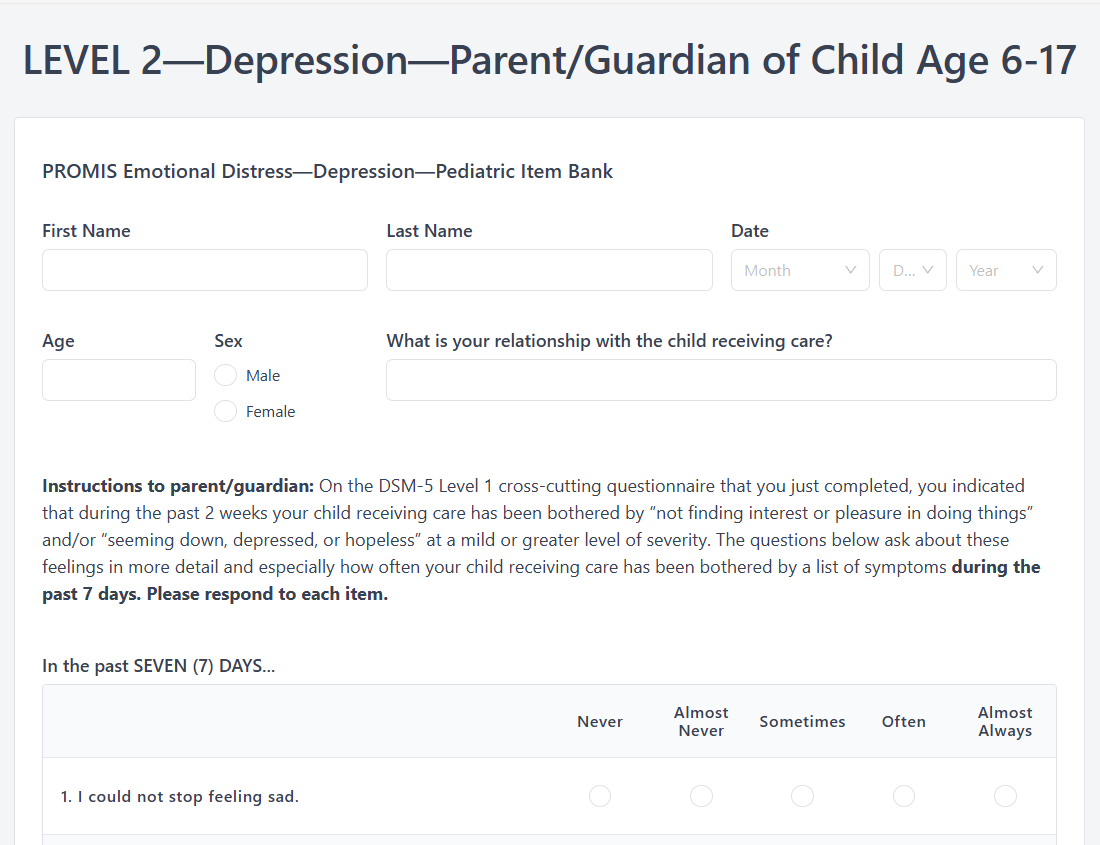

The DSM-5 Level 2—Depression—Parent/Guardian of Child Age 6–17 is an 11-item parent-report measure adapted from the PROMIS Pediatric Depression Short Form. Parents or guardians rate how often, over the past seven days, their child has experienced depressive symptoms on a five-point scale, producing a raw score that is converted to a T-score for severity interpretation. The measure is part of the DSM-5 cross-cutting symptom framework and is used to follow up on a positive Level 1 screen. Zentake's HIPAA-compliant digital platform automates scoring, T-score conversion, and longitudinal tracking.
When a child's DSM-5 Level 1 Cross-Cutting Symptom Measure shows endorsement in the depression domain, the Level 2 measure provides a deeper, more targeted assessment of symptom frequency over the past week. It moves the clinical conversation from "is depression worth exploring?" to "how severe and how recent are the symptoms?"
Because children ages 6–10 may not reliably complete self-report measures, the parent/guardian version captures observable changes in mood, energy, interest, and engagement at home and at school. For adolescents 11–17, the parent measure is often paired with the corresponding child self-report to compare informant perspectives.
Because the measure is anchored to the past seven days, repeat administration provides a sensitive snapshot of week-over-week change. Pediatric and child-psychiatry practices use it to monitor response to therapy, medication initiation or titration, and behavioral interventions.
Structured symptom measurement supports measurement-based care, behavioral-health collaborative-care billing, HEDIS depression follow-up measures, and integrated primary-care/behavioral-health workflows that require documented severity assessments at intake and at defined intervals.
Pediatric Primary Care: Used at well-child visits or sick visits when a Level 1 screen, parental concern, school report, or behavioral change suggests possible depression in a child age 6–17.
Child & Adolescent Psychiatry: Administered at intake and at scheduled follow-up intervals as part of a measurement-based-care protocol, often alongside the corresponding child self-report.
Integrated Behavioral Health & Collaborative Care: Used by care managers and behavioral-health consultants to track parent-reported symptoms between visits and to inform stepped-care decisions.
School-Based Health Centers & Counseling: Used when parents are engaged in the school-based care plan and a structured severity measure is needed.
Telehealth Pediatrics & Behavioral Health: Parents complete the measure at home before a virtual visit; results appear in the chart before the encounter begins.
Items ask the parent or guardian to report how often, in the past seven days, their child experienced symptoms in the depression domain — including sadness, loneliness, hopelessness about the future, feeling that nothing was fun, and trouble feeling happy. The measure is part of the PROMIS framework, which is freely available for clinical use through HealthMeasures and the American Psychiatric Association.
Each item is rated on a 1–5 scale: 1 = Never, 2 = Almost Never, 3 = Sometimes, 4 = Often, 5 = Almost Always. Items are summed to produce a raw score ranging from 11 to 55. Higher scores indicate greater severity of depressive symptoms.
The raw score is converted to a PROMIS T-score (mean 50, SD 10) using the published conversion table. Severity is interpreted from the T-score:
| T-Score | Severity | Typical Clinical Action |
|---|---|---|
| < 55 | None to slight | No further symptom-specific assessment indicated based on this measure; continue routine surveillance |
| 55.0–59.9 | Mild | Consider follow-up assessment and structured re-administration |
| 60.0–69.9 | Moderate | Comprehensive evaluation indicated; consider behavioral-health referral |
| ≥ 70 | Severe | Prompt comprehensive evaluation, safety assessment, and treatment planning |
Raw and T-scores are interpreted in clinical context — not as a diagnosis. A formal diagnosis of a depressive disorder requires a comprehensive clinical evaluation that includes history, observation, and consideration of other contributors.
This measure assesses depressive symptoms in children and adolescents — a population in which mental-health concerns require careful, age-appropriate handling. Clinicians using this tool should pair it with a direct, age-appropriate suicide-risk assessment (for example, the ASQ Suicide Risk Screening Tool or Columbia Protocol where indicated), follow safe-messaging guidelines when discussing results with families, and have a clear pathway for urgent behavioral-health support. The Level 2 measure quantifies symptom severity; it does not establish a diagnosis and does not measure suicide risk.
Structured behavioral-health measurement supports HEDIS depression follow-up measures, behavioral-health collaborative-care billing (CoCM CPT codes), value-based pediatric quality programs, and measurement-based-care requirements increasingly tied to payer contracts and state behavioral-health initiatives.
Any clinician evaluating a child or adolescent age 6–17 for possible depression can use the measure — pediatricians, family physicians, child and adolescent psychiatrists, psychologists, licensed clinical social workers, advanced-practice nurses, and behavioral-health care managers in integrated or collaborative-care settings. The parent or guardian completes the items; the clinician interprets the scores in clinical context.
Most parents complete the 11 items in three to five minutes. With Zentake, scoring and T-score conversion are instantaneous on submission, so the only time cost is the parent or guardian's response — typically before the visit when delivered by SMS or email.
Yes. The measure is part of the DSM-5 Online Assessment Measures published by the American Psychiatric Association and is built on the PROMIS Pediatric Depression Short Form, which has been extensively validated in pediatric and adolescent populations. PROMIS measures are widely used in clinical care and research for symptom severity and treatment monitoring.
No. The Level 2 measure quantifies the severity of depressive symptoms reported by a parent or guardian over the past seven days. A diagnosis of a depressive disorder requires a comprehensive clinical evaluation, including history, mental-status examination, consideration of differential diagnoses, and assessment of functional impairment.
No. The Level 2 Depression measure is not a suicide-risk instrument. Clinicians should pair it with a dedicated, age-appropriate suicide-risk assessment such as the Ask Suicide-Screening Questions (ASQ) tool or the Columbia Protocol when clinically indicated, and follow established safety protocols when warning signs are present.
Yes. Zentake stores every administration against the patient record so clinicians can view raw scores, T-scores, and severity bands chronologically. Trend data supports measurement-based care, response-to-treatment assessment, and decisions about stepping care up or down.
The parent/guardian measure captures observable symptoms from the caregiver's perspective and is suitable for children ages 6–17. The DSM-5 Level 2 Depression—Child Age 11–17 is a self-report version that asks the adolescent to rate their own symptoms. Many practices administer both for adolescents and reconcile differences clinically.
Last updated: May 2026.

The leading patient intake platform. HIPAA compliant forms for healthcare providers and organizations. Find out what you're missing!


