
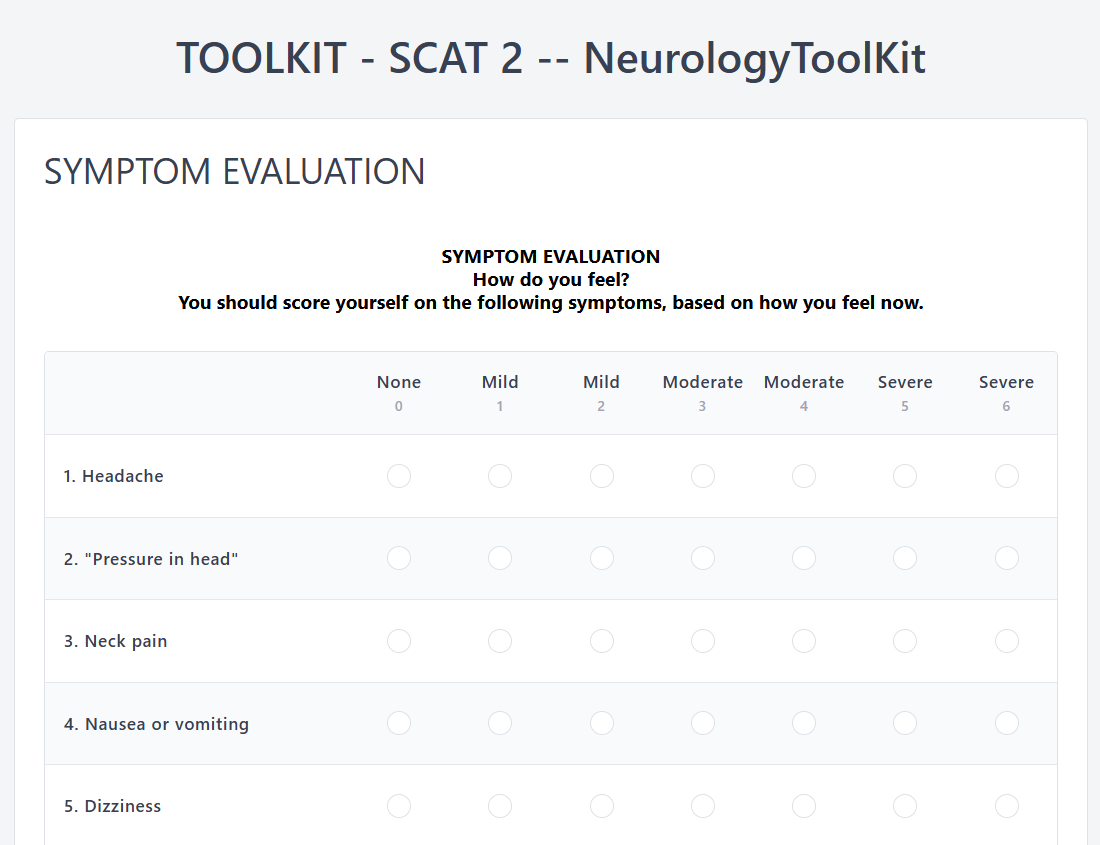

The Sport Concussion Assessment Tool 2 (SCAT 2) is a widely recognized clinical instrument used to evaluate concussions in athletes following a head injury. Designed to support rapid, structured decision-making, SCAT 2 helps clinicians assess symptoms, cognitive function, balance, and neurological status. When delivered digitally through Zentake, the SCAT 2 becomes more efficient, accurate, and secure—supporting modern sports medicine workflows while maintaining HIPAA compliance.
The Sport Concussion Assessment Tool 2 (SCAT 2) is a standardized concussion assessment used in sports and clinical settings. It was developed through international consensus conferences on concussion in sport. The tool is intended for use by healthcare professionals to evaluate athletes after a suspected concussion. SCAT 2 assesses multiple domains including symptom severity, physical signs, cognitive function, balance, and coordination. It combines patient-reported symptoms with clinician-observed measures. The assessment is structured and repeatable, supporting consistent evaluations over time. SCAT 2 is commonly used on the sideline as well as in follow-up clinical assessments. Its primary purpose is to guide concussion management and return-to-play decisions.
SCAT 2 plays a critical role in concussion recognition and management. Early identification of concussion symptoms helps prevent further injury. The tool provides a standardized method for evaluating head injuries. This reduces reliance on subjective judgment alone. SCAT 2 supports evidence-based concussion protocols. It helps clinicians identify subtle neurological changes. Early assessment improves athlete safety outcomes. The tool also supports documentation for clinical decision-making. Accurate assessment reduces the risk of premature return to play. SCAT 2 is widely accepted in sports medicine. Its structured approach improves consistency across evaluations.
For healthcare providers and organizations, SCAT 2 offers a reliable framework for concussion screening. Sports medicine clinics benefit from having a validated assessment tool. Athletic programs can standardize concussion evaluation procedures. Emergency departments use SCAT 2 to support initial neurological screening. The tool enhances communication between clinicians, coaches, and athletic trainers. It improves documentation quality for medical records. Providers can track symptom progression over time. SCAT 2 supports compliance with concussion safety guidelines. Organizations benefit from reduced liability risks. Overall, it strengthens concussion management programs.
Common use cases for SCAT 2 include sideline assessments during athletic events. It is frequently used in contact sports such as football, hockey, rugby, and soccer. Sports medicine clinics use SCAT 2 for post-injury follow-up evaluations. Schools and universities rely on it for student-athlete safety. Professional sports organizations incorporate it into concussion protocols. Research institutions use SCAT 2 as a standardized assessment tool. Military and occupational health settings may also apply it. It supports monitoring recovery progress. SCAT 2 is useful for baseline comparisons. Across settings, it supports safer return-to-play decisions.
Traditional paper-based SCAT 2 forms can slow down concussion evaluations. Paper forms may be difficult to manage during live sporting events. Handwritten notes can be hard to read. Manual scoring increases the risk of errors. Forms can be lost or damaged in field conditions. Data transfer into electronic records requires extra time. Tracking repeated assessments is cumbersome. Sharing results across care teams is inefficient. Paper storage raises security concerns. These limitations reduce overall efficiency.
Digital SCAT 2 forms offer significant advantages. Automated scoring improves accuracy. Required fields ensure complete assessments. Digital timestamps support audit trails. Clinicians can access results instantly. Assessments can be completed on mobile devices. Data is securely stored and easily retrieved. Longitudinal tracking becomes seamless. Integration with other systems improves workflow continuity. Accessibility improves in both field and clinic settings. Digital delivery supports modern concussion protocols.
Customizable Forms: Zentake allows providers to customize the SCAT 2 to fit specific sports or organizational protocols. Instructions can be adapted for athletes and staff. Branding ensures professional presentation. Conditional logic guides clinicians through each section. Additional notes or sections can be added when needed. Updates can be applied instantly. Customization supports consistent evaluations. Different versions can be created for baseline and post-injury use. This flexibility enhances usability. Zentake ensures the SCAT 2 fits seamlessly into existing workflows.
Electronic Signatures: Zentake supports secure electronic signatures for clinician and athlete acknowledgment. This eliminates the need for paper consent or verification forms. Signatures are time-stamped and securely stored. Electronic signing speeds up documentation. It improves compliance with organizational policies. Athletes can sign on mobile devices. Staff avoid missing signatures. Digital records are immediately available. This improves accountability. Electronic signatures modernize concussion documentation.
HIPAA Compliant: Zentake is built with HIPAA compliance at its core. All SCAT 2 data is encrypted and protected. Access is restricted to authorized users. Audit logs track data access and changes. Compliance reduces legal and organizational risk. Athlete health information remains confidential. Zentake follows healthcare security best practices. This builds trust with athletes and organizations. Regulatory requirements are consistently met. HIPAA compliance is seamlessly embedded.
In-Clinic Tablets: Zentake supports SCAT 2 completion on tablets and mobile devices. This is ideal for sideline or clinic use. Tablets improve speed and accessibility. Clinicians can complete assessments on the field. Data syncs instantly to the system. Paper handling is eliminated. Interfaces are optimized for touch use. Tablets support rapid evaluations. This improves response time. In-clinic tablets enhance workflow efficiency.
Calculations: Zentake automatically calculates SCAT 2 scores. This removes manual scoring errors. Results are available immediately. Clinicians can quickly interpret outcomes. Automated calculations ensure consistency. Follow-up assessments can be compared easily. Time savings improve patient care. Clear score presentation supports decisions. Automation improves reliability. Zentake enhances clinical accuracy.
Measures: Zentake’s measures functionality enables tracking of SCAT 2 results over time. Providers can monitor recovery progress. Trends across multiple assessments are easily visualized. This supports return-to-play decisions. Measures improve long-term concussion management. Data-driven insights enhance care planning. Historical assessments remain accessible. Tracking supports research and reporting. Longitudinal data improves outcomes. Measures strengthen clinical oversight.
EHR Integration: Zentake integrates SCAT 2 results with electronic health record systems. Data flows directly into patient charts. Duplicate data entry is eliminated. Clinicians access results within existing workflows. Integration improves care coordination. Documentation accuracy is maintained. Reporting becomes more efficient. EHR connectivity supports continuity of care. Administrative burden is reduced. Integration saves valuable time.
Q1: Who can use the SCAT 2 assessment?
SCAT 2 is intended for use by trained healthcare professionals. This includes sports medicine physicians and athletic trainers. It is commonly used in organized sports settings. Emergency clinicians may also use it. The tool should not be used by untrained individuals. Proper training ensures accurate interpretation. SCAT 2 supports clinical judgment. It is not a standalone diagnostic tool. Results guide further evaluation. Professional oversight is essential.
Q2: How long does it take to complete SCAT 2?
SCAT 2 typically takes 10 to 15 minutes to complete. Digital delivery can reduce completion time. Automated scoring saves additional minutes. Sideline assessments are completed efficiently. Follow-up evaluations may vary slightly. The structured format supports quick administration. Time efficiency supports athlete safety. Digital tools streamline the process. Zentake improves speed and accuracy. Completion time fits clinical workflows.
Q3: Is SCAT 2 scientifically validated?
Yes, SCAT 2 is based on international concussion consensus guidelines. It has been widely studied in sports medicine research. Validation supports its clinical reliability. The tool is endorsed by concussion experts. It is used globally in sports organizations. Evidence supports its effectiveness. Updates have informed newer versions. SCAT 2 remains an important reference tool. Scientific backing builds confidence. Validation supports standardized use.
Q4: Can SCAT 2 results be exported and shared?
Zentake allows secure export of SCAT 2 results. Data can be shared with care teams as needed. Exported records maintain compliance standards. Sharing supports coordinated care. Permissions control access to sensitive data. Results can be included in reports. Digital exports improve efficiency. Secure storage protects athlete information. Collaboration becomes easier. Zentake simplifies data sharing.

The leading patient intake platform. HIPAA compliant forms for healthcare providers and organizations. Find out what you're missing!


