
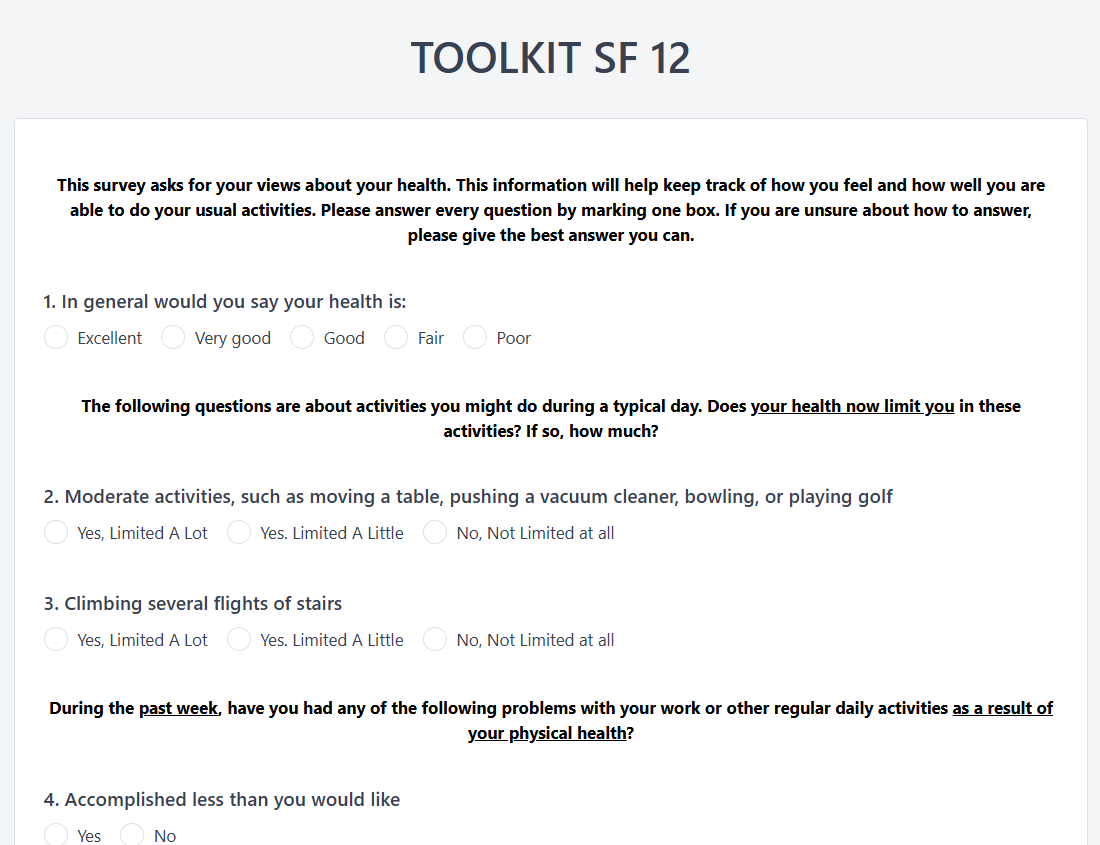

The 12-Item Short Form Health Survey (SF-12) is a validated, multipurpose measure of health-related quality of life (HRQoL) developed by John E. Ware, Mark Kosinski, and Susan D. Keller in 1996. Derived from the 36-item SF-36, the SF-12 uses 12 carefully selected items to produce two composite summary scores: the Physical Component Summary (PCS) and the Mental Component Summary (MCS). Both scores are norm-referenced to a mean of 50 (SD = 10) in the U.S. general population, where scores above 50 indicate above-average health status and scores below 50 indicate below-average status (Ware et al., 1996). The SF-12 achieves R² values of 0.91 and 0.92 in reproducing SF-36 PCS and MCS scores, respectively, demonstrating outstanding criterion validity. Zentake's digital SF-12 auto-calculates PCS and MCS upon submission, delivering instant results to your clinical team.
The SF-12 produces two norm-based summary scores rather than a single total score. Items are weighted and summed using the standard scoring algorithm (Ware, Kosinski & Keller, 1996):
Eight health domains are captured across these two summary scores: physical functioning, role-physical, bodily pain, general health, vitality, social functioning, role-emotional, and mental health. A 3–5 point change in either summary score is generally considered clinically meaningful. Zentake automatically calculates PCS and MCS scores upon form submission and flags scores below the clinical threshold for provider review.
Step 1: Determine eligibility. The SF-12 is validated for adults aged 18 and older across diverse clinical and general-population settings. It requires a reading level of approximately 5th grade and can be self-administered.
Step 2: Deliver the form. The SF-12 can be administered on paper, via tablet, or digitally. Zentake enables you to send the SF-12 directly to patients via secure link or patient portal prior to their appointment, reducing in-clinic wait time.
Step 3: Patient completes the 12 items. Completion takes approximately 2 minutes. Items use Likert-type scales and yes/no response formats covering the past 4 weeks. Zentake's responsive form works on any device and guides patients through each item clearly.
Step 4: Calculate summary scores. Apply the norm-based scoring algorithm to transform raw item scores into PCS and MCS values. Zentake performs this calculation automatically and displays results instantly in your dashboard.
Step 5: Interpret and document results. Compare patient scores to the general population norm (mean = 50) and to previous administrations to track change over time. Zentake's longitudinal tracking feature plots each administration, making trends immediately visible.
Scoring: Paper requires manual weighting and summing using the scoring manual; digital Zentake calculates PCS and MCS instantly upon submission with no manual effort.
Completion time: Both formats take approximately 2 minutes for patients; digital delivery eliminates transcription time for staff.
Delivery: Paper is distributed in-clinic; Zentake sends the SF-12 via secure email or SMS before the visit, increasing pre-visit completion rates.
Data storage: Paper forms require physical filing; Zentake stores responses securely in a HIPAA-compliant cloud environment with instant retrieval.
Longitudinal tracking: Tracking change over time with paper requires manual chart review; Zentake automatically plots PCS and MCS trends across administrations.
Security: Paper is vulnerable to loss or unauthorized access; Zentake uses AES-256 encryption and role-based access controls.
Integration: Paper data must be manually entered into the EMR; Zentake integrates directly with leading EMR platforms.
Cost: Paper forms carry hidden costs in staff time; Zentake automates scoring, storage, and reporting.
What does the SF-12 measure?
The SF-12 measures health-related quality of life (HRQoL) across eight domains: physical functioning, role-physical, bodily pain, general health, vitality, social functioning, role-emotional, and mental health. It produces two composite scores — a Physical Component Summary (PCS) and a Mental Component Summary (MCS) — each normed to a population mean of 50. Zentake delivers the SF-12 digitally and scores it automatically.
How do you score the SF-12?
The SF-12 is scored using a proprietary norm-based algorithm developed by Ware, Kosinski, and Keller (1996). Item responses are weighted and aggregated into PCS and MCS scores, with 50 representing the U.S. population average. Scores above 50 indicate above-average health; below 50 indicates below-average. Zentake automates this entire calculation.
How long does the SF-12 take to complete?
The SF-12 takes approximately 2 minutes to complete, making it one of the most efficient quality-of-life measures available. This brevity makes it ideal for routine use at every visit. Zentake patients can complete it via smartphone before arriving at the clinic.
What is a good SF-12 score?
Both PCS and MCS scores are normed to a population mean of 50 (SD = 10). Scores at or above 50 indicate health status at or above the population average. Scores below 45 on either component are generally considered clinically significant, suggesting meaningful physical or mental health impairment requiring attention.
What age group is the SF-12 validated for?
The SF-12 is validated for adults aged 18 and older. It has been widely used across diverse populations including elderly adults, patients with chronic conditions, and general community samples. Zentake's digital format accommodates patients of all ages with a simple, accessible interface.
Who should administer the SF-12?
The SF-12 is designed for self-administration — patients complete it independently without clinician assistance. It can be delivered by any healthcare provider or researcher who needs a brief, validated measure of overall health status. Zentake enables any practice to include it seamlessly in their intake workflow.
Is the SF-12 free to use?
The SF-12 is a proprietary instrument owned by QualityMetric/Optum. Licensing is typically required for commercial clinical use. However, Zentake includes the SF-12 as part of its template library, enabling compliant digital administration. Contact your Zentake representative for licensing details.
How does the SF-12 differ from the SF-36?
The SF-36 contains 36 items and produces eight individual domain scores plus two summary scores. The SF-12 uses 12 of those items to produce only the two summary scores (PCS and MCS). The SF-12 sacrifices individual domain scores for brevity, achieving R² > 0.90 in reproducing the SF-36 summary scores. Zentake supports both versions.
1. Ware J, Kosinski M, Keller SD. A 12-Item Short-Form Health Survey: construction of scales and preliminary tests of reliability and validity. Med Care. 1996;34(3):220–233.
2. Ware JE Jr, Sherbourne CD. The MOS 36-item short-form health survey (SF-36). I. Conceptual framework and item selection. Med Care. 1992;30(6):473–483.
3. Gandek B, Ware JE, Aaronson NK, et al. Cross-validation of item selection and scoring for the SF-12 Health Survey in nine countries: results from the IQOLA Project. J Clin Epidemiol. 1998;51(11):1171–1178.
4. Gill SC, Butterworth P, Rodgers B, Mackinnon A. Validity of the mental health component scale of the 12-item Short-Form Health Survey (MCS-12) as a measure of common mental disorders in the general population. Psychiatry Res. 2007;152(1):63–71.
Last updated: March 2026

The leading patient intake platform. HIPAA compliant forms for healthcare providers and organizations. Find out what you're missing!


