
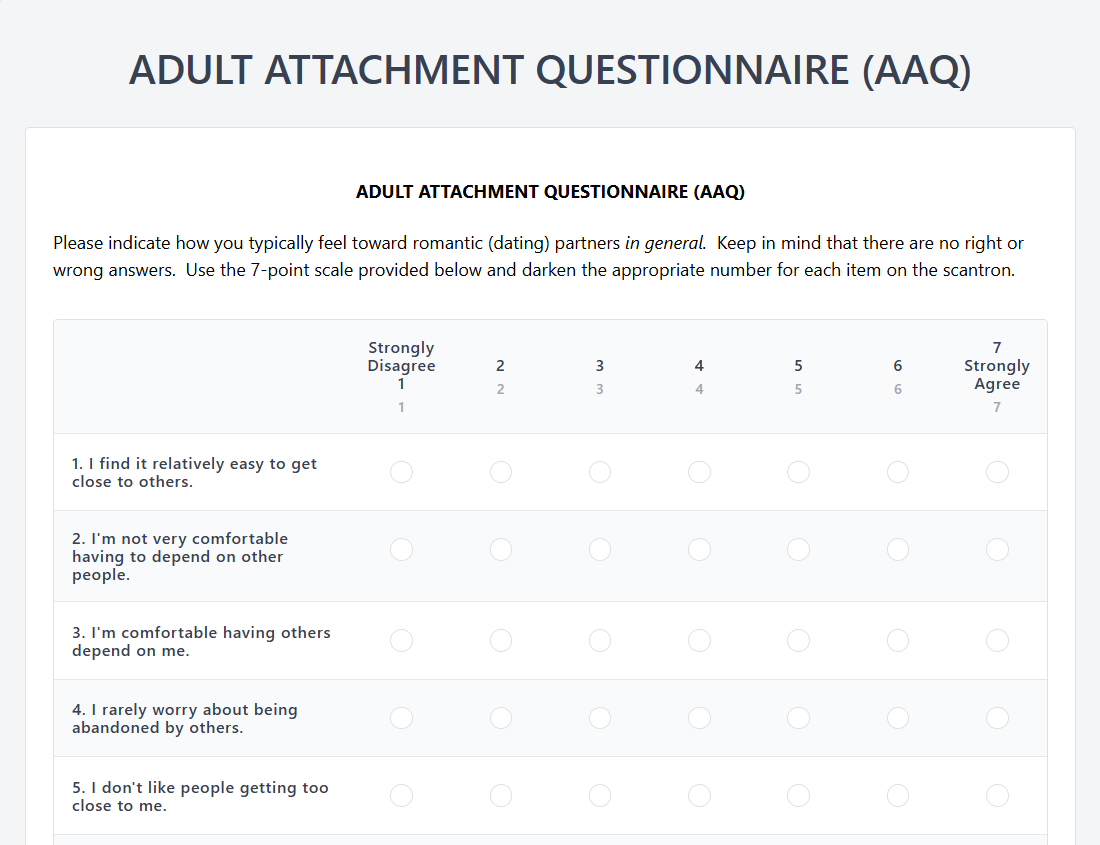

The Adult Attachment Questionnaire (AAQ) is a 40-item self-report measure developed by José Melero and María Cantero in 2008 to assess adult attachment styles across four empirically derived dimensions. Each item is rated on a 6-point Likert scale (1 = strongly disagree to 6 = strongly agree), and the instrument produces scores on four subscales that collectively classify respondents into one of four categorical attachment styles: secure, preoccupied, fearful, and avoidant (Melero & Cantero, 2008). The AAQ was validated in Spanish-speaking populations and has demonstrated adequate internal consistency across three of its four subscales (α = 0.77–0.86). It is used clinically to identify attachment patterns that may influence therapeutic relationships, interpersonal functioning, and treatment outcomes. Zentake’s digital AAQ delivers the form securely to clients before sessions and auto-scores all four subscales upon submission.
The AAQ is scored by summing item responses within each of the four subscales, then comparing subscale profiles to identify the predominant attachment style. All items use a 6-point Likert response format (1–6):
Clinicians compare the client’s subscale profile against normative data to classify attachment style as secure, preoccupied (anxious), fearful (anxious-avoidant), or avoidant (dismissing). Zentake automatically calculates all four subscale scores upon form submission and displays the results in the provider dashboard for immediate clinical review.
Step 1: Establish clinical context. The AAQ is validated for use with adults (18+) in clinical, research, and forensic contexts. Clinicians should explain the purpose of the assessment — to understand how the client typically relates to close others — in a non-threatening, normalized way before administration.
Step 2: Deliver the form. Send the AAQ to the client via Zentake’s secure digital link before or during the session. The form works on any device and takes approximately 10–15 minutes to complete. Zentake’s mobile-responsive interface makes it easy for clients to complete at home before their appointment.
Step 3: Client completes all 40 items. Each item is rated on the 6-point scale. Clients should be instructed to respond based on their typical patterns across close relationships, not a single specific relationship, to maximize construct validity.
Step 4: Review subscale scores. Zentake delivers completed AAQ responses and auto-calculated subscale scores to the clinician immediately. The provider reviews the four subscale score profile to determine the predominant attachment classification and identify areas of clinical focus.
Step 5: Integrate findings into treatment. AAQ findings can inform case conceptualization, therapeutic alliance strategies, and treatment goals, particularly in psychodynamic, attachment-based, schema therapy, or DBT frameworks. Zentake stores all AAQ data securely and allows longitudinal tracking of attachment patterns across the treatment course.
Scoring: Paper requires manual subscale summation and profile comparison; Zentake calculates all four subscale scores automatically and displays the attachment style classification instantly.
Completion: Paper is completed in-session, consuming appointment time; Zentake sends the AAQ before the visit so clients complete it at home, freeing session time for clinical discussion of results.
Delivery: Paper requires in-person distribution; Zentake delivers the AAQ via secure SMS or email link to any device.
Data storage: Paper records require physical filing; Zentake stores all AAQ data in a HIPAA-compliant cloud environment with instant retrieval.
Longitudinal tracking: Tracking attachment pattern changes across therapy with paper requires manual review; Zentake plots subscale scores over time automatically.
Security: Paper is vulnerable to loss or unauthorized access; Zentake uses AES-256 encryption and role-based access controls to protect sensitive attachment data.
Integration: Paper data must be manually entered into the EHR; Zentake exports structured data to compatible platforms.
Cost: Paper carries hidden costs in staff time and storage; Zentake’s automated workflow eliminates administrative overhead.
What does the Adult Attachment Questionnaire measure?
The AAQ measures adult attachment styles across four dimensions: low self-esteem and fear of rejection, hostile conflict resolution and possessiveness, comfort with emotional expression and relationships, and emotional self-sufficiency and discomfort with intimacy. These four subscales combine to identify whether a person’s attachment style is secure, preoccupied, fearful, or avoidant. Zentake delivers the AAQ digitally and auto-scores all four subscales.
How do you score the Adult Attachment Questionnaire?
Each of the 40 items is rated on a 6-point Likert scale. Items are summed within their respective subscales to produce four subscale scores. The pattern of subscale scores is compared against normative profiles to classify attachment style. Zentake performs all subscale calculations automatically upon form submission.
How long does the AAQ take to complete?
The AAQ typically takes 10–15 minutes to complete. Its 40 items are relatively brief and the 6-point response format is familiar to most adults. Zentake patients can complete it easily via smartphone before their appointment.
What are the four attachment styles measured by the AAQ?
The AAQ classifies attachment into four styles: secure (comfortable with intimacy and interdependence), preoccupied (anxious about relationships, high need for approval), fearful (desires closeness but fears rejection; avoids intimacy due to anxiety), and avoidant/dismissing (values independence, uncomfortable with emotional closeness).
What age group is the AAQ validated for?
The AAQ is validated for use with adults (18+). It has been studied in general adult community samples and clinical populations including intimate partner violence offenders. Zentake’s digital format accommodates adult clients across diverse settings.
Who should administer the AAQ?
The AAQ is a self-report instrument that clients complete independently. It is appropriate for use by licensed mental health clinicians including psychologists, therapists, counselors, and forensic evaluators in clinical, research, or court-ordered evaluation contexts. Zentake enables any qualified clinician to include it in their intake or assessment workflow.
Is the AAQ the same as the Acceptance and Action Questionnaire?
No. The Adult Attachment Questionnaire (AAQ) by Melero and Cantero (2008) is distinct from the Acceptance and Action Questionnaire (also abbreviated AAQ), which measures psychological flexibility in the context of ACT therapy. Clinicians should confirm they are using the correct instrument for their assessment purpose.
Can the AAQ be used in forensic assessments?
Yes. The AAQ has been validated in forensic samples, including a 2024 study examining its psychometric properties in intimate partner violence against women (IPVAW) offenders (Marcos-Ortíz et al., Frontiers in Psychology, 2024). It demonstrates adequate construct validity for identifying attachment-related risk factors in legal contexts, though clinicians should interpret results alongside other forensic instruments.
1. Melero R, Cantero MJ. Los estilos afectivos en la población española: un cuestionario de evaluación del apego adulto. Clínica y Salud. 2008;19(1):83–100.
2. Marcos-Ortíz D, Marcos-Ortíz F, Fernández-Díaz P, et al. Adult Attachment Questionnaire: evidence of validity in a sample of IPVAW offenders. Front Psychol. 2024;15:1265303. doi:10.3389/fpsyg.2024.1265303
3. Hazan C, Shaver PR. Romantic love conceptualized as an attachment process. J Pers Soc Psychol. 1987;52(3):511–524.
4. Bartholomew K, Horowitz LM. Attachment styles among young adults: a test of a four-category model. J Pers Soc Psychol. 1991;61(2):226–244.
Last updated: March 2026

The leading patient intake platform. HIPAA compliant forms for healthcare providers and organizations. Find out what you're missing!


