
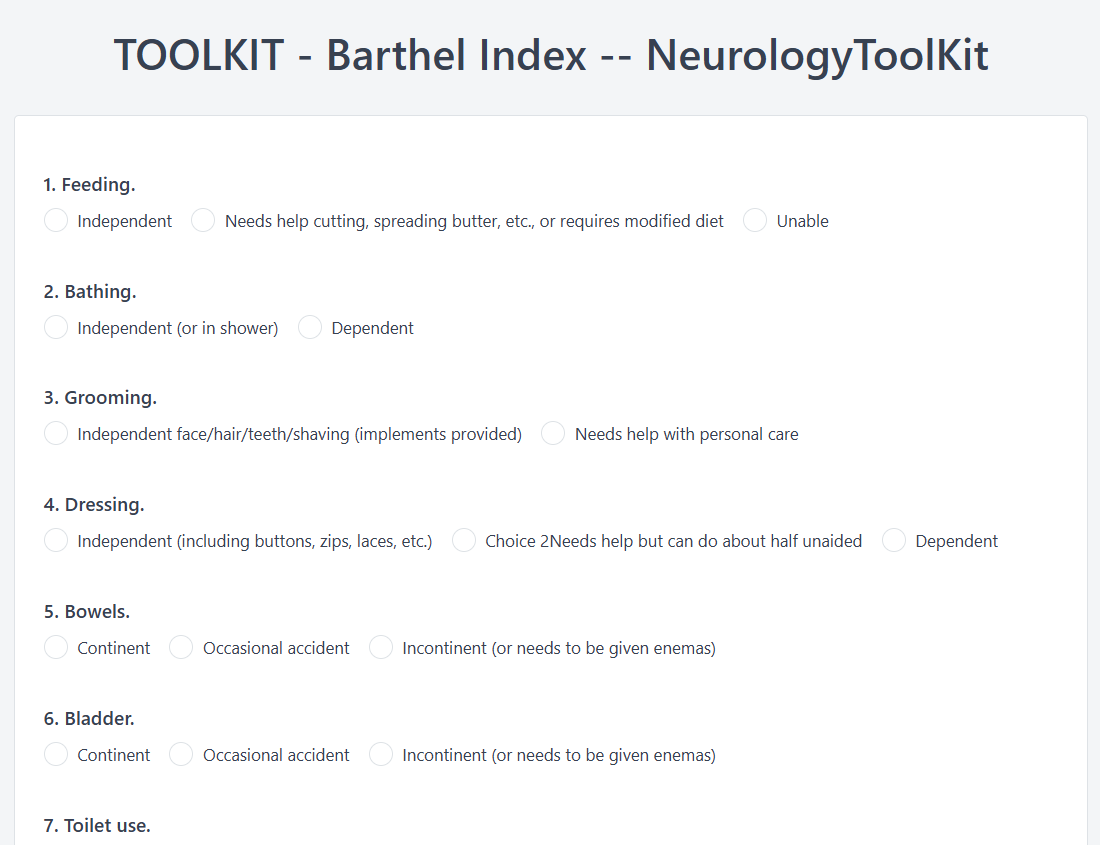

The Barthel Index (BI) is a 10-item ordinal scale developed by Mahoney and Barthel in 1965 to measure a patient's level of independence in activities of daily living (ADLs). It assesses feeding, bathing, grooming, dressing, bowel control, bladder control, toileting, chair transfer, ambulation, and stair climbing. Total scores range from 0 to 100, where higher scores indicate greater independence. Originally published in the Maryland State Medical Journal, the BI remains one of the most widely used functional assessment tools in rehabilitation medicine. The scale demonstrates excellent psychometric properties, with Cronbach's alpha typically ranging from 0.87 to 0.92, confirming strong internal consistency and validity across diverse patient populations. Zentake's digital Barthel Index enables clinicians to administer the assessment remotely or in-office, auto-score results instantly, and track patient progress longitudinally.
Each of the 10 ADL items is rated and summed to produce a total score from 0 to 100. In the most widely used modified version (Granger et al., 1979), each item is scored in increments of 5 or 10 points based on the level of assistance required. Higher scores indicate greater independence; a score of 100 indicates full independence in all assessed activities.
Commonly referenced clinical cutoff thresholds include:
For stroke patients, a Barthel Index score of 55 or below typically corresponds to mRS grade 4 (moderately severe disability), while a score of 94 or above corresponds to mRS grades 0 to 2 (no significant disability). Zentake automatically calculates the total Barthel Index score upon form submission and flags clinical cutoff thresholds for immediate review.
Step 1: Select the appropriate version. Choose between the original 1965 Barthel Index or the modified 0 to 100 version (Granger, 1979). With Zentake, the scoring template is pre-configured, eliminating version confusion.
Step 2: Deliver the assessment. The Barthel Index can be completed by a trained clinician through direct observation, caregiver report, or patient self-report for higher-functioning patients. Send via Zentake's secure digital link so patients can complete it on any device before or during their appointment.
Step 3: Rate each of the 10 ADL items. Score each domain (feeding, bathing, grooming, dressing, bowel and bladder control, toileting, transfer, ambulation, stair climbing) based on observed or reported performance over the preceding 24 to 48 hours. Zentake's digital form guides raters through each item with clear instructions.
Step 4: Calculate the total score. Sum all 10 item scores. Zentake performs this calculation automatically, displaying the total score and corresponding functional category immediately after submission.
Step 5: Document and track progress. Record findings in the patient record. Zentake integrates with leading EMR/EHR systems and enables longitudinal tracking so clinicians can monitor ADL recovery trends across multiple timepoints throughout the rehabilitation process.
Scoring: Paper requires manual summation with risk of arithmetic errors. Zentake auto-scores each submission instantly and accurately.
Completion: Paper forms must be physically present. Zentake sends a secure digital link so the assessment can be completed on any device from any location.
Delivery: Paper forms are distributed and collected in-person. Zentake delivers assessments via SMS, email, or patient portal before or during appointments.
Data Storage: Paper records are stored in physical files with limited searchability. Zentake stores all responses securely in a HIPAA-compliant cloud database with full audit trails.
Longitudinal Tracking: Manually comparing paper records is time-consuming. Zentake visualizes score trends across all assessment timepoints automatically.
Security: Paper forms can be lost, damaged, or accessed without authorization. Zentake provides end-to-end encryption and role-based access controls.
Integration: Paper data must be manually entered into EHR systems. Zentake integrates directly with EMR/EHR platforms like Elation Health to push data automatically.
Cost: Paper involves printing, storage, and staff time for data entry. Zentake reduces administrative overhead and eliminates redundant manual processes.
What does the Barthel Index measure?
The Barthel Index measures a patient's level of independence in 10 essential activities of daily living (ADLs), including feeding, bathing, grooming, dressing, bowel and bladder control, toileting, chair transfer, ambulation, and stair climbing. Total scores range from 0 (total dependence) to 100 (full independence). Zentake's digital version auto-scores all 10 items and displays the functional category instantly.
How do you score the Barthel Index?
Each of the 10 items is rated based on the level of assistance required (independent, requires help, fully dependent), then summed for a total score from 0 to 100. Clinically, scores of 0 to 20 indicate total dependence, 21 to 60 severe dependence, 61 to 90 moderate dependence, 91 to 99 slight dependence, and 100 full independence. Zentake automatically calculates scores upon submission.
Who developed the Barthel Index and when?
The Barthel Index was developed by Florence I. Mahoney and Dorothea W. Barthel and first published in 1965 in the Maryland State Medical Journal. The most widely used modified version (scored 0 to 100) was developed by Granger and colleagues in 1979.
What age or population is the Barthel Index designed for?
The Barthel Index was originally developed for adults undergoing rehabilitation, particularly following stroke or other neurological and musculoskeletal conditions. It is widely used in elderly populations, post-surgical patients, and anyone receiving inpatient or outpatient rehabilitation services.
How long does the Barthel Index take to complete?
The Barthel Index takes approximately 5 to 10 minutes to complete, whether via direct observation, caregiver interview, or patient self-report. Zentake's digital format streamlines administration further by guiding raters step-by-step through each item.
Who should administer the Barthel Index?
The Barthel Index is typically administered by trained clinicians (physicians, physical therapists, occupational therapists, or rehabilitation nurses) through direct observation. It can also be completed via structured caregiver interview. Zentake makes it easy to distribute to the appropriate rater digitally and collects responses securely.
Is the Barthel Index valid and reliable?
Yes. The Barthel Index has strong psychometric properties, with Cronbach's alpha consistently ranging from 0.87 to 0.92, indicating excellent internal consistency. It has demonstrated good concurrent validity with other functional outcome measures and is widely endorsed by stroke rehabilitation and geriatric medicine guidelines globally.
Is the Barthel Index free to use?
The original Barthel Index is in the public domain and freely available for clinical use. Zentake offers a digital, HIPAA-compliant version that automates scoring and integrates with your EMR. Start a free trial at zentake.com.
1. Mahoney FI, Barthel DW. Functional evaluation: the Barthel Index. Maryland State Medical Journal. 1965;14:61-65. PMID: 14258950.
2. Granger CV, Dewis LS, Peters NC, Sherwood CC, Barrett JE. Stroke rehabilitation: analysis of repeated Barthel Index measures. Archives of Physical Medicine and Rehabilitation. 1979;60(1):14-17.
3. Collin C, Wade DT, Davies S, Horne V. The Barthel ADL Index: a reliability study. International Disability Studies. 1988;10(2):61-63.
4. Quinn TJ, Langhorne P, Stott DJ. Barthel Index for stroke trials: development, properties, and application. Stroke. 2011;42(4):1146-1151.
Last updated: March 2026

The leading patient intake platform. HIPAA compliant forms for healthcare providers and organizations. Find out what you're missing!


