
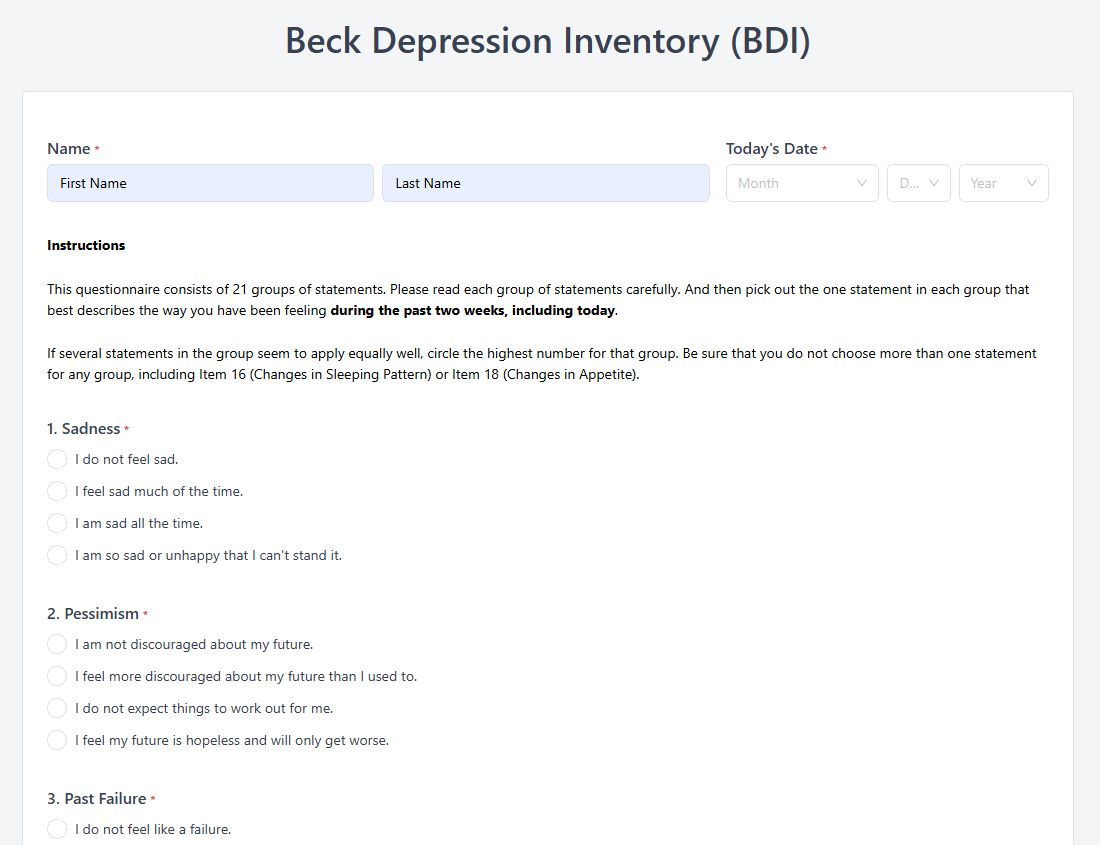

The Beck Depression Inventory–II (BDI-II) is a 21-item self-report questionnaire that measures the severity of depressive symptoms in adolescents and adults aged 13 and older. Originally developed by Aaron T. Beck and colleagues in 1961 and revised to the BDI-II in 1996 to align with DSM-IV criteria, the inventory assesses cognitive-affective symptoms (sadness, pessimism, guilt, suicidal thoughts) and somatic symptoms (fatigue, sleep changes, appetite changes) on a 0–3 scale per item, producing a total score of 0–63 (Beck et al., Archives of General Psychiatry, 1961; Beck, Steer & Brown, 1996). Clinical cutoffs classify scores as minimal (0–13), mild (14–19), moderate (20–28), or severe (29–63) depression. The BDI-II demonstrates excellent internal consistency (α = 0.91–0.93) and test-retest reliability (r = 0.93), and is the most widely used depression severity measure in clinical practice and research worldwide. Zentake’s digital BDI enables HIPAA-compliant administration with automated scoring and longitudinal tracking.
The BDI-II contains 21 items, each consisting of four statements rated 0 to 3 in increasing severity. The patient selects the statement that best describes how they have been feeling during the past two weeks, including today. The total score is the sum of all 21 item ratings, ranging from 0 to 63.
Clinical severity cutoffs for the BDI-II are as follows:
The BDI-II also yields two subscale scores: a Cognitive-Affective subscale (items 1–13, covering sadness, pessimism, past failure, loss of pleasure, guilty feelings, punishment feelings, self-dislike, self-criticalness, suicidal thoughts, crying, agitation, loss of interest, and indecisiveness) and a Somatic subscale (items 14–21, covering loss of energy, sleep changes, irritability, appetite changes, concentration difficulty, fatigue, and loss of interest in sex).
Zentake automatically calculates the total BDI-II score and both subscale scores upon form submission, providing clinicians with instant severity classification and trend data.
Step 1: Select and assign the assessment. Choose the BDI-II from your Zentake template library. Send it to patients via secure email link, SMS, or assign it for completion on an in-clinic tablet before their appointment.
Step 2: Patient self-completion. The patient reads each of the 21 item groups and selects the statement (0–3) that best describes their feelings over the past two weeks. The BDI-II typically takes 5–10 minutes to complete. Zentake’s mobile-friendly interface ensures a smooth experience on any device.
Step 3: Review auto-scored results. Zentake instantly calculates the total score, severity classification, and subscale scores. Clinicians can review results in the patient dashboard before the session begins, enabling more focused and productive clinical encounters.
Step 4: Track longitudinal trends. Use Zentake’s measures tracking to compare current BDI-II scores against previous administrations, visualizing depression severity trajectories over weeks or months of treatment.
Step 5: Document and integrate. Export scored results directly to your EMR system or download a PDF summary for the patient’s chart. All data remains encrypted and HIPAA-compliant throughout.
Scoring: Paper BDI-II requires manual summing of 21 items and severity classification lookup, which is time-consuming and error-prone. Zentake calculates total score, subscale scores, and severity classification instantly upon submission.
Completion: Paper forms must be printed, distributed, and collected in person. Zentake sends the BDI-II digitally before appointments, allowing patients to complete it from home on any device in 5–10 minutes.
Delivery: Paper forms are limited to in-clinic use. Zentake enables remote completion via secure link, supporting telehealth and pre-visit preparation workflows.
Data Storage: Paper forms require physical filing and are vulnerable to loss, damage, or unauthorized access. Zentake stores all data in encrypted, HIPAA-compliant cloud storage with full audit trails.
Longitudinal Tracking: Comparing paper BDI-II scores over multiple visits requires manual chart review. Zentake automatically graphs score trends and severity changes, making treatment response patterns immediately visible.
Security: Paper forms can be read by unauthorized staff or visitors. Zentake employs role-based access controls, encryption at rest and in transit, and comprehensive audit logging.
Integration: Paper results must be manually transcribed into EHR systems. Zentake integrates directly with leading EMR platforms, eliminating duplicate data entry.
Cost: Paper-based workflows involve printing, storage, and staff time for scoring and transcription. Zentake’s digital solution reduces these costs while improving accuracy, speed, and patient experience.
What does the BDI-II measure?
The BDI-II measures the severity of depressive symptoms across 21 domains, including sadness, pessimism, loss of pleasure, guilt, fatigue, sleep disturbance, appetite changes, and suicidal thoughts. It produces a total score from 0 to 63, with higher scores indicating more severe depression. Zentake’s digital version captures all 21 items and calculates scores automatically.
How do you score the BDI-II?
Sum the ratings (0–3) for all 21 items to produce a total score from 0 to 63. Severity is classified as minimal (0–13), mild (14–19), moderate (20–28), or severe (29–63). For primary care screening, a cutoff of ≥14 indicates clinically significant depression; in psychiatric settings, ≥19 is often used. Zentake performs this calculation instantly upon form submission.
How long does the BDI-II take to complete?
The BDI-II typically takes 5 to 10 minutes to complete. It consists of 21 multiple-choice item groups, each with four response options. Zentake’s mobile-friendly digital format enables efficient completion on any device before or during clinic visits.
Is the BDI-II free to use?
The BDI-II is a copyrighted instrument published by Pearson Clinical. Licensing is required for the official BDI-II form. Zentake provides a ready-to-use digital depression screening template that can be configured to match BDI-II item structure, with automated scoring and HIPAA-compliant storage included in the platform.
What age group is the BDI-II designed for?
The BDI-II is validated for adolescents and adults aged 13 years and older. It has been validated across diverse populations in over 25 countries and multiple languages. For children under 13, the Children’s Depression Inventory (CDI) is the recommended alternative.
Who should administer the BDI-II?
The BDI-II is a self-report questionnaire completed independently by the patient. Any licensed healthcare professional can incorporate it into clinical practice, including psychologists, psychiatrists, counselors, social workers, primary care physicians, and nurse practitioners. Zentake makes distribution and collection fully automated.
What is the difference between the BDI and PHQ-9?
The BDI-II is a 21-item measure providing detailed depression severity assessment across cognitive-affective and somatic domains. The PHQ-9 is a briefer 9-item screening tool aligned with DSM diagnostic criteria, commonly used in primary care. Both are valid depression measures; the BDI-II provides more granular symptom information while the PHQ-9 is faster to administer. Both are available as digital templates on Zentake.
Can the BDI-II detect suicidal ideation?
Yes. Item 9 of the BDI-II specifically asks about suicidal thoughts or wishes, scored from 0 (“I don’t have any thoughts of killing myself”) to 3 (“I would kill myself if I had the chance”). Any endorsement of this item should prompt immediate clinical follow-up. Zentake can be configured to flag critical item responses for urgent clinician review.
1. Beck AT, Ward CH, Mendelson M, Mock J, Erbaugh J. An inventory for measuring depression. Archives of General Psychiatry. 1961;4(6):561-571.
2. Beck AT, Steer RA, Brown GK. Manual for the Beck Depression Inventory–II. San Antonio, TX: Psychological Corporation; 1996.
3. Wang YP, Gorenstein C. Psychometric properties of the Beck Depression Inventory-II: a comprehensive review. Revista Brasileira de Psiquiatria. 2013;35(4):416-431.
4. Smarr KL, Keefer AL. Measures of depression and depressive symptoms. Arthritis Care & Research. 2011;63(S11):S483-S496.
Last updated: March 2026

The leading patient intake platform. HIPAA compliant forms for healthcare providers and organizations. Find out what you're missing!


