
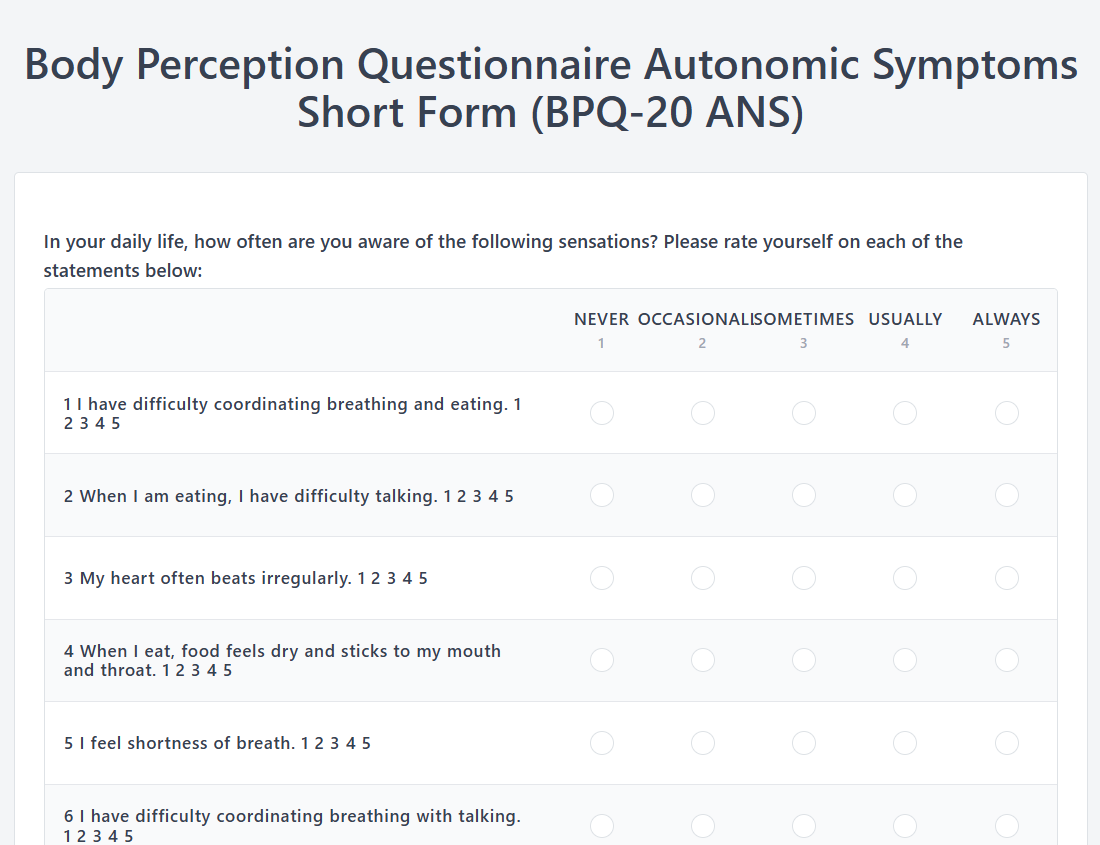

The Body Perception Questionnaire Autonomic Nervous System Subscale (BPQ-20 ANS) is a 20-item self-report measure developed by Stephen W. Porges in 1993 at the University of Maryland to assess the frequency of autonomic nervous system–related body sensations. Items cover stress reactions in organs innervated by the ANS, spanning both supradiaphragmatic (heart, lungs, throat) and subdiaphragmatic (stomach, intestines) domains. The BPQ-SF demonstrates excellent test-retest reliability (ICC = .96–.99) and strong internal consistency (ω = .77–.96 across subscales) (Cabrera et al., 2018). Zentake's digital BPQ-20 ANS auto-calculates subscale and total scores upon submission.
Each of the 20 items is rated on a 5-point ordinal scale from 1 (Never) to 5 (Always), reflecting how frequently the respondent experiences each autonomic body sensation. For clinical and research scoring, responses are typically dichotomized: "Never" = 0, and "Occasionally" through "Always" = 1. Summed scores produce subscale totals for supradiaphragmatic reactivity (0–15) and subdiaphragmatic reactivity (0–6), with higher scores indicating more frequent autonomic activation.
There are no universal clinical cutoff scores for the BPQ-20 ANS. Interpretation relies on comparison to normative data. U.S. adult normative values, percentiles, and T-scores have been derived by Kolacz et al. (2022). Individuals reporting psychiatric diagnoses consistently show elevated scores across all subscales.
Zentake automatically calculates supradiaphragmatic, subdiaphragmatic, and total autonomic reactivity scores upon form submission, providing clinicians with immediate results.
Step 1: Select the appropriate form. The BPQ-20 ANS focuses specifically on autonomic nervous system reactivity. Choose this subscale when assessing somatic stress responses rather than general body awareness.
Step 2: Deliver the questionnaire to the patient. With Zentake, send a secure digital link via email, text, or patient portal. The patient completes the form on any device before or during their appointment.
Step 3: Instruct the patient to rate each sensation honestly. Patients indicate how frequently they experience each body sensation on the 1-to-5 scale. Emphasize there are no right or wrong answers.
Step 4: Review auto-scored results. Zentake instantly calculates subscale totals, eliminating manual scoring errors and saving clinician time.
Step 5: Interpret scores in clinical context. Compare results to normative values and consider the patient's history of trauma, adversity, or psychiatric conditions. Use results to inform treatment planning for trauma-related, anxiety, or somatic symptom disorders.
Scoring: Paper requires manual dichotomization and summation across 20 items with risk of calculation errors. Zentake auto-scores all subscales instantly upon submission.
Completion: Paper forms require in-office completion. Digital forms via Zentake can be completed on any device from any location before the appointment.
Delivery: Paper forms must be printed and physically distributed. Zentake sends secure links via email, SMS, or patient portal.
Data Storage: Paper forms require physical filing and are vulnerable to loss or damage. Zentake stores all responses in a HIPAA-compliant cloud environment.
Longitudinal Tracking: Comparing paper scores over time requires manual chart review. Zentake automatically tracks and visualizes score trends across sessions.
Security: Paper forms can be misplaced or accessed by unauthorized individuals. Zentake encrypts all data in transit and at rest with HIPAA-compliant protocols.
Integration: Paper results must be manually transcribed into EHR systems. Zentake integrates directly with EMR platforms for seamless data transfer.
Cost: Paper forms incur ongoing printing, storage, and labor costs. Zentake eliminates these with a digital-first approach.
What does the BPQ-20 ANS measure?
The BPQ-20 ANS measures the frequency of body sensations caused by activation of the autonomic nervous system. It quantifies how often a person experiences stress-related reactions in organs above the diaphragm (heart, lungs, throat) and below the diaphragm (stomach, intestines). Zentake's digital version provides instant scoring for both subscales.
How do you score the BPQ-20 ANS?
Each item is rated from 1 (Never) to 5 (Always). For clinical scoring, responses are dichotomized (Never = 0, all other responses = 1) and summed into supradiaphragmatic (0–15) and subdiaphragmatic (0–6) subscale totals. Zentake auto-calculates these scores upon form submission.
How long does the BPQ-20 ANS take to complete?
The 20-item questionnaire typically takes 3–5 minutes to complete. Zentake's mobile-friendly digital format allows patients to complete it conveniently from any device.
Is the BPQ-20 ANS free to use?
The BPQ-20 ANS is freely available for clinical and research use from the Traumatic Stress Research Consortium. Zentake offers a free trial that includes the digital BPQ-20 ANS with automated scoring, HIPAA-compliant data storage, and EMR integration.
What population is the BPQ-20 ANS validated for?
The BPQ-SF has been validated in U.S. adult, Spanish adult, and Chinese college student samples. Normative values exist for U.S. adults. It is used across diverse clinical populations including trauma survivors, individuals with PTSD, and patients with somatic symptom disorders.
Who developed the BPQ?
The Body Perception Questionnaire was developed by Stephen W. Porges, PhD, in 1993 at the University of Maryland's Laboratory of Developmental Assessment. Porges is also the originator of Polyvagal Theory, which provides the theoretical framework for understanding autonomic nervous system reactivity.
Who should administer the BPQ-20 ANS?
The BPQ-20 ANS can be administered by any licensed clinician, including psychologists, psychiatrists, social workers, counselors, and primary care providers. It is a self-report instrument that does not require specialized training to administer. Zentake simplifies administration by handling digital delivery, scoring, and secure storage.
Are there clinical cutoff scores for the BPQ-20 ANS?
The BPQ-20 ANS does not have established clinical cutoff scores like many diagnostic screeners. Instead, interpretation is based on comparison to normative data and T-scores. Particularly high scores suggest frequent autonomic activation that may be related to chronic stress, trauma, or threat responses.
1. Porges, S.W. (1993). Body Perception Questionnaire. Laboratory of Developmental Assessment, University of Maryland.
2. Cabrera, A., Kolacz, J., Pailhez, G., Bulbena-Cabre, A., Bulbena, A., & Porges, S.W. (2018). Assessing body awareness and autonomic reactivity: Factor structure and psychometric properties of the Body Perception Questionnaire–Short Form (BPQ-SF). International Journal of Methods in Psychiatric Research, 27(2), e1596.
3. Kolacz, J., Holmes, L., & Porges, S.W. (2022). Measuring autonomic symptoms with the Body Perception Questionnaire Short Form (BPQ-SF): Factor analysis, derivation of U.S. adult normative values, and association with sensor-based physiological measures. medRxiv.
4. Zheng, Y., Xu, F., & Zhou, R. (2020). Factor structure and psychometric properties of the Body Perception Questionnaire–Short Form (BPQ-SF) among Chinese college students. Frontiers in Psychology, 11, 1355.
Last updated: March 2026

The leading patient intake platform. HIPAA compliant forms for healthcare providers and organizations. Find out what you're missing!


