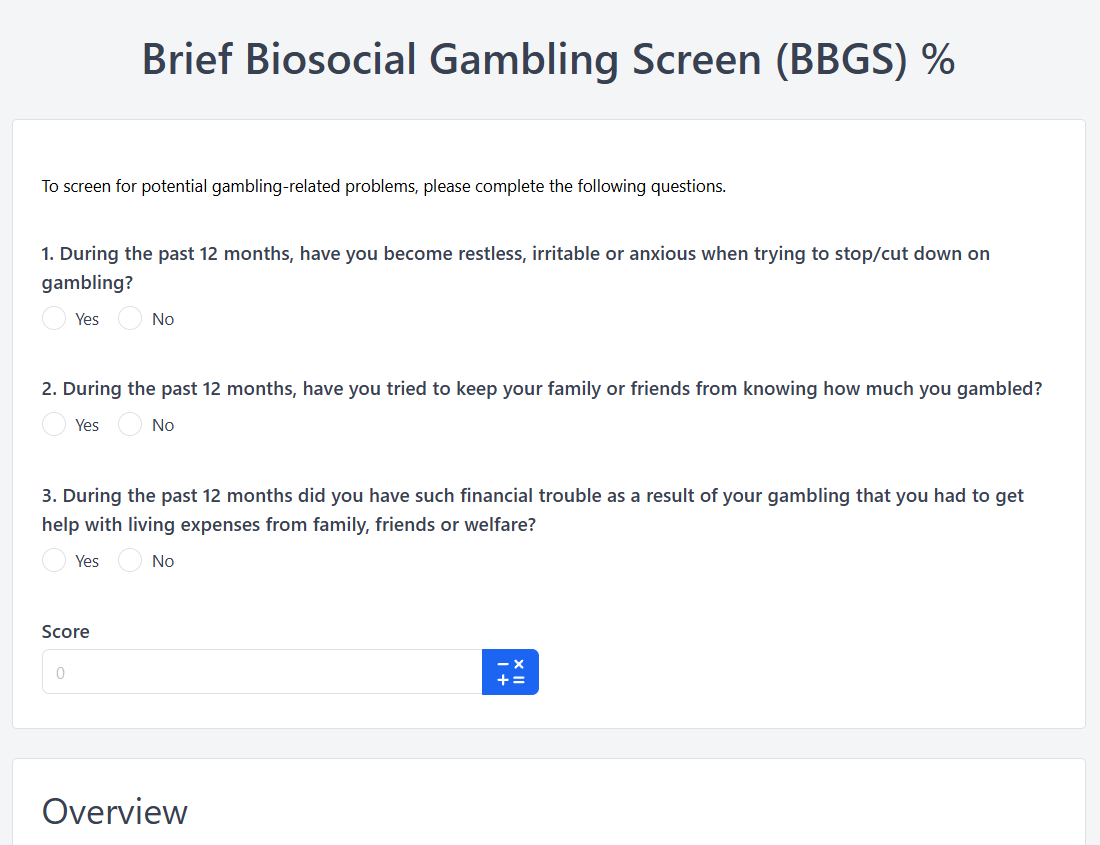
Brief Biosocial Gambling Screen (BBGS)

Assesses gambling behaviors to identify risk patterns and support targeted intervention and personalized care planning.
Stars
Rated 4.9/5 on Capterra

What is the Brief Biosocial Gambling Screen (BBGS)?

The Brief Biosocial Gambling Screen (BBGS) is a concise, evidence-based assessment tool designed to evaluate gambling behavior and identify potential gambling problems in patients. Developed by researchers with expertise in behavioral addiction, the BBGS focuses on both biosocial and psychological indicators of gambling risk, making it a robust clinical instrument. The questionnaire is structured with three targeted items, each designed to assess core gambling behaviors, including frequency, control, and associated distress. Its simplicity allows for rapid administration in a variety of healthcare settings, ensuring that patients can complete the assessment without burden. The BBGS can be used across different populations, including adults in primary care, mental health clinics, and addiction treatment programs. Importantly, it not only identifies problem gambling behaviors but also provides insight into potential social and familial risk factors that may influence gambling severity. The tool has been validated in multiple studies, demonstrating reliability and effectiveness as a brief screening measure. By combining brevity with scientific rigor, the BBGS serves as a practical yet powerful instrument for early detection of gambling-related issues.

Importance & Use Cases in Healthcare

The BBGS plays a critical role in modern healthcare by allowing providers to quickly identify individuals at risk for problem gambling, which can impact both mental and physical health. Early detection through the BBGS helps healthcare professionals intervene before gambling behavior escalates, potentially preventing severe financial, psychological, and social consequences. The tool is particularly valuable in primary care, mental health, and addiction treatment settings, where early identification is essential for integrated care planning. Providers benefit from a standardized measure that ensures consistency in screening, reducing variability in clinical assessments. By using the BBGS, healthcare organizations can collect data to support research, monitor population-level trends, and develop targeted prevention programs. The assessment also supports patient-centered care by highlighting individual risk factors and enabling personalized interventions. Common use cases include routine screenings during patient intake, periodic monitoring for patients with a history of gambling problems, and inclusion in research studies examining gambling behaviors. The BBGS is effective for both single-session evaluations and longitudinal tracking, providing insights into changes in gambling severity over time. Additionally, the form is useful for identifying comorbidities such as anxiety, depression, or substance use disorders that often co-occur with problem gambling. By integrating the BBGS into healthcare workflows, clinicians can make informed decisions, improve patient outcomes, and allocate resources more effectively. The BBGS also enhances communication between providers and patients by offering an objective framework for discussing sensitive gambling behaviors. Organizations benefit from streamlined documentation, standardized scoring, and the ability to benchmark outcomes across different patient populations. Overall, the BBGS is a versatile and clinically relevant tool that supports early identification, effective intervention, and comprehensive care for patients at risk of problem gambling.

Digital vs. Traditional BBGS Forms

Digital BBGS forms provide numerous advantages over traditional paper-based screening methods. Digital administration ensures faster completion and immediate scoring, reducing human error and streamlining workflow. Digital forms are more secure, protecting sensitive patient information with encryption and HIPAA-compliant protocols, whereas paper forms risk unauthorized access or loss. Accessibility is enhanced as digital forms can be completed on multiple devices, including tablets, computers, or mobile phones, accommodating diverse patient needs. Integration with electronic health records (EHR) allows seamless documentation, reducing administrative burden and enabling providers to track patient outcomes over time. Digital forms facilitate automatic reminders for follow-up screenings and generate real-time reports to support clinical decision-making. Unlike traditional paper forms, digital BBGS questionnaires allow for instant calculation of scores and risk levels, aiding clinicians in timely intervention. Digital systems also support branching logic, ensuring patients only answer relevant questions, which improves engagement and response accuracy. Data collected digitally can be anonymized for research purposes, providing a broader understanding of gambling behaviors without compromising patient privacy. The digital workflow also reduces environmental impact by eliminating paper usage and minimizing storage requirements. For healthcare teams, centralized digital data simplifies reporting, quality assurance, and regulatory compliance. Patients experience a smoother, more intuitive process, fostering higher completion rates and better engagement with their care. Traditional forms, while still useful in certain contexts, often require manual scoring, data entry, and filing, which increases the risk of errors and delays. Digital BBGS forms can also include multimedia guidance, such as instructions or clarifying examples, enhancing patient understanding. Automated analytics allow providers to monitor trends and identify high-risk populations more effectively than paper-based methods. Overall, digital administration of the BBGS ensures a secure, efficient, and patient-friendly experience, aligning with modern clinical workflows and organizational needs.

How Zentake Transforms the BBGS Experience

Customizable Forms: Zentake allows providers to fully customize BBGS questionnaires to meet the specific needs of their clinic or patient population. Clinicians can adjust wording, add contextual questions, or modify response options without compromising the validated structure of the BBGS. This flexibility ensures that assessments are relevant, patient-friendly, and aligned with organizational workflows. Customization supports specialized programs, research studies, and compliance requirements, allowing clinics to tailor the experience to each patient. Zentake’s interface makes adjustments quick and intuitive, reducing administrative effort. Providers can also set conditional logic so patients see only the questions that apply to them, improving accuracy and engagement. The platform supports multi-language options to accommodate diverse populations. Customization ensures consistent branding, helping clinics maintain a professional appearance. It also enables integration with other assessments for comprehensive evaluation. Ultimately, customized forms enhance patient experience, streamline workflows, and maintain clinical integrity.

Electronic Signatures: Zentake supports secure electronic signatures for all BBGS submissions, ensuring legal compliance and patient consent without the need for paper forms. Electronic signatures provide a faster, more convenient method for patients to authorize assessments. They eliminate errors and ensure authenticity, maintaining the integrity of the screening process. Patients can sign directly on tablets, computers, or mobile devices, enhancing flexibility. Electronic signatures are securely stored and easily retrievable, reducing administrative overhead. They also support compliance with HIPAA and other regulatory requirements. This feature ensures that providers maintain accurate records for audits or research purposes. Electronic signatures reduce delays associated with manual paperwork. Patients often feel more empowered and confident in the process, enhancing engagement. Overall, electronic signatures streamline workflows while maintaining legal and clinical rigor.

HIPAA Compliant: Zentake’s BBGS forms are fully HIPAA-compliant, providing end-to-end encryption and secure data storage. This ensures that sensitive patient information, including gambling behaviors and associated risk factors, is protected. Compliance reduces liability for healthcare organizations and builds trust with patients. Zentake maintains strict access controls so only authorized personnel can view assessment data. Digital audit trails allow monitoring of access and edits, supporting accountability. The platform undergoes regular security updates to maintain compliance with evolving regulations. HIPAA-compliant infrastructure also facilitates research and reporting while safeguarding patient privacy. Clinicians can confidently use Zentake knowing that patient confidentiality is prioritized. Data backups prevent loss of critical assessment information. Overall, HIPAA compliance ensures a secure, reliable, and trustworthy digital workflow for the BBGS.

In-Clinic Tablets: Zentake enables seamless BBGS completion on in-clinic tablets, providing patients with an intuitive, user-friendly experience. Tablets are optimized for readability, ease of navigation, and accessibility. In-clinic administration reduces missed assessments and increases compliance. Tablets allow for real-time scoring and immediate feedback for clinicians. Patients can complete forms privately, enhancing comfort and honesty. The system supports multimedia instructions to guide patients through the assessment. Tablets integrate with Zentake’s cloud platform for secure data transmission. Clinicians can monitor completion status in real time. This approach reduces administrative workload and paper handling. Ultimately, in-clinic tablets streamline the BBGS process while improving patient engagement and data accuracy.

Calculations: Zentake automatically calculates BBGS scores, providing instant interpretation of gambling risk levels. Automatic calculations reduce errors associated with manual scoring. Clinicians receive immediate results, enabling timely interventions. Scores are stored securely for longitudinal tracking. Automated calculations support clinical decision-making by highlighting high-risk patients. The system can flag abnormal patterns or trends over time. This feature integrates seamlessly with patient records for holistic care planning. Automated scoring enhances efficiency for busy clinics. It allows providers to compare individual results against population benchmarks. Overall, automated calculations save time, improve accuracy, and support better patient outcomes.

Measures: Zentake’s measures tool provides powerful tracking capabilities for BBGS assessments over time. Providers can monitor changes in gambling severity and patient progress. Longitudinal data supports personalized care planning and targeted interventions. Trends can be visualized for easy interpretation and reporting. The system allows for identification of early warning signs and emerging risk factors. Measures can inform treatment modifications and follow-up schedules. Data-driven insights enhance communication between providers and patients. Aggregated measures support research and population health initiatives. The tool integrates with other clinical assessments for comprehensive monitoring. Overall, measures enable evidence-based decision-making and improved patient care.

EHR Integration: Zentake integrates BBGS data directly into electronic health records (EHR), ensuring seamless documentation. Integration eliminates double entry and reduces administrative errors. Providers can access assessment results alongside other clinical data. EHR integration facilitates interdisciplinary communication and coordinated care. It supports compliance with healthcare regulations and reporting standards. Historical data can be used for longitudinal analysis and outcome tracking. Integration enables automated reminders and follow-up scheduling. Providers can generate reports for audits, research, or quality improvement initiatives. Secure integration enhances workflow efficiency. Overall, EHR connectivity maximizes clinical utility and streamlines BBGS management.

FAQs

Q1: Who can use the BBGS form?

The BBGS form is designed for use by healthcare providers, including primary care physicians, mental health specialists, and addiction treatment professionals. It can be administered to adults across diverse clinical settings. Patients with suspected gambling issues, at-risk individuals, or those participating in research studies can benefit from the assessment. The tool is suitable for routine screening, periodic monitoring, or targeted evaluation. Training requirements are minimal, as the form is brief and straightforward. It is validated for general adult populations. Clinicians can customize administration based on patient needs. Use in combination with other assessments is recommended for comprehensive evaluation. Organizations can adopt the BBGS as part of standard intake or wellness screening protocols. Overall, the BBGS is versatile, clinically relevant, and suitable for a wide range of applications.

Q2: How long does it take to complete the BBGS?

The BBGS is designed for rapid administration, typically taking fewer than five minutes to complete. Its three concise items enable patients to answer quickly without extensive explanation. Digital administration through Zentake further reduces time by automating scoring and submission. Completion time may vary slightly depending on patient literacy or language proficiency. The brief format ensures minimal disruption to clinical workflows. Short administration time enhances patient engagement and compliance. Providers can integrate the BBGS seamlessly into routine appointments or intake sessions. Fast results allow clinicians to act immediately on high-risk scores. Overall, the BBGS provides an efficient screening process without sacrificing clinical accuracy. Its brevity makes it suitable for busy healthcare environments.

Q3: Is the BBGS scientifically validated?

Yes, the BBGS has undergone rigorous validation studies demonstrating its reliability and effectiveness as a screening tool. Research supports its ability to identify problem gambling behaviors with high sensitivity and specificity. Validation studies encompass diverse populations and clinical settings, confirming broad applicability. The tool assesses both behavioral and social risk factors for gambling. Evidence shows that the BBGS correlates with longer, more comprehensive gambling assessments. Scientific validation ensures confidence in the results and clinical decision-making. Providers can rely on BBGS outcomes for early intervention and treatment planning. Validation supports its use in both clinical practice and research initiatives. The form adheres to ethical standards for patient assessment. Overall, the BBGS is a trusted, evidence-based instrument.

Q4: Can I export BBGS results?

Yes, Zentake allows secure export of BBGS results for reporting, research, or EHR integration. Data can be exported in multiple formats, including PDF, CSV, or direct EHR sync. Exported results maintain patient confidentiality through encryption and HIPAA-compliant protocols. Clinicians can generate summaries, trend reports, and longitudinal analyses. Export functionality supports audits, compliance, and quality improvement initiatives. Secure export enhances collaboration among interdisciplinary teams. Data can be anonymized for research or population-level analysis. Real-time access ensures timely decision-making and follow-up. Exporting is streamlined through Zentake’s intuitive interface. Overall, the platform provides flexibility while maintaining robust security and compliance.