
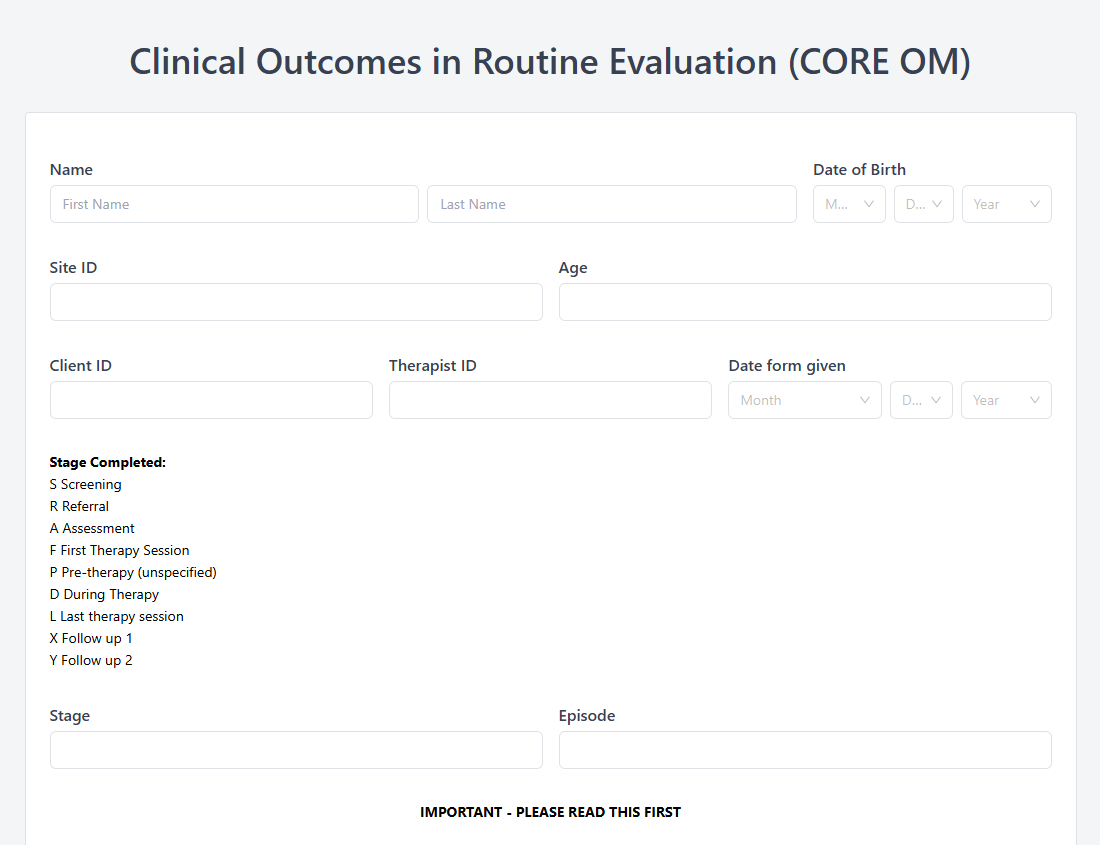

The CORE-OM (Clinical Outcomes in Routine Evaluation — Outcome Measure) is a 34-item self-report questionnaire developed by Evans, Barkham, Mellor-Clark and colleagues in 2000 to track progress in psychological therapies. Items span four domains — subjective well-being (4 items), problems/symptoms (12 items), life functioning (12 items), and risk (6 items) — each rated on a 0–4 scale from "not at all" to "most or all the time" (Evans et al., 2002, British Journal of Psychiatry).
The CORE-OM has strong reliability and validity across clinical and non-clinical populations and has been translated into more than 50 languages. Zentake's digital CORE-OM auto-scores every domain and total score upon submission and tracks change between sessions.
Each of the 34 items is scored 0 (not at all) to 4 (most or all the time). The clinical score is calculated as the mean of all completed items multiplied by 10, producing a total between 0 and 40. Domain scores are calculated the same way within each subscale.
Zentake automatically calculates all four domain scores, the total clinical score, and flags risk items upon form submission.
Step 1: Send pre-therapy and at regular intervals. Administer the CORE-OM at intake, every 4–6 sessions, and at discharge. Zentake automates delivery on your chosen schedule.
Step 2: Explain the 0–4 rating scale. Patients rate each item based on how they felt over the last week. Zentake's clean digital layout makes the scale self-evident.
Step 3: Allow 5–10 minutes for completion. Patients can complete the CORE-OM on any device before the session begins.
Step 4: Review results before the session. Zentake pushes completed scores to the clinician's dashboard, so therapists can open each session with data in hand.
Step 5: Track change over time. Use longitudinal graphs to measure therapeutic progress and identify deterioration. Zentake visualizes CORE-OM trajectories per client.
Scoring: Paper requires hand calculation of four domains and a total; Zentake does it instantly with no math errors.
Completion: Paper adds friction at the start of sessions; Zentake allows pre-session completion on any device.
Delivery: Paper requires printing and handing out; Zentake sends HIPAA-compliant links automatically.
Data Storage: Paper creates file-room overhead; Zentake stores responses in an encrypted database.
Longitudinal Tracking: Paper makes trend analysis tedious; Zentake graphs change automatically.
Security: Paper can be misfiled; Zentake is encrypted and HIPAA-compliant.
Integration: Paper requires manual EMR entry; Zentake syncs CORE-OM data directly.
Cost: Paper burns staff time and supplies; Zentake eliminates that overhead.
What does the CORE-OM measure?
The CORE-OM measures global psychological distress across four domains: subjective well-being, problems/symptoms, life functioning, and risk to self and others. It tracks therapy progress from intake through discharge. Zentake delivers and auto-scores the CORE-OM digitally.
How do you score the CORE-OM?
Sum all item responses (0–4), divide by the number of completed items, and multiply by 10 for a clinical score between 0 and 40. A score of 10 or above generally indicates a clinical range of distress. Zentake calculates this automatically.
How long does the CORE-OM take?
The CORE-OM takes 5–10 minutes to complete. Zentake's mobile-optimized form lets patients finish it before their session.
Is the CORE-OM free to use?
Yes — the CORE-OM is free for clinical use under a Creative Commons license through the CORE System Trust. Zentake provides a digital version at no added licensing cost.
What age or population is the CORE-OM for?
The CORE-OM is validated for adults aged 16 and up. A separate YP-CORE exists for adolescents. It is widely used in UK IAPT services and global mental health programs.
Who should administer the CORE-OM?
The CORE-OM is a self-report questionnaire and can be completed by the patient independently. Clinicians review results to guide treatment planning. Zentake automates delivery and scoring.
What is the clinical cutoff for the CORE-OM?
A clinical score of 10 (mean item score of 1.0) is the most widely used cutoff between clinical and non-clinical populations. A reduction of 5 or more clinical points indicates reliable change.
Last updated: March 2026

The leading patient intake platform. HIPAA compliant forms for healthcare providers and organizations. Find out what you're missing!


