
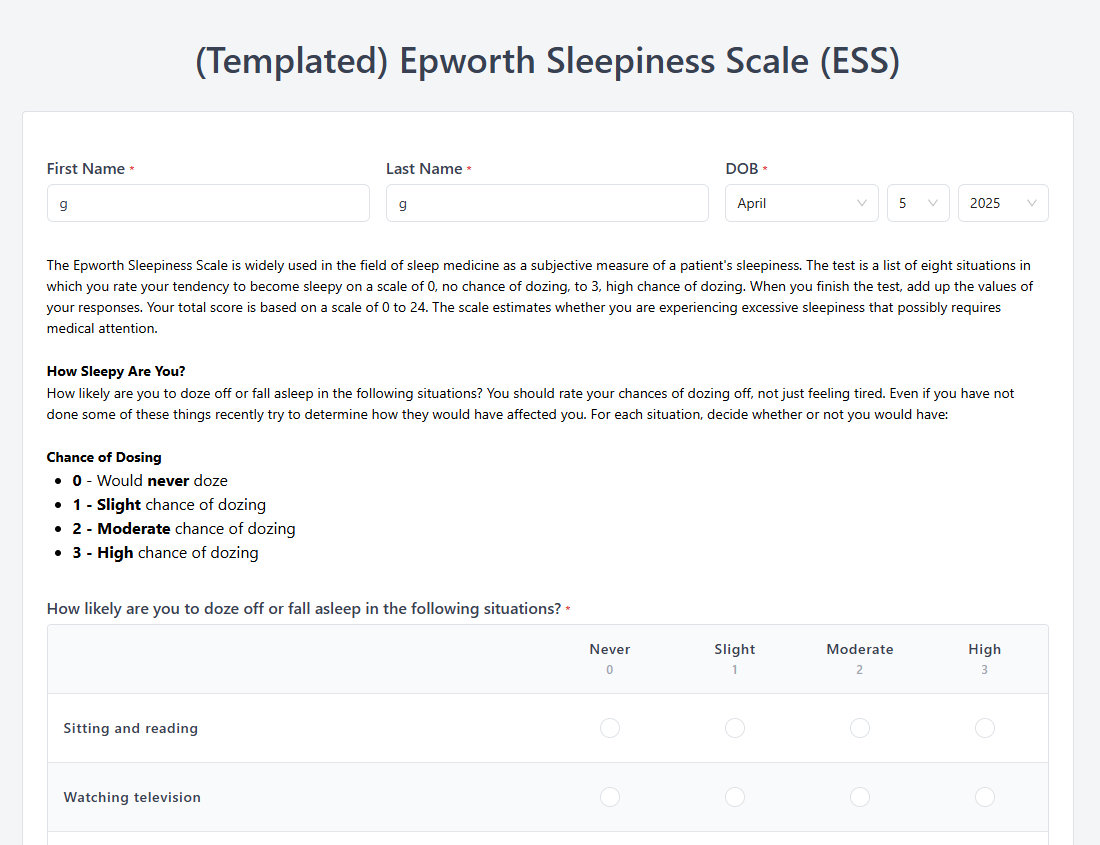

The Epworth Sleepiness Scale (ESS) is a validated 8-item self-report questionnaire developed by Dr. Murray W. Johns at Epworth Hospital in Melbourne, Australia in 1991 to measure general levels of daytime sleepiness. Respondents rate on a 4-point scale (0–3) their likelihood of dozing in eight common everyday situations, yielding a total score of 0–24. Scores of 0–10 indicate normal daytime sleepiness, while scores of 11–24 indicate excessive daytime sleepiness (EDS) warranting clinical investigation (Johns, 1991). The ESS demonstrates good internal consistency (Cronbach's α = 0.73–0.90; mean 0.82) and strong test-retest reliability (ICC = 0.81–0.93). Zentake's digital ESS delivers the questionnaire via a HIPAA-compliant intake form and auto-calculates the total score upon submission.
Each of the 8 items asks the patient to rate the chance they would doze in a specific situation: 0 = would never doze, 1 = slight chance of dozing, 2 = moderate chance of dozing, 3 = high chance of dozing. Sum all 8 item scores for a total ranging from 0 to 24. Clinical interpretation ranges are:
Zentake automatically calculates the ESS total score and flags clinically significant results upon form submission, enabling immediate review and documentation in the patient chart.
Step 1: Introduce the questionnaire. Explain to the patient that the ESS measures general daytime sleepiness by asking about the likelihood of dozing in common situations. Emphasize that responses should reflect their usual life, not just the current day. Zentake's digital intake platform delivers the ESS automatically as part of the pre-appointment screening workflow.
Step 2: Patient self-completes the 8-item questionnaire. The ESS takes approximately 2 minutes and is designed for self-administration. Patients can complete it securely via Zentake's mobile-friendly form on any device before or during the clinical visit.
Step 3: Review the auto-calculated score. Zentake instantly calculates the total ESS score and flags excessive daytime sleepiness (score ≥11) in the clinician dashboard, enabling a focused conversation about sleep symptoms at the start of the encounter.
Step 4: Conduct a clinical follow-up for elevated scores. For ESS scores of 11 or above, conduct a clinical sleep history, consider ordering a polysomnography or home sleep apnea test, and evaluate for underlying conditions such as obstructive sleep apnea (OSA), narcolepsy, or idiopathic hypersomnia.
Step 5: Repeat the ESS to monitor treatment response. The ESS is widely used to monitor the effectiveness of treatments such as CPAP therapy for OSA. Zentake's longitudinal tracking enables side-by-side score comparisons across visits to objectively document improvement.
Scoring: Paper ESS requires manual summation of 8 items; Zentake auto-calculates the total and flags scores ≥11 for excessive daytime sleepiness instantly with no clinician calculation required.
Completion: Paper forms can be skipped or returned incomplete; Zentake's digital form requires completion of all 8 items before submission, ensuring complete data.
Delivery: Paper requires printing, distributing, and collecting physical forms; Zentake sends the ESS via secure link by text or email before the patient arrives, saving clinic time.
Data Storage: Paper forms must be scanned and filed; Zentake stores all responses securely in the cloud with automatic HIPAA-compliant audit trails.
Longitudinal Tracking: Manually comparing paper ESS scores across visits is cumbersome; Zentake's measures dashboard plots ESS scores across all encounters for instant trend visualization and treatment monitoring.
Security: Paper forms can be misplaced; Zentake protects all data with 256-bit encryption and role-based access controls to ensure patient privacy.
Integration: Paper data must be manually entered into the EMR; Zentake pushes completed ESS results directly to the patient chart via EMR integration.
Cost: Paper forms incur printing, staff time, and storage costs; Zentake replaces these with a scalable digital workflow.
What does the Epworth Sleepiness Scale measure?
The ESS measures a person’s general level of daytime sleepiness by asking how likely they are to doze off in eight common everyday situations. It provides a standardized quantitative index of excessive daytime sleepiness (EDS) that correlates with sleep debt and the presence of sleep disorders such as obstructive sleep apnea, narcolepsy, and idiopathic hypersomnia.
How do you score the Epworth Sleepiness Scale?
Sum the scores from all 8 items. Each item is scored 0–3 (0 = would never doze, 3 = high chance of dozing). Total scores range from 0 to 24. Scores of 0–10 indicate normal daytime sleepiness; scores of 11–24 indicate excessive daytime sleepiness. Zentake auto-calculates the total score and clinical flag upon form submission.
How long does the ESS take to complete?
The ESS typically takes less than 2 minutes to complete. Its brevity makes it ideal for routine use in busy clinical settings, including primary care, sleep medicine, and neurology practices.
Is the Epworth Sleepiness Scale free to use?
The ESS is copyright protected by Dr. Murray Johns and Mapi Research Trust. Licensing may be required for certain commercial uses. Zentake's digital ESS template is available as part of the Zentake platform — contact Zentake for licensing details specific to your practice.
What population is the ESS validated for?
The ESS was originally validated in adults and has been extensively studied in clinical sleep disorder populations including patients with obstructive sleep apnea, narcolepsy, idiopathic hypersomnia, and restless legs syndrome. Modified versions exist for children and adolescents. It is appropriate for use across adult primary care and specialty sleep clinic populations.
Who should administer the Epworth Sleepiness Scale?
The ESS is designed for patient self-administration. It is routinely used by sleep medicine specialists, pulmonologists, neurologists, primary care physicians, and occupational medicine physicians. A trained clinician should always follow up on positive screens (score ≥11) with a comprehensive sleep history and appropriate diagnostic workup.
Is the ESS a diagnostic test?
No. The ESS is a screening tool, not a diagnostic test. An elevated ESS score indicates excessive daytime sleepiness and warrants further clinical evaluation, which may include a polysomnography (sleep study) or home sleep apnea test. The ESS does not diagnose specific sleep disorders.
Can the ESS monitor treatment response to CPAP?
Yes. The ESS is widely used to monitor the effectiveness of CPAP therapy and other sleep disorder treatments. A decrease in ESS score after initiating treatment indicates improved daytime sleepiness. Zentake's longitudinal tracking dashboard enables side-by-side ESS score comparisons across visits to objectively document treatment response.
1. Johns MW. A new method for measuring daytime sleepiness: the Epworth Sleepiness Scale. Sleep. 1991;14(6):540–545.
2. Johns MW. Reliability and factor analysis of the Epworth Sleepiness Scale. Sleep. 1992;15(4):376–381.
3. Kendzerska TB, et al. Evaluation of the measurement properties of the Epworth Sleepiness Scale: A systematic review. Sleep Medicine Reviews. 2014;18(4):321–331.
Last updated: March 2026
The leading patient intake platform. HIPAA compliant forms for healthcare providers and organizations. Find out what you're missing!


