
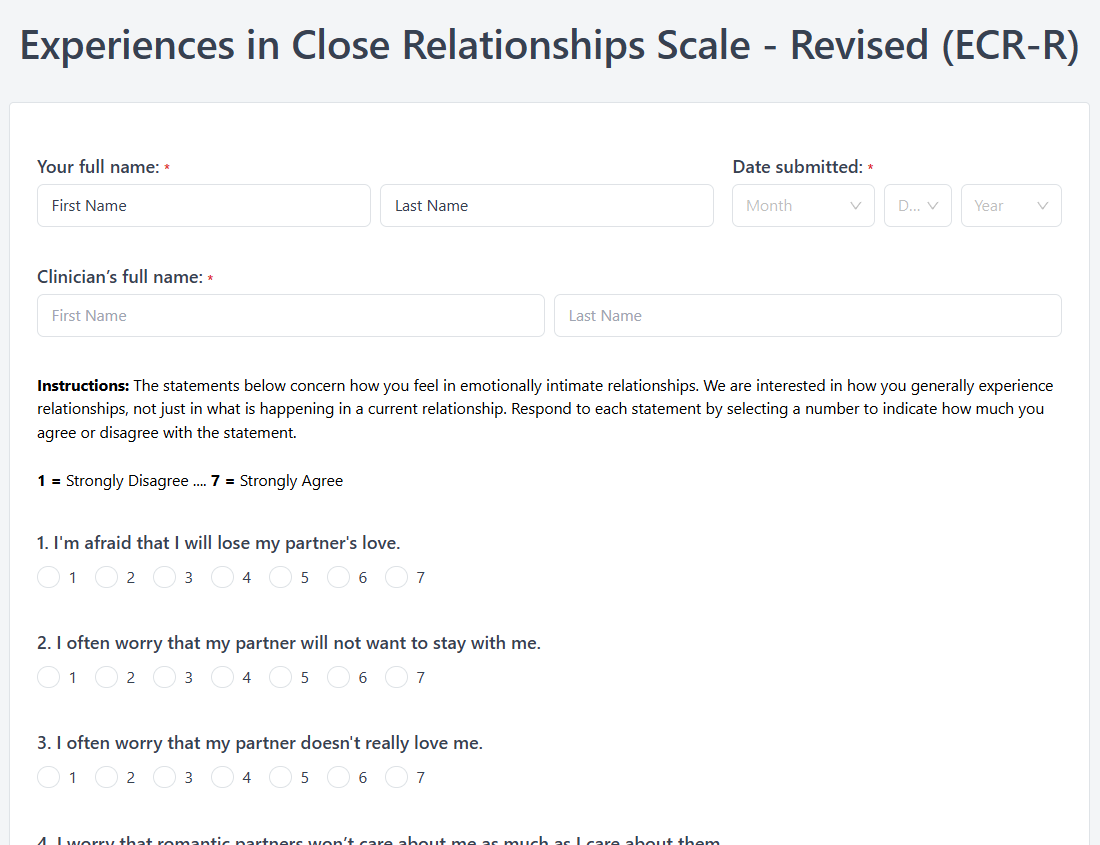

The Experiences in Close Relationships Scale–Revised (ECR-R) is a 36-item self-report measure of adult romantic attachment, developed by R. Chris Fraley, Niall G. Waller, and Kelly A. Brennan in 2000 using Item Response Theory (IRT) analysis. It assesses two core dimensions of adult attachment: Attachment Anxiety (fear of rejection and abandonment) and Attachment Avoidance (discomfort with closeness and reliance on others). Each subscale contains 18 items rated on a 7-point Likert scale (1 = Strongly Disagree, 7 = Strongly Agree). The original ECR was published by Brennan, Clark, and Shaver (1998). Psychometric studies confirm excellent internal consistency (Cronbach's α typically > .90 for both subscales) and strong test-retest reliability (approximately 85–86% shared variance over 3–6 weeks). Zentake's digital version automates subscale scoring and delivers results instantly upon completion.
The ECR-R produces two subscale scores, each ranging from 1.00 to 7.00:
There are no formal clinical cutoff thresholds; instead, scores are interpreted dimensionally. Individuals scoring above the sample mean on Anxiety are considered anxiously attached; those scoring above the mean on Avoidance are considered avoidantly attached. Individuals low on both dimensions are classified as securely attached. Zentake automatically calculates both subscale scores upon form submission, flagging elevated anxiety and avoidance relative to population norms.
Step 1: Select the appropriate respondent. The ECR-R is validated for adults (18+) currently in or who have been in a romantic relationship. It is a self-report measure completed by the patient, not the clinician.
Step 2: Deliver the form digitally or on paper. With Zentake, send the ECR-R directly to the patient's phone or email before the intake appointment. Patients complete all 36 items at their own pace, typically in 8–12 minutes.
Step 3: Review auto-calculated subscale scores. Zentake computes Anxiety and Avoidance subscale averages automatically, including reverse-keyed item correction, so no manual calculation is needed.
Step 4: Interpret results in a relational context. Use the two-dimensional profile to inform case conceptualization, identify attachment patterns (anxious, avoidant, fearful, or secure), and tailor therapeutic interventions accordingly.
Step 5: Track change over time. Readminister the ECR-R at intervals throughout therapy to monitor shifts in attachment orientation. Zentake's longitudinal tracking dashboard visualizes progress across sessions.
Scoring: Paper requires manual reverse-coding of items 9 and 11 and calculation of two subscale averages — a time-consuming and error-prone process. Zentake computes both scores instantly and automatically.
Completion: Paper forms must be administered in-office. Zentake delivers the ECR-R to patients via text or email for pre-visit completion, reducing session time spent on paperwork.
Delivery: Paper forms are limited to in-person settings. Zentake supports telehealth and remote delivery for any care model.
Data Storage: Paper responses are filed in physical records with no search or audit capabilities. Zentake stores all responses securely in a HIPAA-compliant cloud environment.
Longitudinal Tracking: Paper forms require manual comparison across visits. Zentake's dashboard displays subscale score trends over time automatically.
Security: Paper forms risk loss, unauthorized access, or physical damage. Zentake encrypts all data at rest and in transit.
Integration: Paper forms cannot integrate with EMR systems. Zentake exports data directly to supported EMR platforms.
Cost: Paper printing, storage, and manual scoring consume staff time and resources. Zentake's per-provider pricing eliminates these overhead costs.
What does the ECR-R measure?
The ECR-R measures two dimensions of adult romantic attachment: Attachment Anxiety (fear of abandonment and rejection) and Attachment Avoidance (discomfort with intimacy and emotional closeness). These dimensions are used to classify attachment styles as secure, anxious, avoidant, or fearful-avoidant. Zentake delivers the full 36-item ECR-R digitally with automatic subscale scoring.
How do you score the ECR-R?
Score the ECR-R by averaging responses to items 1–18 for the Anxiety subscale (reverse-coding items 9 and 11 first) and averaging responses to items 19–36 for the Avoidance subscale. Both subscales range from 1.00 to 7.00. Zentake performs all reverse-coding and averaging automatically upon submission.
How long does the ECR-R take to complete?
Most adults complete the ECR-R in 8–12 minutes. The 36-item format is designed for efficient self-administration. When sent digitally through Zentake, patients complete it before their appointment, freeing clinical time for discussion and intervention.
Is the ECR-R free to use?
The ECR-R items are publicly available through Dr. R. Chris Fraley's research lab. Zentake provides a ready-to-use digital version with automated scoring as part of its platform. Start a free trial at zentake.com.
What population is the ECR-R validated for?
The ECR-R is validated for adults (18+) who are currently in or have previously been in a romantic relationship. It has been used in clinical, community, and research populations across multiple cultures and countries.
Who should administer the ECR-R?
The ECR-R is a self-report measure administered to the patient. It requires no specialized training to deliver. Clinicians — including therapists, psychologists, psychiatrists, and social workers — use the results to inform case conceptualization and treatment planning. Zentake automates delivery and results reporting.
What is the difference between secure, anxious, avoidant, and fearful attachment on the ECR-R?
Secure attachment corresponds to low scores on both Anxiety and Avoidance subscales. Anxious attachment reflects high Anxiety and low Avoidance — these individuals fear abandonment but seek closeness. Avoidant attachment reflects low Anxiety and high Avoidance — these individuals are self-reliant and uncomfortable with closeness. Fearful-avoidant attachment reflects high scores on both subscales — these individuals desire closeness but fear it simultaneously.
1. Fraley, R. C., Waller, N. G., & Brennan, K. A. (2000). An item response theory analysis of self-report measures of adult attachment. Journal of Personality and Social Psychology, 78(2), 350–365.
2. Brennan, K. A., Clark, C. L., & Shaver, P. R. (1998). Self-report measurement of adult attachment: An integrative overview. In J. A. Simpson & W. S. Rholes (Eds.), Attachment Theory and Close Relationships (pp. 46–76). Guilford Press.
3. Sibley, C. G., & Liu, J. H. (2004). Short-term temporal stability and factor structure of the revised experiences in close relationships (ECR-R) measure of adult attachment. Personality and Individual Differences, 36(5), 969–975.
4. Fraley, R. C., Heffernan, M. E., Vicary, A. M., & Brumbaugh, C. C. (2011). The Experiences in Close Relationships–Relationship Structures questionnaire. Psychological Assessment, 23(3), 615–625.
Last updated: April 2026

The leading patient intake platform. HIPAA compliant forms for healthcare providers and organizations. Find out what you're missing!


