
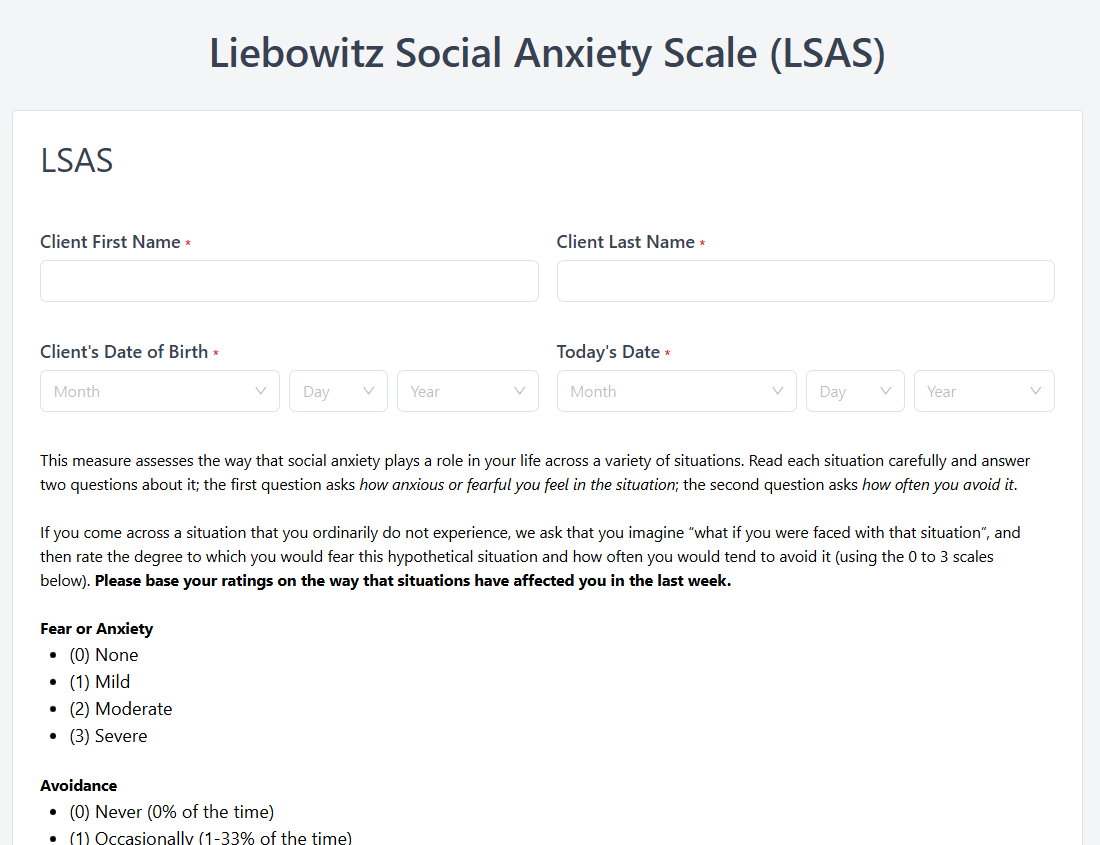

The Liebowitz Social Anxiety Scale (LSAS) is a widely recognized and validated tool used to assess the severity of social anxiety symptoms in adults. Utilizing Zentake’s HIPAA-compliant digital platform, healthcare providers can administer, score, and securely store LSAS assessments while streamlining workflow efficiency and improving accuracy. Digitizing this assessment ensures faster results, reduces administrative burdens, and provides reliable documentation for clinical decision-making. With immediate scoring and integration into electronic health records (EHRs), clinicians can quickly identify high-risk patients, monitor symptom progression, and implement timely interventions to enhance patient outcomes.
The LSAS is a structured questionnaire designed to evaluate fear and avoidance behaviors across social interaction and performance situations. It measures social anxiety symptoms in adults by assessing anxiety severity and avoidance frequency in everyday social and performance-related scenarios. Developed by Dr. Michael R. Liebowitz in 1987, this assessment is considered a gold standard in social anxiety disorder evaluation and is widely used in both clinical and research settings.
The scale consists of 24 items divided into two subscales: performance situations and social interaction situations. Each item is rated on a 4-point scale for fear and avoidance, providing quantitative scores for severity and functional impairment. This structured scoring allows clinicians to assess the intensity of social anxiety, monitor treatment progress, and identify individuals who may benefit from psychotherapy, cognitive-behavioral therapy, or pharmacological intervention. LSAS results provide actionable insights for treatment planning and patient counseling, supporting a comprehensive approach to mental health care.
Key features of the LSAS include standardized scoring, evidence-based questions, and clear guidelines for interpreting results. The scale can be administered in-person, remotely, or via telehealth platforms, offering flexibility for diverse healthcare settings. By systematically capturing symptom patterns, the LSAS provides a reliable foundation for clinical decision-making, research studies, and evaluation of therapeutic outcomes in adults with social anxiety disorder.
The LSAS is essential for accurately identifying social anxiety disorder, a condition that can significantly impact quality of life, interpersonal relationships, and occupational functioning. Untreated social anxiety may lead to avoidance behaviors, depression, substance use, and decreased social engagement. Early detection through structured assessments like the LSAS allows healthcare providers to develop targeted interventions, monitor treatment effectiveness, and improve patient outcomes. Regular use of this tool enables clinicians to track symptom progression over time, identify emerging risks, and guide personalized care planning.
Healthcare organizations benefit from the LSAS as it provides standardized data that enhances clinical documentation, ensures adherence to mental health guidelines, and supports continuity of care. Clinics and mental health practices can incorporate the LSAS into routine assessments for adults presenting with anxiety symptoms, allowing for early intervention and preventive mental health strategies. Data from repeated LSAS assessments can also inform research on treatment efficacy, population health trends, and program evaluation initiatives.
Common use cases include initial evaluation of patients with suspected social anxiety disorder, monitoring response to therapy or pharmacological treatment, assessing the impact of social anxiety on daily functioning, and supporting clinical research studies. The LSAS helps identify high-risk patients, facilitates risk stratification, and provides evidence-based insights for interdisciplinary care coordination, ensuring comprehensive patient support.
Traditional paper-based LSAS assessments require patients to complete forms manually, with clinicians scoring responses by hand. This process can be time-consuming, prone to errors, and may delay clinical decision-making. Paper forms are also susceptible to misplacement or incomplete documentation, reducing reliability. Sharing results with other healthcare providers or integrating them into EHRs is often cumbersome and inefficient.
Digital LSAS assessments, particularly through Zentake, transform this workflow by automating scoring, securely storing data, and providing instant access to results. Patients can complete the assessment on tablets, computers, or mobile devices, and results are immediately calculated for clinician review. Digital storage ensures HIPAA compliance and long-term security, while EHR integration enables seamless documentation and efficient care coordination. Additionally, remote and telehealth administration becomes possible without compromising data integrity or patient privacy, enhancing accessibility and convenience for both patients and clinicians.
Q1: Who can use the LSAS?
The LSAS is suitable for mental health professionals, including psychologists, psychiatrists, primary care providers, and therapists. It is designed for adult patients presenting with social anxiety or related symptoms.
Q2: How long does it take to complete the LSAS?
The assessment typically takes 10–15 minutes. Zentake’s platform guides patients through each item, automatically calculates scores, and provides immediate results for clinical review.
Q3: Is the LSAS scientifically validated?
Yes. The LSAS is a gold-standard, evidence-based assessment widely used in clinical practice and research. It reliably measures social anxiety severity, fear, and avoidance patterns, supporting accurate diagnosis and treatment planning.
Q4: Can I export LSAS results or integrate them into EHRs?
Yes. Zentake supports secure export of completed assessments and direct EHR integration. This functionality streamlines documentation, supports care coordination, and enables longitudinal tracking.
Q5: How does Zentake enhance the clinical experience?
Digitization reduces administrative workload, ensures accurate scoring, and provides instant, actionable results. HIPAA-compliant security and EHR integration enable clinicians to focus on patient care, delivering timely interventions and improving mental health outcomes.

The leading patient intake platform. HIPAA compliant forms for healthcare providers and organizations. Find out what you're missing!


