
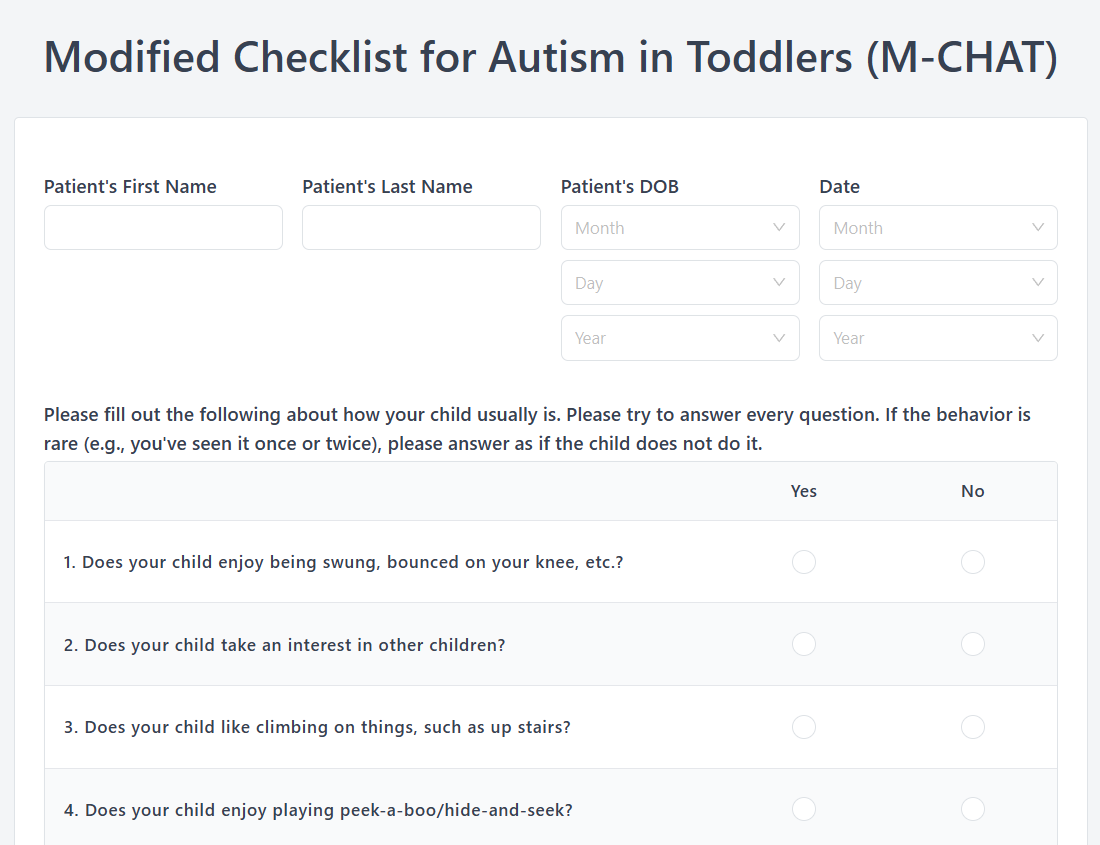

Early identification of autism spectrum disorder (ASD) plays a critical role in improving developmental outcomes for young children. The Modified Checklist for Autism in Toddlers (M-CHAT) is one of the most widely used pediatric autism screening tools, designed to help healthcare providers identify early signs of autism in toddlers. When delivered digitally through Zentake, the M-CHAT becomes easier to administer, score, track, and integrate into modern clinical workflows—while maintaining strict HIPAA compliance and a seamless experience for both providers and families.
The Modified Checklist for Autism in Toddlers (M-CHAT) is a standardized screening tool used to identify early risk indicators of autism spectrum disorder in young children. It is designed for toddlers between 16 and 30 months of age and is typically completed by a parent or caregiver. The tool was developed by Dr. Diana Robins, Dr. Deborah Fein, and Dr. Marianne Barton to support early autism detection in primary care and pediatric settings. The M-CHAT consists of a series of simple yes-or-no questions focused on social interaction, communication, and behavioral patterns. Its purpose is not to diagnose autism, but to determine whether further evaluation is recommended. A revised version, the M-CHAT-R/F, includes a structured follow-up interview to reduce false positives. The questionnaire is quick to complete and easy for caregivers to understand. Because of its simplicity and strong research backing, the M-CHAT is widely adopted in routine pediatric developmental screenings.
Early autism screening is essential because it allows children at risk for ASD to access intervention services as soon as possible. The M-CHAT helps clinicians identify developmental concerns during a critical window of brain development. Early detection through tools like the M-CHAT can significantly improve long-term outcomes in communication, social skills, and adaptive behavior. Pediatricians often use the M-CHAT during well-child visits to ensure developmental milestones are being met. The tool supports evidence-based decision-making by providing structured, validated screening data. It also helps normalize conversations about developmental health between providers and caregivers. By using the M-CHAT consistently, healthcare organizations can standardize autism screening protocols across practices. This improves equity in care by ensuring all children receive the same level of screening. The M-CHAT also reduces reliance on subjective observations alone. Overall, it plays a foundational role in early childhood developmental evaluation.
For healthcare providers, the M-CHAT offers a reliable and efficient way to screen large populations of toddlers. It saves time compared to unstructured interviews while still capturing meaningful behavioral insights. Providers benefit from having a validated autism risk assessment that aligns with pediatric guidelines. The tool supports compliance with recommendations from organizations such as the American Academy of Pediatrics. It also helps clinicians prioritize referrals to specialists when needed. Practices can use M-CHAT results to guide conversations with families about next steps. The structured format reduces ambiguity in interpretation. It also improves documentation quality within patient records. For multidisciplinary teams, the M-CHAT provides a shared reference point. This enhances collaboration between pediatricians, psychologists, and early intervention providers.
Common use cases for the M-CHAT include routine pediatric screenings, developmental monitoring, and early intervention referrals. It is frequently used in primary care clinics, pediatric practices, and family medicine settings. Public health programs also use the M-CHAT in community-based screening initiatives. Research institutions rely on it as a standardized instrument in autism studies. Early childhood programs may use it to support developmental surveillance. The tool is also valuable in telehealth and remote screening contexts. Schools and early learning centers may reference M-CHAT results during transitions to early intervention services. Pediatric subspecialty clinics use it as an initial screening step before comprehensive evaluations. Healthcare systems may integrate it into quality improvement initiatives. Across all these use cases, the M-CHAT supports proactive, data-driven care.
Traditional paper-based M-CHAT forms can create inefficiencies in busy clinical environments. Paper forms are prone to being misplaced, damaged, or incompletely filled out. Manual scoring increases the risk of human error and inconsistencies. Providers must spend additional time interpreting results and documenting them in patient charts. Storage of paper records introduces compliance and security concerns. Sharing results across care teams often requires scanning or copying documents. Follow-up tracking can be difficult when forms are stored in physical files. Data aggregation for reporting or research becomes time-consuming. Paper workflows can also slow down patient throughput. Overall, traditional methods limit scalability and efficiency.
Digital M-CHAT forms address many of these challenges by automating key parts of the process. Electronic forms ensure all required questions are completed before submission. Automatic scoring reduces errors and saves clinician time. Results are available instantly, enabling faster clinical decisions. Digital records are securely stored and easily retrievable. Providers can track screening outcomes over time without manual data entry. Integration with other digital systems improves continuity of care. Families can complete forms remotely before appointments. Accessibility is improved through mobile-friendly interfaces. Digital workflows also support analytics and quality reporting. Compared to paper-based processes, digital M-CHAT delivery is more efficient, secure, and patient-centered.
Customizable Forms: Zentake allows healthcare organizations to fully customize the M-CHAT form to fit their clinical workflow. Providers can adjust instructions to match their practice’s tone and patient population. Branding options help maintain a consistent, professional appearance. Custom logic can guide caregivers through the questionnaire seamlessly. Practices can add supplemental questions if needed. Language adjustments improve accessibility for diverse populations. Customization supports alignment with internal protocols. The digital layout improves readability and comprehension. Updates can be made instantly without reprinting forms. This flexibility ensures the M-CHAT fits naturally into any care setting.
Electronic Signatures: Zentake supports secure electronic signatures for caregiver acknowledgment and consent. This eliminates the need for printed signature pages. Digital signatures are time-stamped and securely stored. Providers can ensure documentation is complete before proceeding. Electronic signing improves compliance with administrative requirements. It also reduces delays during check-in. Caregivers can sign from any device. The process is intuitive and user-friendly. Electronic signatures streamline recordkeeping. This enhances overall workflow efficiency.
HIPAA Compliant: Zentake is built with HIPAA compliance at its core. All M-CHAT data is encrypted in transit and at rest. Secure access controls protect sensitive patient information. Audit trails provide accountability and transparency. Compliance features reduce organizational risk. Providers can confidently store and manage pediatric data. Zentake follows best practices for healthcare data security. This supports trust between families and providers. Regulatory requirements are consistently met. HIPAA compliance is seamlessly integrated into daily operations.
In-Clinic Tablets: Zentake supports in-clinic tablet use for on-site completion of the M-CHAT. Tablets reduce the need for paper forms at check-in. Caregivers can complete screenings in waiting rooms. The interface is optimized for touchscreens. Staff can quickly assign forms to patients. Completed assessments sync instantly with the system. This reduces front-desk workload. Tablets support multilingual delivery. Data is captured accurately and efficiently. In-clinic tablets enhance the patient experience.
Calculations: Zentake automatically calculates M-CHAT scores upon submission. This removes the need for manual scoring. Automated calculations reduce errors. Providers receive immediate results. Risk categories are clearly displayed. Follow-up recommendations can be triggered automatically. Scoring consistency is maintained across all patients. Clinicians save valuable time. Results are easy to interpret. Automated calculations support faster clinical action.
Measures: Zentake’s measures functionality enables longitudinal tracking of M-CHAT results over time. Providers can monitor developmental trends across multiple screenings. This supports informed care planning. Visual data helps identify patterns early. Tracking improves communication with caregivers. Measures support outcome-based care. Providers can compare results across populations. Historical data remains easily accessible. This enhances decision-making. Long-term monitoring improves quality of care.
EHR Integration: Zentake integrates seamlessly with electronic health record systems. M-CHAT results can be synced directly into patient charts. This eliminates duplicate data entry. Providers access results within their existing workflows. Integration improves care coordination. Data accuracy is maintained across systems. Reporting becomes more efficient. EHR connectivity supports continuity of care. Clinical documentation is streamlined. Integration saves time and reduces administrative burden.
Q1: Who can use the M-CHAT screening tool?
The M-CHAT is designed for use by healthcare professionals working with toddlers, particularly pediatricians and family medicine providers. It is typically completed by a parent or caregiver who knows the child well. The tool is suitable for children between 16 and 30 months of age. It can be used in primary care, specialty clinics, and community health settings. Early childhood programs may also reference results. The M-CHAT supports both in-person and remote screening. Providers use it as part of routine developmental surveillance. It is not intended for self-diagnosis. Results should always be interpreted by a qualified professional. Proper use ensures accurate screening outcomes.
Q2: How long does it take to complete the M-CHAT?
The M-CHAT is designed to be quick and efficient. Most caregivers complete the questionnaire in about 5 to 10 minutes. The yes-or-no format makes it easy to understand. Digital delivery through Zentake further streamlines completion. Automated prompts prevent skipped questions. Follow-up questions, if needed, may add a few more minutes. Overall, it fits easily into routine visits. Short completion time reduces caregiver burden. Providers can review results immediately. Efficiency supports consistent use. Time savings benefit both families and clinics.
Q3: Is the M-CHAT scientifically validated?
Yes, the M-CHAT is a scientifically validated screening instrument. It has been extensively studied in pediatric populations. Research supports its effectiveness in identifying autism risk. The revised version, M-CHAT-R/F, improves accuracy through structured follow-up. Validation studies show strong sensitivity and specificity. It is endorsed by major pediatric organizations. The tool is widely used in clinical and research settings. Evidence-based design supports reliable screening. Validation ensures confidence in results. Scientific backing makes it a trusted autism screening tool.
Q4: Can M-CHAT results be exported and shared?
Zentake allows M-CHAT results to be securely exported as needed. Providers can share results with specialists or early intervention programs. Export options support care coordination. Digital records ensure accuracy during sharing. Permissions control access to sensitive data. Exported data maintains compliance standards. Results can be included in reports or referrals. Sharing supports continuity of care. Secure exports reduce administrative friction. Zentake makes collaboration simple and compliant.

The leading patient intake platform. HIPAA compliant forms for healthcare providers and organizations. Find out what you're missing!


