
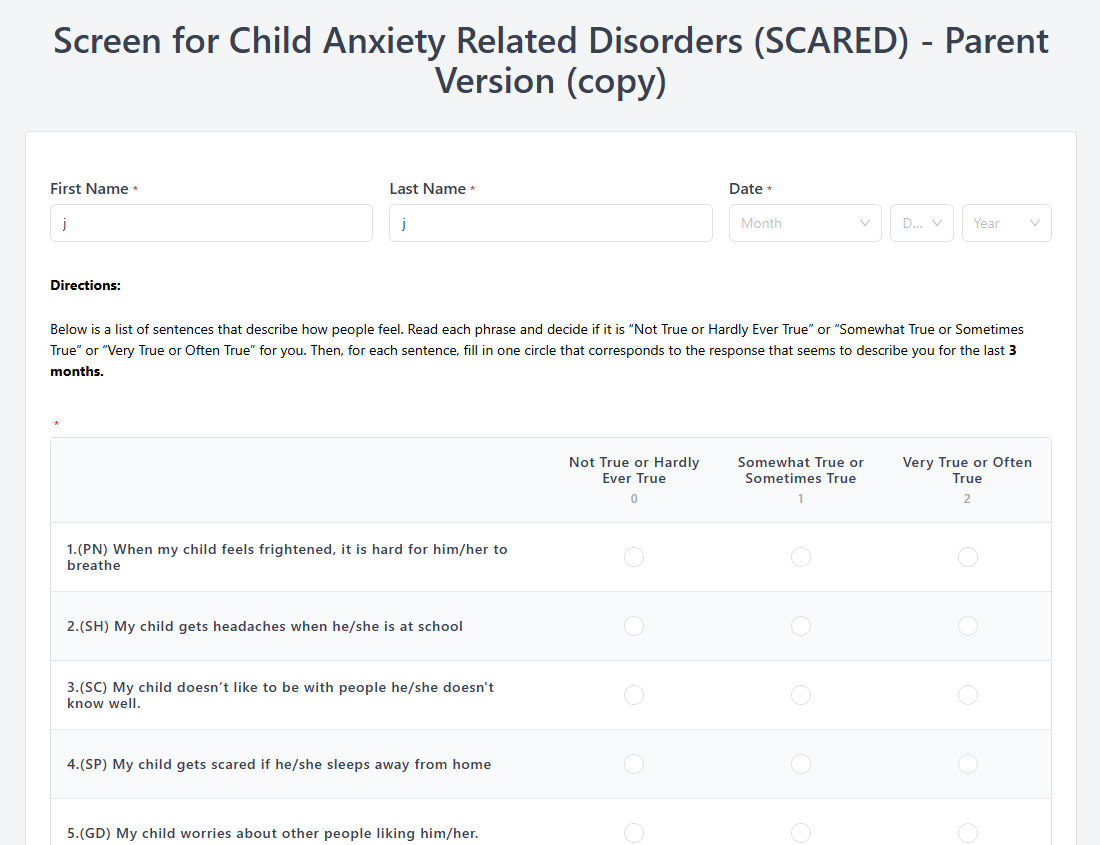

The Screen for Child Anxiety Related Disorders – Parent Version (SCARED) is a 41-item parent-report screening questionnaire that identifies anxiety disorders in children and adolescents aged 8–18. Developed by Birmaher et al. (1997) at the University of Pittsburgh, it screens five DSM-aligned anxiety domains: panic disorder/somatic symptoms, generalized anxiety disorder, separation anxiety disorder, social anxiety disorder, and school avoidance. A total score of 25 or higher suggests a clinically significant anxiety disorder.
The SCARED is free to use, requires no licensing fees, and has been validated in over 20 languages with strong psychometric properties — including internal consistency (Cronbach's α = 0.90) and test-retest reliability (ICC = 0.86 over 5 weeks).
Zentake's digital SCARED Parent Form delivers this validated assessment through a HIPAA-compliant, mobile-friendly platform with automated scoring, instant results, and EMR/EHR integration.
Each of the 41 SCARED items is rated on a 3-point scale: 0 (not true or hardly ever true), 1 (somewhat true or sometimes true), or 2 (very true or often true). The total score ranges from 0 to 82.
A total SCARED score of 25 or higher may indicate the presence of an anxiety disorder (Birmaher et al., 1999). In addition to the total score, five subscale scores help identify the specific type of anxiety:
Zentake automatically calculates both the total score and all five subscale scores upon form submission — eliminating manual scoring errors and delivering instant, actionable results to clinicians.
Step 1: Select the appropriate version. Use the parent version (SCARED-P) when a caregiver will complete the form. For children aged 8+ who can self-report, also consider administering the child version (SCARED-C) alongside it for a more comprehensive assessment.
Step 2: Deliver the form to the parent or guardian. The SCARED can be administered in-office or sent digitally before the appointment. Zentake enables secure, HIPAA-compliant delivery via email or text message, allowing parents to complete the form at home on any device.
Step 3: Allow 10–15 minutes for completion. The parent reads each of the 41 statements and rates how often it has been true for their child in the last 3 months. No clinician involvement is needed during completion.
Step 4: Score and interpret results. Sum all items for the total score and calculate the five subscale scores. A total score ≥25 warrants further clinical evaluation. Zentake's platform scores the form automatically and flags results that exceed clinical cutoffs.
Step 5: Integrate into the clinical workflow. Use baseline SCARED results for treatment planning. Re-administer at 8–12 week intervals to monitor treatment response. Zentake stores all results in the patient's record and tracks longitudinal score trends.
The SCARED parent form is used across a wide range of clinical and educational settings:
Clinicians often use paper-based SCARED Parent Forms to assess anxiety symptoms in children. While functional, manual workflows can be slow, prone to errors, and difficult to manage securely. Here's how Zentake's digital approach compares:
Scoring: Paper requires manual calculation (error-prone). Zentake calculates total + all 5 subscales instantly and automatically.
Completion: Paper forms require 10–15 minutes in-office. Zentake lets parents complete the form at home before the appointment on any device.
Delivery: Paper is printed and handed out in the waiting room. Zentake sends forms via secure email or text message.
Data Storage: Physical copies can be lost or damaged. Zentake securely stores all data in the cloud with HIPAA-compliant encryption and audit logs.
Longitudinal Tracking: Paper requires manual comparison across visits. Zentake automatically tracks score trends over time and visualizes progress.
Security: Paper creates physical storage risks. Zentake provides end-to-end encryption, SOC 2 compliance, and HIPAA-compliant infrastructure.
Integration: Paper cannot connect to other systems. Zentake integrates seamlessly with EMRs, EHRs, and analytics tools.
Cost: The SCARED instrument is free (public domain). Zentake provides the digital platform — no licensing fees for the assessment itself.
Zentake digitizes the SCARED parent form into a secure, mobile-friendly assessment that integrates directly with your practice workflow. Key capabilities include:
Zentake offers digital versions of assessments commonly used alongside the SCARED parent form:
What does the SCARED parent form measure?
The SCARED parent form measures five anxiety-related domains in children aged 8–18: panic disorder/somatic symptoms, generalized anxiety disorder, separation anxiety disorder, social anxiety disorder, and school avoidance. It contains 41 items rated on a 3-point scale (0 = not true, 1 = sometimes true, 2 = often true), producing a total score ranging from 0 to 82.
How do you score the SCARED parent form?
Sum all 41 items for a total score (range: 0–82). A total score of 25 or higher suggests a clinically significant anxiety disorder. Subscale cutoffs are: Panic/Somatic ≥7, Generalized Anxiety ≥9, Separation Anxiety ≥5, Social Anxiety ≥8, and School Avoidance ≥3. Zentake's digital version calculates total and subscale scores automatically upon submission.
What is the difference between the SCARED parent and child versions?
Both the parent and child versions contain the same 41 items across the same five anxiety domains, but they are worded from different perspectives. The parent version asks caregivers to rate their child's behavior, while the child version asks the child to self-report. Administering both provides a more comprehensive assessment, as research shows moderate parent-child agreement (r = 0.20–0.47), with parents tending to report more observable symptoms and children reporting more internal experiences.
How long does the SCARED parent form take to complete?
The SCARED parent form typically takes 10–15 minutes to complete on paper. Zentake's digital version reduces completion time with a mobile-friendly interface, auto-save functionality, and the ability for parents to complete the form at home before their appointment — eliminating waiting room bottlenecks.
Is the SCARED parent form free to use?
Yes. The SCARED instrument itself is in the public domain and free to use in clinical practice and research. It was developed by Boris Birmaher, M.D. and colleagues at the University of Pittsburgh. Zentake provides a free digital version with automated scoring, HIPAA-compliant delivery, and EMR integration — no licensing fees for the assessment itself.
What age range is the SCARED validated for?
The SCARED is validated for screening anxiety in children and adolescents aged 8–18 years. For children under 8, clinicians may consider alternative instruments such as the Preschool Anxiety Scale (PAS). For younger children within the 8–18 range, a clinician or parent may need to assist with reading and comprehension of the items.
Who should administer the SCARED parent form?
The SCARED parent form can be administered by mental health clinicians, pediatricians, primary care providers, school counselors, and other healthcare professionals. It is designed as a screening tool — not a diagnostic instrument — and results should be interpreted by a qualified professional. Zentake makes administration easy for office managers and admin staff by automating delivery, scoring, and integration with your existing workflow.
1. Birmaher, B., Khetarpal, S., Brent, D., et al. (1997). The Screen for Child Anxiety Related Emotional Disorders (SCARED): Scale construction and psychometric characteristics. Journal of the American Academy of Child and Adolescent Psychiatry, 36(4), 545–553.
2. Birmaher, B., Brent, D., Chiappetta, L., et al. (1999). Psychometric properties of the Screen for Child Anxiety Related Emotional Disorders (SCARED): A replication study. Journal of the American Academy of Child and Adolescent Psychiatry, 38(10), 1230–1236.
3. Hale, W. W., Crocetti, E., Raaijmakers, Q. A., & Meeus, W. H. (2011). A meta-analysis of the cross-cultural psychometric properties of the Screen for Child Anxiety Related Emotional Disorders (SCARED). Journal of Child Psychology and Psychiatry, 52(1), 80–90.
4. U.S. Preventive Services Task Force. (2022). Screening for Anxiety in Children and Adolescents: Recommendation Statement. JAMA, 328(14), 1438–1444.
Last updated: March 2026

The leading patient intake platform. HIPAA compliant forms for healthcare providers and organizations. Find out what you're missing!


