
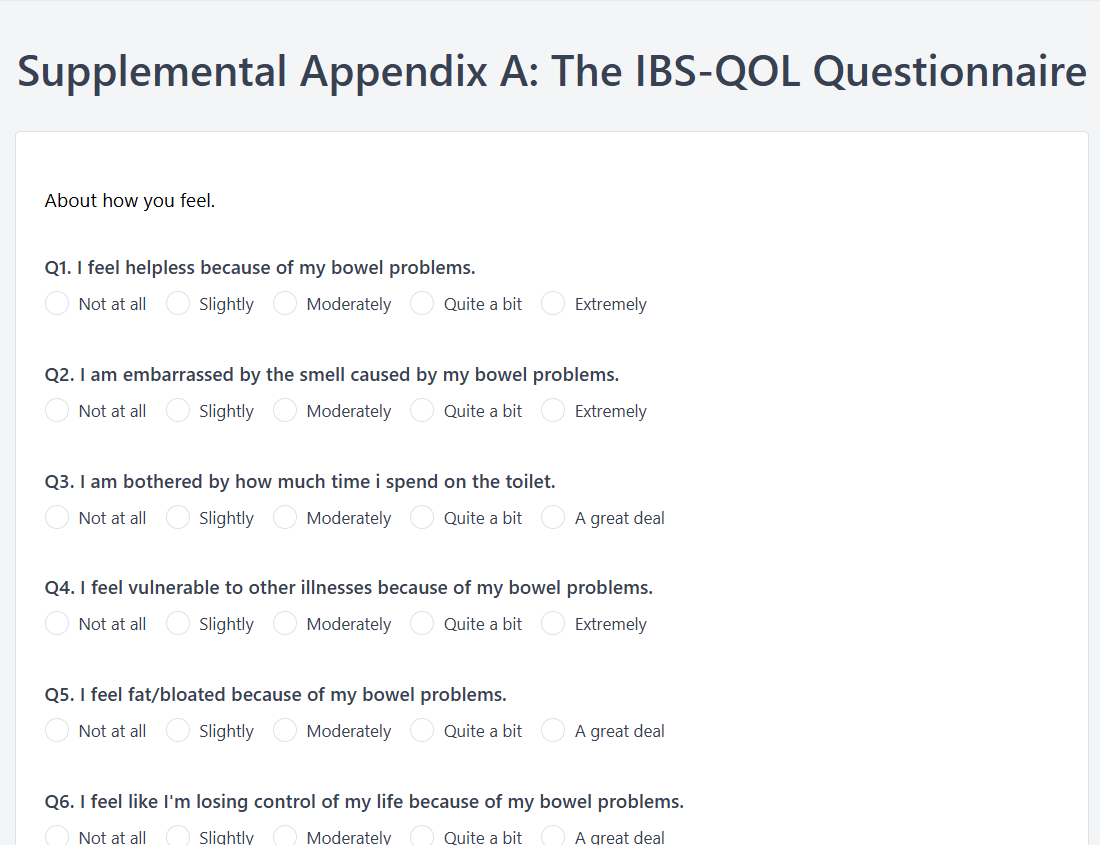

The Supplemental Appendix A: The IBS-QOL Questionnaire is a validated tool designed to measure the impact of Irritable Bowel Syndrome (IBS) on a patient’s quality of life. Developed by researchers to capture the multidimensional effects of IBS, it evaluates emotional, social, and physical domains that may be affected by the disorder. The questionnaire contains multiple items, each focused on assessing specific aspects such as bowel symptoms, food avoidance, emotional well-being, and social interactions. Its structured format allows healthcare providers to quantify patient-reported outcomes consistently. Patients rate their experiences on a standardized scale, providing data that can be analyzed for both clinical and research purposes. The IBS-QOL is frequently used in clinical trials, routine assessments, and longitudinal studies to track changes in quality of life over time. Its short form design minimizes patient burden while retaining strong psychometric reliability. Integrating this questionnaire into patient care helps clinicians tailor interventions based on both symptom severity and quality of life considerations.
The IBS-QOL Questionnaire plays a critical role in understanding the patient experience of IBS. It allows clinicians to identify how IBS affects daily functioning and emotional well-being, which may not be apparent through symptom reporting alone. By measuring quality of life, healthcare providers can better prioritize treatment goals and patient-centered interventions. It supports monitoring treatment efficacy, revealing improvements or declines in quality of life over time. Researchers rely on the IBS-QOL for clinical studies evaluating new therapies or interventions. Clinics benefit from standardized data collection that can inform care protocols. Patients gain a voice in their care by reporting outcomes that matter most to their daily life. The tool enhances communication between providers and patients, facilitating shared decision-making. IBS-QOL data can also help in designing multidisciplinary care plans involving gastroenterologists, dietitians, and mental health specialists. Organizations can use aggregated results for quality improvement initiatives, benchmarking, and population health management. Common use cases include baseline assessment of IBS impact, routine follow-up monitoring, evaluating treatment efficacy, and supporting clinical research. The questionnaire can guide interventions such as dietary modifications, pharmacotherapy, behavioral therapy, and stress management. It is valuable in identifying areas where patients struggle most, such as emotional health, social participation, or sleep disruption. By assessing multiple dimensions of quality of life, the tool provides a holistic view of IBS impact. It is applicable across age groups and adaptable to diverse patient populations. Results can inform patient education and self-management strategies. Longitudinal tracking allows clinicians to detect subtle changes over time. Research applications include comparing treatment outcomes, assessing intervention impact, and supporting evidence-based practice. Clinics can streamline workflows by combining IBS-QOL with other digital assessments. Overall, it enhances clinical decision-making, patient engagement, and health outcomes.
Traditional paper-based IBS-QOL forms have historically been used for clinical assessments and research studies. While reliable, they present challenges such as manual scoring, risk of lost forms, and storage requirements. Data entry errors are common with manual transcription, potentially affecting the accuracy of outcomes. In contrast, digital forms provide immediate scoring, reducing delays in interpretation. Digital administration allows patients to complete the questionnaire remotely or in-clinic via tablets, computers, or smartphones. Secure digital storage ensures HIPAA compliance, protecting sensitive health information. Integration with electronic health records streamlines access for clinicians and enhances continuity of care. Digital forms enable automated reminders to improve patient completion rates. Data visualization features allow rapid identification of trends and patterns in quality of life scores. Digital tools also facilitate longitudinal tracking, making it easier to monitor changes over multiple visits. Automated analytics reduce administrative burden while improving data accuracy. Researchers can collect large datasets efficiently, supporting robust statistical analyses. Digital formats also allow conditional branching, tailoring questions to individual patients. Multimedia instructions or examples can be embedded to improve comprehension. Remote access increases accessibility for patients with mobility or geographic constraints. Real-time updates allow clinicians to act on concerning responses quickly. Digital IBS-QOL forms support standardized workflows across multiple sites or studies. Automated alerts notify providers of significant changes in patient-reported outcomes. Overall, digital administration enhances security, efficiency, accessibility, and analytical capabilities compared to traditional paper methods.
Customizable Forms – Zentake enables clinicians to tailor the IBS-QOL Questionnaire to their workflow, adjusting instructions, formatting, and presentation to meet patient and clinic needs. Conditional logic can be applied to streamline completion and minimize patient burden. Forms can be customized for specific patient populations without compromising validation. Branding and logos can be included for professional presentation. Multiple language options support diverse patients. Templates can be duplicated for follow-up assessments. Reporting layouts can be personalized for ease of interpretation. Custom alerts notify providers when responses indicate high symptom impact. Digital customization enhances patient engagement and accuracy. Clinicians save time while maintaining data reliability and consistency.
Electronic Signatures – Patients can securely sign IBS-QOL forms electronically, eliminating paper handling and ensuring consent compliance. Signatures are encrypted and stored securely, meeting legal and regulatory standards. The process is intuitive and accessible on any device. Clinicians receive instant confirmation of completion and signature. Administrative errors are minimized. Timestamps provide audit trails for accountability. Remote completion is supported for telehealth services. Signatures are automatically linked to the correct patient record. Patients can review and update consent digitally if needed. Electronic signatures enhance workflow efficiency while maintaining compliance.
HIPAA Compliant – Zentake ensures all IBS-QOL data is protected according to HIPAA standards. Data is encrypted both at rest and in transit. Access is limited to authorized personnel, maintaining confidentiality. Compliance enhances patient trust and confidence. Regular backups prevent data loss and ensure continuity of care. Audit logs track all activity for accountability. Security updates protect against emerging threats. Regulatory reporting is simplified. Clinicians can safely share data with collaborators. Patients are reassured their sensitive health information is secure.
In-Clinic Tablets – Zentake supports tablet-based completion for IBS-QOL, streamlining intake and minimizing delays. Patients can complete the questionnaire in waiting rooms or exam rooms efficiently. Data is captured directly into the digital system, reducing transcription errors. Staff can manage multiple devices simultaneously. The interface is intuitive and accessible. Immediate scoring and result visualization are available. Completion can be paused and resumed if needed. Integration with EHR ensures responses are instantly accessible. Offline completion is supported with automatic syncing. Device management ensures patient privacy and session security.
Calculations – Zentake automatically scores IBS-QOL responses, eliminating manual errors and saving clinician time. Scores include total and domain-specific analyses. Automated scoring provides immediate interpretation. Clinicians can quickly identify areas of concern. Results are securely shareable with the care team. Analytics reduce misinterpretation risk. Calculations enable longitudinal monitoring and trend analysis. Scoring parameters can be customized. Dashboard integration provides visual insights. Immediate scoring supports efficient clinical decision-making.
Measures – Zentake’s tracking tools help providers monitor IBS-QOL outcomes over time, supporting better care planning. Trends in symptom impact and quality of life can be visualized. Baseline and follow-up comparisons are straightforward. Significant deviations are highlighted for clinician review. Data informs interventions for symptom management, dietary changes, or behavioral therapy. Longitudinal tracking supports research and quality improvement. Patients engage more effectively in self-management. Reports can be generated for interdisciplinary care. Alerts notify clinicians of notable changes. Continuous monitoring enhances treatment effectiveness and patient outcomes.
EHR Integration – Zentake integrates IBS-QOL results directly into electronic health records. Integration reduces errors from double entry. Clinicians can view assessments alongside other clinical data. Longitudinal tracking is simplified across multiple visits. Secure integration maintains HIPAA compliance. Data is immediately available for care coordination. Automated reporting is supported within the EHR. Historical comparisons are easy to generate. Integration facilitates research and population health initiatives. Workflow efficiency is enhanced, freeing clinicians to focus on patient care.
Q1: Who can use the IBS-QOL Questionnaire?
The IBS-QOL is suitable for clinicians, researchers, and healthcare organizations seeking to assess the impact of IBS on patient quality of life. Both adults and adolescents can complete appropriately adapted versions. It is used in routine clinical assessments, research studies, and wellness programs. Gastroenterologists, dietitians, and mental health professionals often incorporate it into multidisciplinary care. The form allows patients to report outcomes that matter to their daily functioning. Researchers use it to compare interventions and track study results. Clinics benefit from standardized and reliable data collection. Telehealth and in-person administration are both supported. Remote completion improves accessibility for patients. Overall, it is a versatile tool for patient-centered care.
Q2: How long does it take to complete?
The IBS-QOL Questionnaire typically requires 10–15 minutes to complete. Its short form design minimizes patient burden. Patients can fill it out on tablets, computers, or printed forms. Completion time may vary depending on patient literacy and instruction requirements. Digital completion provides instant scoring. Instructions and examples can be included to ensure accurate responses. Remote or in-clinic administration is supported. Patients may pause and resume completion if needed. Brief administration encourages higher compliance. The short duration allows repeated assessments for tracking changes over time.
Q3: Is it scientifically validated?
Yes, the IBS-QOL Questionnaire has undergone rigorous validation studies. Reliability and validity have been confirmed in diverse populations. Both total scores and domain-specific subscales demonstrate consistency. The tool is widely cited in peer-reviewed research. Validation supports its use in clinical, research, and quality improvement settings. Short-form adaptations retain psychometric reliability. Cross-cultural and language validations ensure applicability. Scientific validation allows confident interpretation for treatment planning. Regular updates maintain alignment with best practices. Evidence-based use enhances patient care outcomes.
Q4: Can I export results from Zentake?
Yes, Zentake allows secure export of IBS-QOL data. Formats include PDF, CSV, and integration with analytics tools. Data remains encrypted and HIPAA-compliant. Clinicians can share results with care teams or EHR systems. Historical data can be retrieved for longitudinal analysis. Export supports research, quality improvement, and reporting needs. Automated scheduling simplifies regular exports. Consent tracking ensures secure sharing. Summary reports and detailed datasets are available. Exported data maintains integrity and accuracy for clinical use.

The leading patient intake platform. HIPAA compliant forms for healthcare providers and organizations. Find out what you're missing!


