
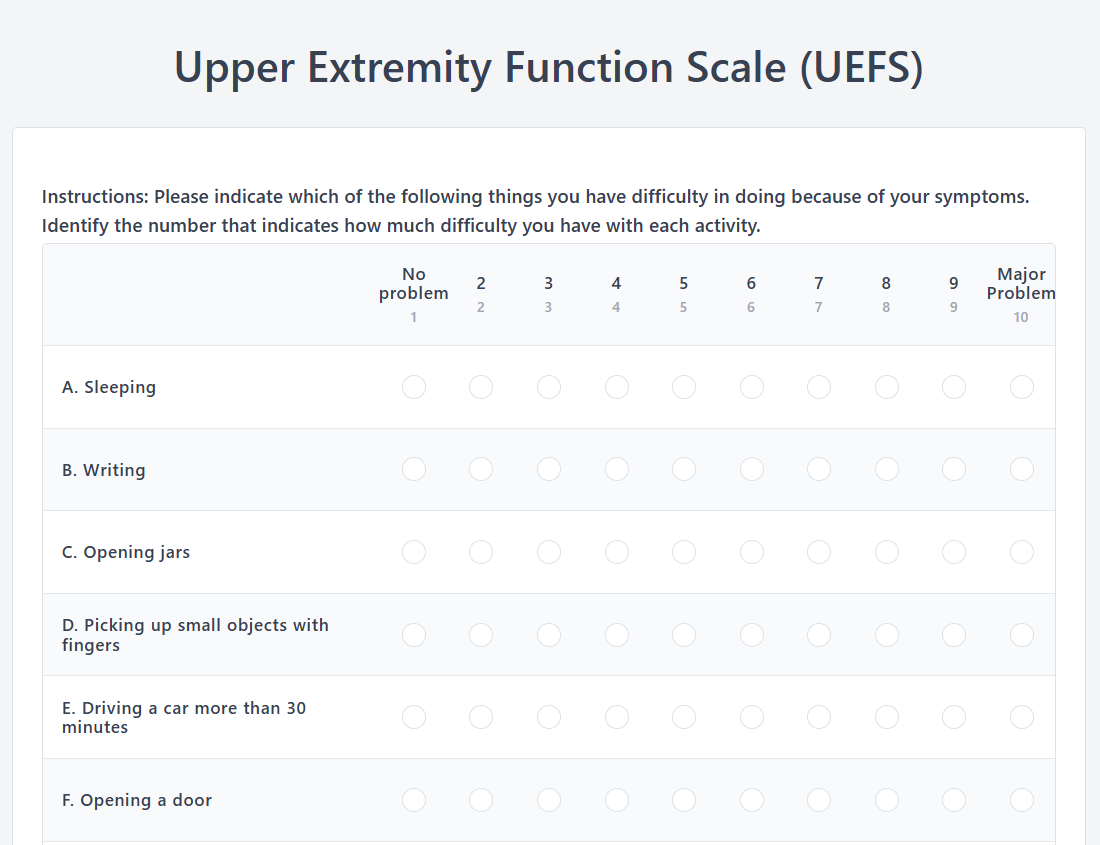

The Upper Extremity Function Scale (UEFS) is a standardized patient-reported outcome measure used to evaluate functional ability in the arms, shoulders, and hands. It provides clinicians with valuable insight into how upper extremity conditions affect daily activities, mobility, and overall quality of life. This information is essential for guiding rehabilitation and recovery planning. With Zentake’s HIPAA-secure digital platform, the UEFS becomes an efficient, accurate, and fully integrated digital upper extremity assessment that supports better clinical decision-making and rehabilitation outcomes. Digital workflows reduce administrative effort and improve data reliability. As a result, clinicians can focus more on patient care and less on paperwork.
The Upper Extremity Function Scale (UEFS) is a patient-reported upper extremity functional assessment designed to measure physical function related to the arms, shoulders, elbows, wrists, and hands. It captures the patient’s perspective on their ability to perform everyday movements and tasks that may be limited by injury, surgery, or chronic conditions. The UEFS is commonly used in physical therapy, orthopedic, and rehabilitation settings to quantify functional limitations and recovery progress. It consists of a series of structured questions scored using a standardized scale to ensure consistency and comparability across time. As an upper extremity outcome measure, it supports objective tracking of functional change throughout the episode of care. The UEFS is valued for its simplicity, clinical relevance, and applicability across a wide range of upper limb conditions. Its patient-centered design encourages engagement and honest reporting. This makes it a reliable tool for monitoring real-world functional improvement.
Assessing upper extremity function is essential for understanding how injuries or conditions impact a patient’s daily life, making the UEFS assessment a critical rehabilitation functional outcome tool. It allows clinicians to quantify functional limitations that may not be fully captured through physical examination alone. By focusing on patient-reported outcomes, the UEFS provides insight into real-world functional performance outside the clinic. This supports more personalized and goal-oriented treatment planning. The scale is widely used throughout the rehabilitation process, from initial evaluation to discharge. It helps clinicians monitor progress and adjust interventions as needed. In orthopedic care, the UEFS supports post-surgical recovery tracking and functional milestone assessment. In physical therapy, it guides exercise progression and return-to-activity decisions. The UEFS also plays a role in documenting outcomes for insurance and compliance purposes. Overall, it strengthens patient-centered, outcomes-driven care while supporting measurable clinical improvements.
For healthcare providers and organizations, the UEFS delivers significant clinical and operational benefits. It standardizes upper extremity functional assessment across providers, departments, and locations. Consistent measurement improves communication among interdisciplinary care teams. The UEFS supports evidence-based practice by providing quantifiable data linked directly to functional improvement. It also enhances patient engagement by involving individuals in reporting their own progress. Clinics benefit from improved documentation that supports reimbursement and regulatory requirements. Aggregated UEFS data can be used for performance benchmarking and quality improvement initiatives. The scale reduces subjectivity in functional evaluation and increases clinical confidence. When digitized, it minimizes administrative workload and data entry errors. Providers gain faster access to actionable insights that inform care decisions. These benefits make the UEFS an essential orthopedic functional assessment tool in modern healthcare systems.
The UEFS is used across a wide range of clinical and operational scenarios. Physical therapists administer it during initial evaluations to establish baseline upper extremity function. It is frequently repeated during treatment to monitor recovery and functional gains over time. Orthopedic practices use the UEFS to assess outcomes following surgery, trauma, or joint replacement. Rehabilitation centers rely on it to track progress across multiple visits or care plans. The scale is also used in occupational therapy to evaluate functional independence in daily activities. Researchers apply the UEFS in studies related to musculoskeletal recovery and rehabilitation outcomes. Telehealth providers use digital UEFS assessments to monitor patients remotely between visits. Multidisciplinary teams integrate UEFS results into collaborative care planning. Health systems use UEFS data for outcomes reporting and program evaluation. These diverse use cases highlight the flexibility, scalability, and clinical value of the UEFS.
Traditional paper-based UEFS forms introduce inefficiencies into clinical workflows. Manual distribution, scoring, and data entry increase administrative burden for clinical and administrative staff. Paper forms are susceptible to errors, incomplete responses, and illegible entries. Accessing historical data requires physical storage and time-consuming retrieval. These limitations slow down clinical decision-making and reporting. In contrast, a digital upper extremity assessment streamlines the entire process from completion to analysis. Automated scoring ensures accuracy and consistency across all assessments. Secure electronic storage improves accessibility while maintaining HIPAA compliance. Patients can complete the UEFS on tablets, kiosks, or remote devices. Digital workflows reduce staff workload and improve turnaround time. Integration with clinical systems enhances continuity of care and long-term data tracking. Zentake’s digital UEFS solution delivers efficiency, security, scalability, and a superior patient experience compared to traditional paper-based methods.
Q1. Who can use the Upper Extremity Function Scale (UEFS)?
The UEFS is used by physical therapists, occupational therapists, orthopedic specialists, and rehabilitation professionals. It is appropriate for patients with musculoskeletal or neurological upper extremity conditions. Clinics, hospitals, outpatient centers, and rehabilitation facilities commonly use it. The scale supports both adult and adolescent populations. Digital access through Zentake expands usability across in-person and telehealth care models. This flexibility supports consistent functional assessment across diverse settings.
Q2. How long does it take to complete the UEFS?
The UEFS is designed to be quick and easy for patients to complete. Most patients finish the assessment in just a few minutes. Its concise format minimizes fatigue and confusion. Digital completion further reduces time and improves accuracy. This makes it suitable for repeated use throughout treatment. Short completion time supports high patient compliance.
Q3. Is the UEFS scientifically validated?
The UEFS is widely recognized as a reliable upper extremity outcome measure in rehabilitation settings. It is commonly used in physical therapy and orthopedic care. Research supports the value of patient-reported functional assessments. The UEFS aligns with evidence-based rehabilitation practices. Validation supports its use for both clinical care and outcomes reporting. Many organizations rely on it for standardized functional measurement.
Q4. Can UEFS results be exported from Zentake?
Zentake allows secure export of UEFS data for reporting, analysis, and system integration. Authorized users can access results at any time. Exported data supports quality improvement and performance monitoring initiatives. Integration options support EHR documentation and continuity of care. Patient privacy and data security are maintained throughout the process. This flexibility supports both clinical and operational needs.

The leading patient intake platform. HIPAA compliant forms for healthcare providers and organizations. Find out what you're missing!


