
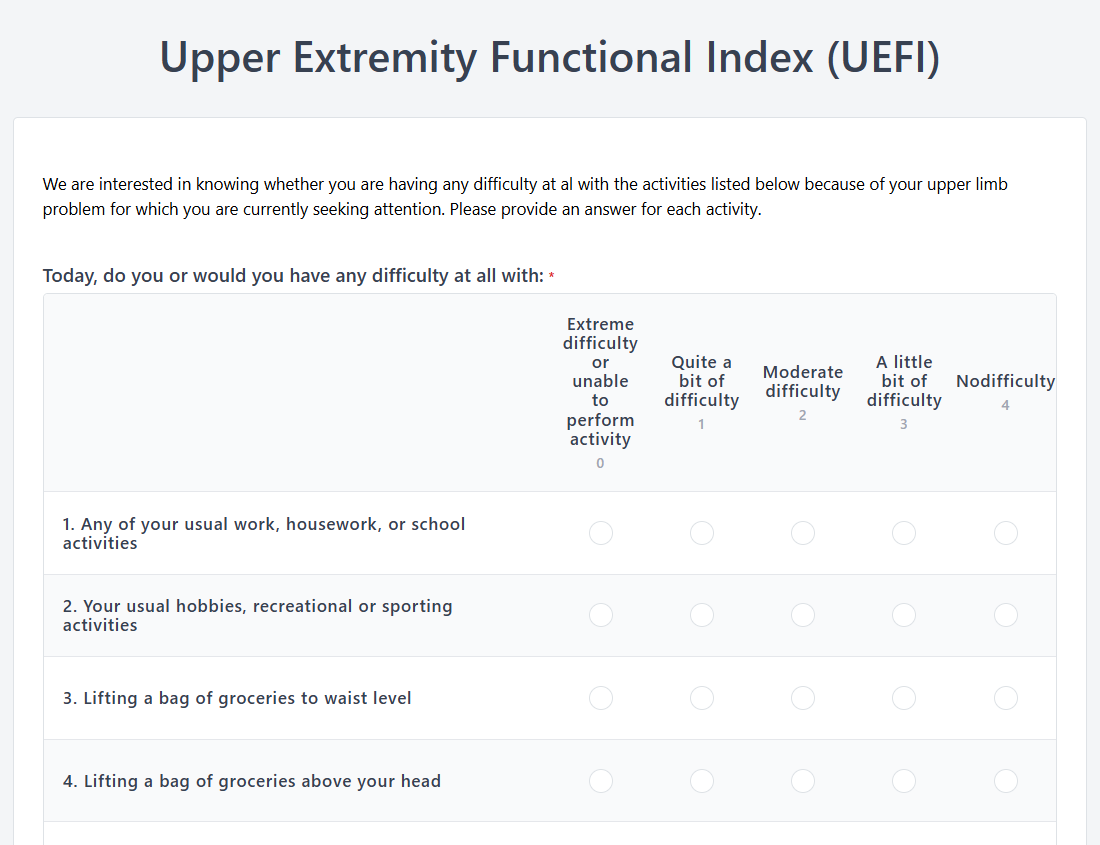

The Upper Extremity Functional Index (UEFI) is a widely used patient-reported outcome measure designed to assess functional limitations and recovery related to the shoulder, arm, elbow, wrist, and hand. It helps healthcare providers understand how upper extremity conditions impact a patient’s ability to perform everyday activities. By capturing standardized, measurable data directly from patients, the UEFI assessment supports informed clinical decision-making and progress tracking. When delivered digitally through Zentake, the Upper Extremity Functional Index questionnaire becomes easier to administer, score, and manage while maintaining HIPAA-compliant security. Zentake modernizes the UEFI clinical assessment by eliminating paper-based inefficiencies and enhancing data accuracy. This creates a smoother experience for both providers and patients across clinical settings.
The Upper Extremity Functional Index (UEFI) is a standardized assessment tool used to evaluate functional ability of the upper limbs. It was developed for use primarily in physical therapy and rehabilitation environments to quantify upper extremity disability and functional change. The Upper Extremity Functional Index questionnaire consists of multiple items that ask patients to rate their difficulty performing daily tasks involving the arms and hands. Responses are scored numerically and combined into a total score representing overall upper extremity function. This structure allows clinicians to easily interpret results and monitor progress over time. The UEFI outcome measure is valued for its simplicity, reliability, and sensitivity to clinically meaningful changes.
The Upper Extremity Functional Index plays a critical role in patient-centered care by focusing on functional ability rather than isolated clinical findings. It provides insight into how musculoskeletal or neurological conditions affect daily living activities. This perspective supports individualized treatment planning and goal setting. The UEFI assessment helps clinicians identify functional limitations that may not be visible during a physical exam alone. By using consistent scoring, providers can objectively measure improvement or decline. This makes the tool especially valuable throughout the rehabilitation process.
For healthcare providers and organizations, the UEFI offers standardized data that supports evidence-based practice. Physical therapists use it to document baseline function and demonstrate treatment effectiveness. Rehabilitation clinics benefit from consistent outcome tracking across patient populations. The UEFI clinical assessment also supports compliance, reporting, and quality improvement initiatives. Digital administration reduces administrative workload and scoring errors. Providers gain faster access to meaningful insights that support clinical decisions.
Common use cases for the Upper Extremity Functional Index include patient intake, progress monitoring, and discharge evaluation. It is frequently used in physical therapy, orthopedic care, sports medicine, and post-surgical rehabilitation. The UEFI rehabilitation assessment is also applied in research settings to evaluate treatment outcomes. It can be used to monitor chronic upper extremity conditions over time. Its versatility makes it a trusted upper extremity functional evaluation tool across diverse healthcare environments.
Traditional paper-based UEFI forms require manual completion, scoring, and storage, which can slow down clinical workflows. Paper assessments increase the risk of incomplete responses and scoring inconsistencies. Retrieving historical data from physical files can be time-consuming for providers. Manual data entry into electronic systems adds unnecessary administrative burden. Physical storage also increases the risk of data loss or security issues.
Digital UEFI assessments eliminate these challenges by automating scoring and data management. Automated calculations improve accuracy and consistency in UEFI score interpretation. Digital accessibility allows patients to complete the form using tablets or secure devices. Platforms like Zentake ensure HIPAA-compliant protection of patient information. Integration with digital systems improves data continuity. Overall, digital workflows enhance efficiency, security, and patient experience.
Customizable Forms: Zentake enables providers to customize the Upper Extremity Functional Index while preserving its validated structure. Clinics can add branding, instructions, or contextual guidance to improve patient comprehension. Smart form logic reduces confusion by displaying only relevant questions. Customization improves completion rates and data quality. This flexibility ensures consistent assessment delivery across care settings.
Electronic Signatures: Zentake supports secure electronic signatures alongside the UEFI assessment. Patients can complete and sign required documentation digitally during intake or follow-up visits. This reduces paperwork and administrative delays. Signed forms are securely stored with assessment records. Electronic signatures streamline workflows while supporting compliance.
HIPAA Compliant: Zentake is built with HIPAA-compliant security to protect sensitive assessment data. All UEFI clinical assessment responses are encrypted during transmission and storage. Access controls ensure only authorized users can view patient information. Audit trails support accountability and compliance. Providers can confidently manage digital outcome measures within a secure environment.
In-Clinic Tablets: Zentake supports in-clinic tablet use for digital UEFI administration. Tablets improve accessibility and reduce reliance on paper forms. Patient responses are immediately available to clinicians. Real-time access supports better clinical conversations and faster decision-making. This approach enhances both efficiency and patient experience.
Calculations: Zentake automates scoring for the Upper Extremity Functional Index. Automated calculations eliminate manual errors and inconsistencies. Clinicians receive immediate results upon form completion. This saves time and supports faster clinical evaluation. Automated scoring also simplifies longitudinal tracking.
Measures: Zentake includes powerful tracking tools that monitor UEFI scores over time. Providers can visualize trends to evaluate functional progress. Longitudinal data supports more informed care planning. Changes in scores help identify improvements or setbacks early. This enhances clinical decision-making and patient outcomes.
EHR Integration: Zentake integrates UEFI data directly into electronic health record systems. This eliminates duplicate data entry and improves accuracy. Integrated records support continuity of care across providers. Clinicians can access historical assessments alongside other clinical data. EHR integration strengthens operational efficiency and data integrity.
Q1: Who can use the Upper Extremity Functional Index?
The Upper Extremity Functional Index is commonly used by physical therapists, rehabilitation specialists, and orthopedic clinicians. It is appropriate for adult patients with upper extremity conditions or injuries. The UEFI patient questionnaire relies on patient self-reporting. This makes it easy to administer across clinical settings. It is suitable for both clinical practice and research.
Q2: How long does it take to complete the UEFI assessment?
The UEFI assessment is designed to be quick and patient-friendly. Most patients complete it in just a few minutes. Digital delivery through Zentake further improves efficiency. Clear instructions support smooth completion. This makes it ideal for busy clinical environments.
Q3: Is the Upper Extremity Functional Index scientifically validated?
Yes, the Upper Extremity Functional Index is a validated outcome measure supported by clinical research. It has demonstrated reliability and responsiveness in rehabilitation settings. Clinicians trust it for monitoring functional change. Validation supports its role in evidence-based care. Peer-reviewed research and professional rehabilitation organizations reference its use.
Q4: Can I export UEFI results from Zentake?
Zentake allows secure export of UEFI assessment results. Providers can integrate data with EHR systems or use it for reporting. Exported results maintain accuracy and formatting. This supports both clinical documentation and research needs. All exports follow HIPAA-compliant standards.

The leading patient intake platform. HIPAA compliant forms for healthcare providers and organizations. Find out what you're missing!


