
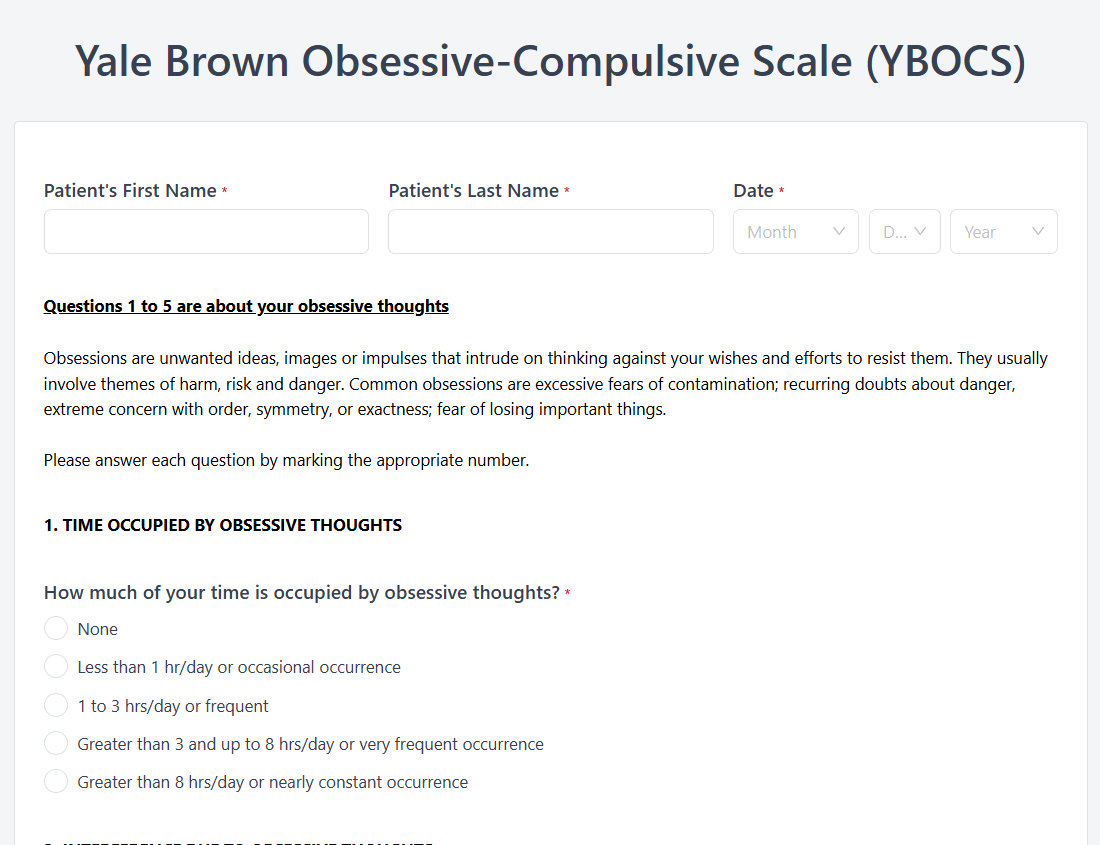

The Yale Brown Obsessive-Compulsive Scale (YBOCS) is a widely recognized clinical assessment tool designed to evaluate the severity and type of symptoms in individuals with obsessive-compulsive disorder (OCD). It helps mental health professionals measure both obsessive thoughts and compulsive behaviors, providing a comprehensive understanding of the disorder’s impact on daily functioning. The YBOCS assessment is structured, validated, and widely used in research, clinical, and treatment settings to track changes in symptom severity over time. When implemented digitally through Zentake, the YBOCS questionnaire is easier to administer, score, and store securely while maintaining HIPAA compliance. Zentake’s platform streamlines data collection, minimizes manual errors, and provides clinicians with actionable insights for treatment planning. This ensures a professional, efficient, and patient-friendly assessment experience.
The Yale Brown Obsessive-Compulsive Scale (YBOCS) is a standardized tool that evaluates the intensity and impact of obsessive thoughts and compulsive behaviors. Developed by Wayne K. Goodman and colleagues at Yale University, the scale is considered the gold standard for OCD assessment. The YBOCS questionnaire consists of two sections: one focusing on obsessions and the other on compulsions, each with five key items. Each item is rated on a 0–4 scale, producing a total score that indicates overall OCD severity. The scale also includes a symptom checklist to identify specific types of obsessions and compulsions. Its structured format allows for reliable scoring, repeatable use, and comparison across clinical and research populations.
The YBOCS assessment is crucial for accurately diagnosing OCD and determining the severity of symptoms. It provides clinicians with quantifiable data to guide treatment decisions and evaluate therapeutic outcomes. By highlighting the intensity and interference of obsessions and compulsions, the tool helps prioritize interventions and personalize care plans. The scale also assists in tracking changes over time, making it valuable for monitoring treatment effectiveness. Mental health professionals rely on it to communicate symptom severity clearly to patients, families, and interdisciplinary teams. For healthcare providers, using the YBOCS enables consistent documentation and enhances the credibility of clinical records. Digital administration further reduces the risk of scoring errors and incomplete responses. Clinicians can use YBOCS results to adjust therapy approaches, plan medication strategies, or recommend additional support services. Researchers utilize the scale in clinical trials and studies to evaluate treatment efficacy and understand OCD symptom patterns. The YBOCS also facilitates population-level analysis in mental health programs and contributes to evidence-based practice in psychiatric care.
Common use cases for the Yale Brown Obsessive-Compulsive Scale include initial patient assessments, ongoing monitoring of treatment response, and pre- and post-intervention evaluations. It is widely used in outpatient clinics, psychiatric hospitals, and research settings. Clinicians employ it to identify and quantify obsessive thoughts and compulsive behaviors. Researchers use the scale to standardize symptom measurement across studies. The YBOCS outcome measure also supports clinical documentation for insurance and compliance purposes. It is instrumental in evaluating cognitive-behavioral therapy, pharmacological interventions, and combined treatment approaches. The tool can be applied longitudinally to measure changes in symptom severity. Mental health programs use it to assess the effectiveness of interventions at the community or organizational level. Its structured scoring allows comparisons between patients, treatment protocols, and research cohorts. Digital administration improves efficiency, reduces administrative burden, and ensures secure storage of sensitive patient data.
Traditional paper-based YBOCS forms require manual scoring and storage, which can slow clinical workflows. Paper assessments are susceptible to incomplete responses and scoring errors. Retrieving historical records from physical files is time-consuming. Manual data entry into electronic systems increases administrative workload and introduces transcription errors. Paper forms are also more vulnerable to privacy and security risks. In contrast, digital YBOCS assessments streamline the process from administration to analysis. Automated scoring ensures consistent and accurate results. Patients can complete the form securely on tablets or remote devices. Digital data is HIPAA-compliant and easily integrated with electronic health records. Zentake’s platform enhances efficiency, accessibility, and data reliability while reducing the risk of errors and administrative delays. Clinicians benefit from immediate access to results, supporting timely and informed treatment decisions. Overall, digital delivery improves patient experience and operational workflow.
Customizable Forms: Zentake allows providers to customize the YBOCS questionnaire while preserving its validated structure. Clinics can add instructions, branding, or explanatory notes to improve patient understanding. Smart logic ensures that only relevant sections appear to each patient. Customization enhances completion rates and data accuracy. This functionality allows consistent assessment delivery across multiple locations and providers.
Electronic Signatures: Zentake supports secure electronic signatures with the YBOCS assessment. Patients can complete and sign forms digitally during intake or follow-up visits. This eliminates paperwork, accelerates administrative processes, and reduces errors. Electronic signatures are securely stored with the assessment record. Compliance with legal and regulatory standards is maintained seamlessly.
HIPAA Compliant: Zentake ensures all YBOCS responses are encrypted and stored in compliance with HIPAA regulations. Role-based access controls protect sensitive patient data. Audit trails provide accountability for clinical workflows. Providers can confidently manage and review patient information. HIPAA compliance safeguards both patient privacy and organizational trust.
In-Clinic Tablets: Zentake supports in-clinic tablet administration of the YBOCS assessment. Tablets enhance accessibility and convenience for patients. Responses are immediately available to clinicians for review. Real-time access supports timely clinical decisions. This digital approach streamlines intake and improves the overall patient experience.
Calculations: Zentake automates YBOCS scoring to eliminate manual errors. Calculated scores are instantly available for interpretation. Automation ensures consistency and reliability in outcome measurement. Clinicians save time and can focus on patient care. Longitudinal tracking of scores is simplified for progress monitoring.
Measures: Zentake provides tools to track YBOCS scores over time. Trend analysis allows clinicians to monitor symptom progression and treatment effectiveness. Longitudinal data supports more informed care planning. Providers can quickly identify changes in symptom severity. This feature empowers data-driven decision-making and improved patient outcomes.
EHR Integration: Zentake integrates YBOCS data directly into electronic health records. This eliminates duplicate entry and improves record accuracy. Integrated records allow for continuity of care across providers. Clinicians can access historical assessment data alongside other patient information. EHR integration enhances workflow efficiency and strengthens documentation integrity.
Q1: Who can use the Yale Brown Obsessive-Compulsive Scale?
The YBOCS is intended for use by licensed mental health professionals, including psychiatrists, psychologists, and therapists. It is suitable for adults and adolescents diagnosed with or suspected of having OCD. The YBOCS patient questionnaire is self-reported but interpreted by clinicians. Researchers also use it in clinical trials to standardize symptom measurement. The scale provides a reliable framework for both clinical practice and research applications.
Q2: How long does it take to complete the YBOCS assessment?
The YBOCS is designed to be concise and efficient. Most patients complete the questionnaire in approximately 15–30 minutes. Digital administration through Zentake reduces time by providing guided, structured forms. Clear instructions improve accuracy and patient understanding. This efficiency makes it suitable for busy clinical environments.
Q3: Is the Yale Brown Obsessive-Compulsive Scale scientifically validated?
Yes, the YBOCS is a validated and widely recognized tool in OCD research and clinical practice. It demonstrates high reliability and sensitivity to changes in symptom severity. Peer-reviewed studies support its use in both treatment monitoring and research. The scale is referenced by professional psychiatric and psychological associations. Validation ensures its credibility for evidence-based practice.
Q4: Can I export YBOCS results from Zentake?
Zentake allows secure export of YBOCS assessment results for reporting, research, or integration with EHR systems. Exported data maintains accuracy, formatting, and compliance. Providers can use the data for documentation or analysis. Export functionality adheres to HIPAA standards. This feature supports seamless workflow and secure data management.

The leading patient intake platform. HIPAA compliant forms for healthcare providers and organizations. Find out what you're missing!


