
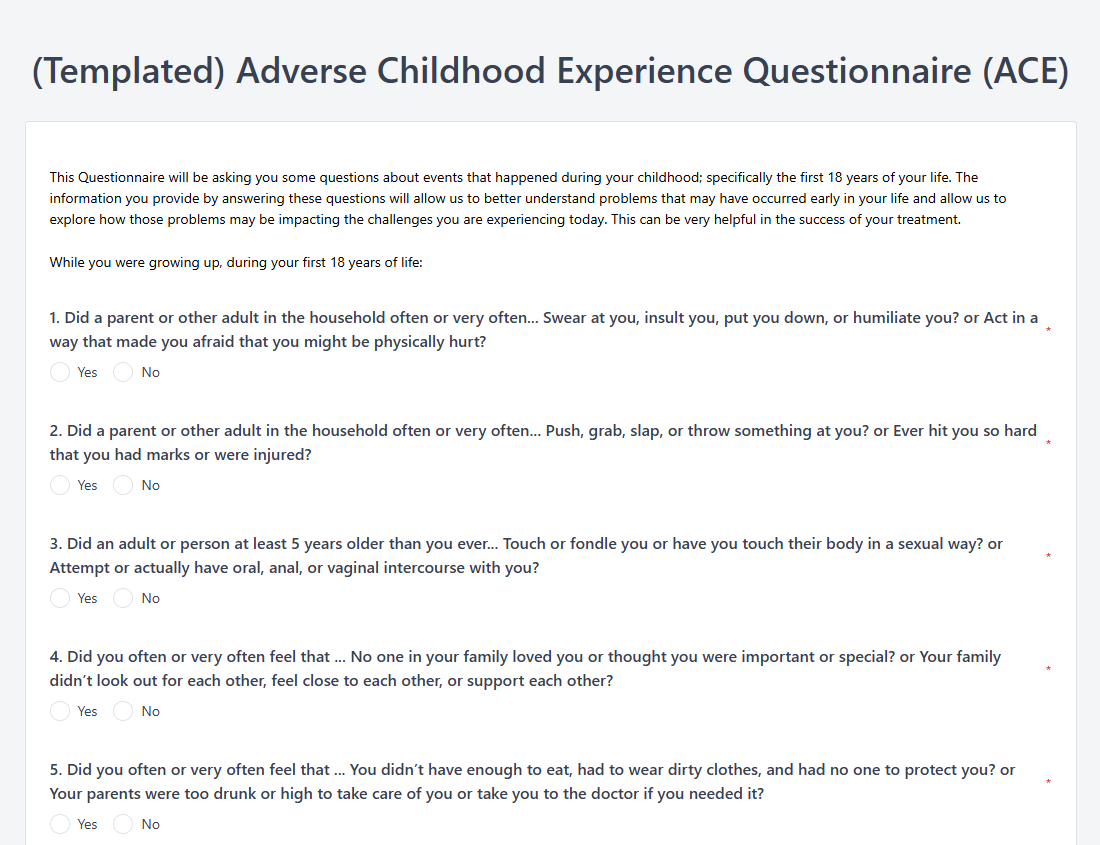

The Adverse Childhood Experiences Questionnaire (ACE) is a 10-item retrospective screening tool developed by Vincent Felitti, MD, and Robert Anda, MD, as part of the landmark CDC-Kaiser Permanente ACE Study published in 1998. The ACE assesses exposure to 10 categories of childhood adversity—including abuse, neglect, and household dysfunction—before age 18, using a simple yes/no format with scores ranging from 0 to 10 (Felitti et al., 1998). The ACE is validated for adults across diverse populations and demonstrates a strong dose-response relationship between ACE scores and long-term health outcomes.
The ACE demonstrates acceptable internal consistency, with Cronbach's alpha coefficients ranging from 0.70 to 0.76 across validation studies. Zentake's digital ACE Questionnaire auto-calculates total scores upon submission, streamlining trauma-informed screening in clinical settings.
The ACE Questionnaire uses a simple dichotomous scoring method. Each of the 10 items is answered "Yes" or "No." Each "Yes" response receives 1 point, and the total ACE score is the sum of all affirmative answers, yielding a score range of 0 to 10.
Unlike many clinical assessments, the ACE does not use traditional clinical cutoffs for diagnosis. Instead, research demonstrates a graded dose-response relationship: as ACE scores increase, so does the risk of negative health outcomes. Key research-based thresholds include:
The ACE measures two broad domains: Abuse/Neglect (physical abuse, emotional abuse, sexual abuse, physical neglect, emotional neglect) and Household Dysfunction (parental separation/divorce, domestic violence, household substance abuse, household mental illness, incarcerated household member).
Zentake automatically calculates the total ACE score upon form submission, eliminating manual tallying and reducing scoring errors in busy clinical environments.
Step 1: Prepare the clinical environment. Ensure the patient is in a private, safe setting. ACE screening involves sensitive questions about childhood trauma, so establishing trust and explaining the purpose of the questionnaire is essential. With Zentake, you can send the ACE digitally before the appointment so patients can complete it in a comfortable setting.
Step 2: Deliver the questionnaire. Present all 10 items to the patient. Each question asks about a specific adverse experience that occurred before the patient's 18th birthday. Zentake delivers the ACE via secure digital link—accessible on any device—eliminating the need for paper forms.
Step 3: Allow self-completion. The ACE is designed as a self-report instrument. Patients should complete it independently, without clinician influence. Digital delivery via Zentake ensures patients can respond privately and at their own pace.
Step 4: Review scores and context. After submission, review the total ACE score alongside the patient's current clinical presentation, symptoms, and protective factors. Zentake auto-scores the form instantly, so results are ready for review the moment the patient finishes.
Step 5: Integrate into treatment planning. Use ACE results to inform trauma-informed care approaches. High ACE scores may warrant further assessment for PTSD, depression, anxiety, or substance use. Zentake's longitudinal tracking lets you monitor ACE-related screenings over time for each patient.
Scoring: Paper ACE forms require manual counting of "Yes" responses, which is simple but still subject to human error. Zentake auto-calculates the total ACE score instantly upon submission.
Completion: Paper forms must be completed on-site during the visit. Zentake allows patients to complete the ACE remotely before their appointment, saving valuable clinical time.
Delivery: Paper forms require printing, stocking, and physical distribution. Zentake delivers the ACE via secure link to any smartphone, tablet, or computer.
Data Storage: Paper ACE forms must be scanned or manually filed, creating storage and retrieval challenges. Zentake stores all responses in a secure, HIPAA-compliant cloud environment.
Longitudinal Tracking: Comparing ACE results over time on paper requires pulling and comparing physical records. Zentake provides automated longitudinal tracking with visual score trends.
Security: Paper forms can be lost, misplaced, or viewed by unauthorized personnel. Zentake uses encryption, role-based access, and HIPAA-compliant infrastructure to protect sensitive trauma data.
Integration: Paper ACE data must be manually entered into EHR systems. Zentake integrates directly with EMR platforms, pushing ACE scores and responses automatically.
Cost: Paper forms incur ongoing printing and storage costs. Zentake reduces overhead with a digital-first approach and offers a free trial to get started.
What does the ACE Questionnaire measure?
The ACE Questionnaire measures exposure to 10 categories of adverse childhood experiences that occurred before age 18. These include five types of abuse and neglect (physical, emotional, and sexual abuse; physical and emotional neglect) and five types of household dysfunction (parental separation/divorce, domestic violence, substance abuse, mental illness, and incarceration of a household member). Zentake's digital ACE form captures all 10 domains with auto-scoring for immediate clinical use.
How do you score the ACE Questionnaire?
Each of the 10 ACE items is scored as either 0 (No) or 1 (Yes). The total ACE score is the sum of all affirmative responses, ranging from 0 to 10. Higher scores indicate greater cumulative childhood adversity exposure. Zentake auto-calculates this score upon submission.
How long does the ACE Questionnaire take to complete?
The ACE Questionnaire typically takes 3 to 5 minutes to complete. The 10 yes/no questions are straightforward and require no specialized knowledge from the respondent. Zentake's digital format allows patients to complete it before their visit, saving clinical time.
Is the ACE Questionnaire free to use?
The ACE Questionnaire itself is in the public domain and free to use without licensing fees. Zentake offers a free trial that includes the digital ACE form with auto-scoring, HIPAA-compliant storage, and EMR integration.
What age group is the ACE Questionnaire designed for?
The ACE Questionnaire is designed for adults (18 and older) to retrospectively report on experiences that occurred during childhood (before age 18). It has been validated across diverse adult populations in healthcare, social services, and research settings.
Who should administer the ACE Questionnaire?
The ACE can be administered by any qualified healthcare professional, including physicians, psychologists, social workers, nurses, and school counselors. It is a self-report instrument, meaning the patient completes it independently. Zentake allows any staff member to send the digital ACE to patients without specialized training.
What is the clinical significance of an ACE score of 4 or higher?
Research from the original CDC-Kaiser study found that individuals with an ACE score of 4 or more have a 4- to 12-fold increased risk for alcoholism, drug abuse, depression, and suicide attempt. They also have a 2- to 4-fold increase in smoking, poor self-rated health, and sexually transmitted infections. An ACE score of 4+ should prompt further clinical evaluation and trauma-informed care planning.
Can the ACE Questionnaire be used in pediatric settings?
The standard ACE Questionnaire is designed for adult retrospective self-report. For pediatric screening, clinicians should consider the Pediatric ACEs and Related Life-events Screener (PEARLS) or other age-appropriate tools. Zentake offers multiple trauma screening templates suitable for various age groups.
Does a high ACE score mean someone will develop health problems?
A high ACE score indicates increased statistical risk, not certainty. Many individuals with high ACE scores lead healthy lives, particularly when they have strong protective factors such as supportive relationships, access to mental healthcare, and community resources. The ACE is a screening tool, not a diagnostic instrument.
1. Felitti, V. J., Anda, R. F., Nordenberg, D., Williamson, D. F., Spitz, A. M., Edwards, V., Koss, M. P., & Marks, J. S. (1998). Relationship of childhood abuse and household dysfunction to many of the leading causes of death in adults: The Adverse Childhood Experiences (ACE) Study. American Journal of Preventive Medicine, 14(4), 245–258.
2. Centers for Disease Control and Prevention. (2024). About the CDC-Kaiser ACE Study. CDC Violence Prevention. https://www.cdc.gov/violenceprevention/aces/about.html
3. Merrick, M. T., Ford, D. C., Ports, K. A., Guinn, A. S., Chen, J., Klevens, J., Metzler, M., Jones, C. M., Simon, T. R., Daniel, V. M., Ottley, P., & Mercy, J. A. (2019). Vital signs: Estimated proportion of adult health problems attributable to adverse childhood experiences and implications for prevention. Morbidity and Mortality Weekly Report, 68(44), 999–1005.
Last updated: March 2026

The leading patient intake platform. HIPAA compliant forms for healthcare providers and organizations. Find out what you're missing!


