
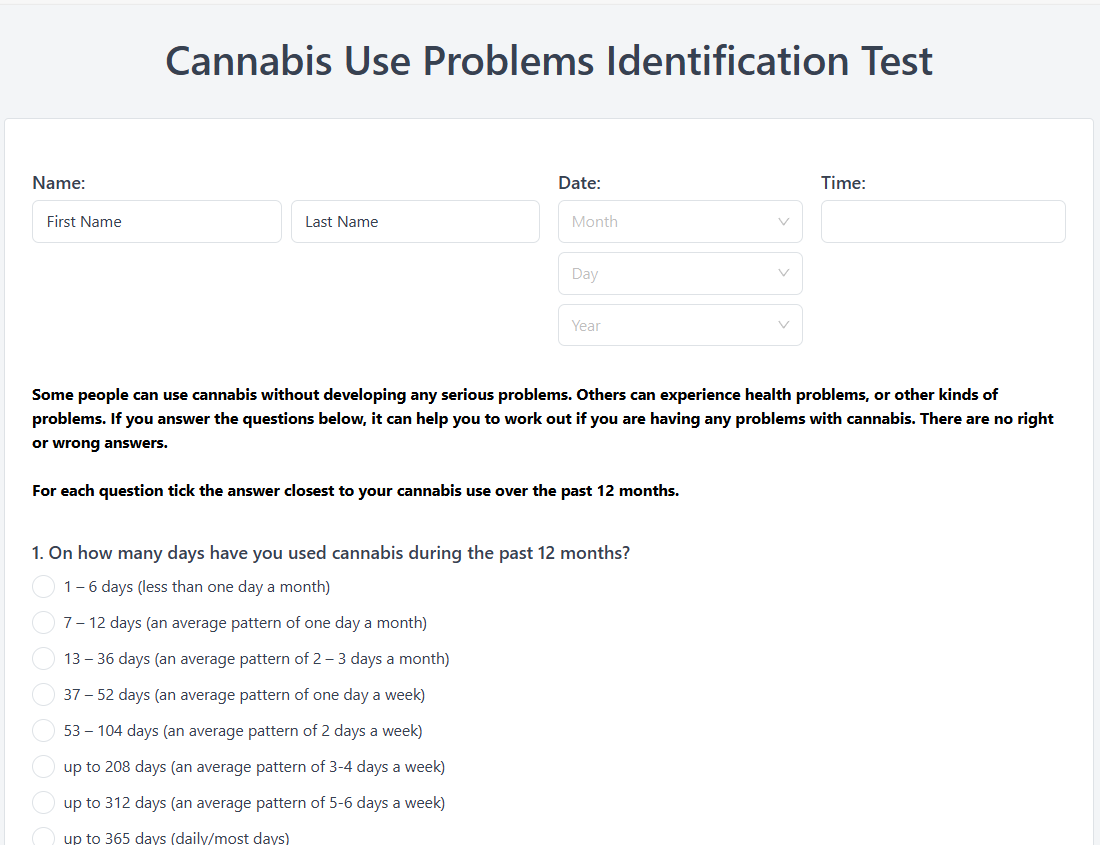

The Cannabis Use Problems Identification Test (CUPIT) is a 16-item self-report screening tool developed by Jan Bashford, Ross Flett, and Jan Copeland (2010) to identify problematic cannabis use and risk of cannabis use disorder. The CUPIT measures two dimensions: Impaired Control over cannabis use (items 1–9) and Problems caused by cannabis use (items 10–16). A total score of 12 or above is the optimal cutoff for identifying both current cannabis use disorder and risk of meeting diagnostic criteria within 12 months. The CUPIT demonstrates excellent psychometric properties, with internal consistency of 0.92 and 0.83 for the two subscales and test-retest reliability of 0.89–0.99. It was validated on 212 participants aged 13–61 across diverse community settings. Zentake’s digital CUPIT provides automated scoring, subscale breakdowns, and longitudinal tracking of cannabis use patterns over time.
The CUPIT consists of 16 items divided into two subscales. Items use varying response formats to capture frequency, quantity, and consequences of cannabis use. The total score is calculated by summing all 16 item responses.
The clinical cutoff score of 12 was established through receiver operating characteristic (ROC) analysis to maximize sensitivity for detecting both currently diagnosable cannabis use disorder and individuals at risk of meeting diagnostic criteria in the following 12 months (Bashford et al., 2010). Research shows that adults tend to score higher on the Impaired Control subscale while adolescents score higher on the Problems subscale.
Zentake automatically calculates total CUPIT scores and both subscale scores upon form submission, providing instant clinical classification and flagging scores at or above the cutoff threshold.
Step 1: Determine eligibility. The CUPIT is designed for past-year cannabis users aged 13 and older. Confirm the individual has used cannabis in the past 12 months before administering. With Zentake, screening eligibility questions can be built into the form flow, automatically routing to the CUPIT when appropriate.
Step 2: Explain the purpose. Inform the individual that the questionnaire asks about their cannabis use patterns and any related concerns. Emphasize confidentiality and that honest answers will help provide the best care. Zentake displays standardized instructions and confidentiality notices at the top of the digital form.
Step 3: Allow independent completion. The CUPIT is a self-report measure that takes approximately 5–10 minutes to complete. The individual responds to 16 items about their cannabis use frequency, control, and consequences. Zentake presents items in a clear, sequential format on any device.
Step 4: Review scored results. After completion, review the total score against the cutoff of 12. Examine both subscale scores to understand whether impaired control, cannabis-related problems, or both are the primary concern. Zentake generates an instant score summary with subscale breakdowns and clinical flags.
Step 5: Develop a clinical response. Scores at or above 12 indicate the need for further assessment, possible brief intervention, or referral to substance use treatment. Use subscale scores to tailor the intervention approach. Zentake stores results alongside other screening data for a comprehensive clinical picture and supports longitudinal monitoring of treatment progress.
Scoring: Paper requires manual summing of 16 items across two subscales and comparison against the cutoff score. Zentake auto-calculates total and subscale scores instantly with automatic clinical threshold flagging.
Completion: Paper forms take 5–10 minutes but must be printed and physically distributed. Zentake delivers the CUPIT via secure link for completion on any device before or during an appointment.
Delivery: Paper assessments require in-person distribution, which can create discomfort for patients discussing substance use. Zentake allows private digital completion, reducing stigma-related barriers to honest reporting.
Data Storage: Paper forms containing sensitive substance use information require secure physical filing. Zentake stores all responses in HIPAA-compliant encrypted cloud storage with role-based access.
Longitudinal Tracking: Comparing paper CUPIT scores over treatment requires pulling charts and manual comparison. Zentake automatically graphs score trends to visualize treatment progress or escalating use patterns.
Security: Paper forms with substance use data can be accessed by unauthorized personnel. Zentake provides encrypted storage, audit trails, and role-based access controls for sensitive screening data.
Integration: Paper scores must be manually transcribed into EHR/EMR systems. Zentake integrates directly with electronic medical records for seamless clinical documentation.
Cost: Paper involves ongoing printing and administrative overhead. Zentake eliminates material costs and reduces staff scoring time to zero.
What does the CUPIT measure?
The CUPIT measures two dimensions of cannabis use: Impaired Control (difficulty managing frequency and quantity of use, failed quit attempts) and Problems (negative social, occupational, psychological, and physical consequences of cannabis use). It was developed by Bashford, Flett, and Copeland (2010) and validated across adolescent and adult populations.
How do you score the CUPIT?
Sum all 16 item responses for a total score. Items 1–9 form the Impaired Control subscale (CUPIT-A) and items 10–16 form the Problems subscale (CUPIT-B). A total score of 12 or above indicates probable cannabis use disorder or significant risk of developing one within 12 months. Zentake calculates all scores automatically.
How long does the CUPIT take to complete?
The CUPIT takes approximately 5–10 minutes to complete. Its 16-item format makes it brief enough for routine screening while comprehensive enough to capture both use patterns and consequences.
Is the CUPIT free to use?
The CUPIT is available for clinical and research use. The original instrument was published in the journal Addiction by Bashford et al. (2010). Zentake provides a digital version with automated scoring and EMR integration at no additional cost during your free trial period.
What age group is the CUPIT designed for?
The CUPIT was validated on individuals aged 13–61, making it one of the few cannabis screening tools suitable for both adolescents and adults. Research shows differential scoring patterns between age groups: adults score higher on Impaired Control while adolescents score higher on Problems.
Who should administer the CUPIT?
The CUPIT is a self-report screening tool that can be administered by any healthcare professional, including physicians, nurses, counselors, social workers, and other clinical staff. It is designed for use in primary care, mental health, substance abuse treatment, and community health settings.
How is the CUPIT different from the CUDIT?
The CUPIT (Cannabis Use Problems Identification Test) is a 16-item tool with two subscales measuring impaired control and problems, while the CUDIT (Cannabis Use Disorders Identification Test) and its revised version CUDIT-R are shorter screening tools modeled after the AUDIT for alcohol. The CUPIT provides more detailed assessment of both use patterns and consequences, making it better suited for clinical evaluation beyond initial screening.
Can the CUPIT be used for treatment monitoring?
Yes, the CUPIT’s sensitivity to change makes it suitable for monitoring treatment progress. Repeated administration allows clinicians to track changes in both impaired control and cannabis-related problems over time. Zentake’s longitudinal tracking feature automates this comparison across assessment intervals.
What should I do if a patient scores 12 or above?
A score of 12 or above suggests probable cannabis use disorder or significant risk. Clinicians should conduct a comprehensive substance use assessment, consider brief intervention strategies, and evaluate the need for referral to specialized treatment. The subscale breakdown can guide whether intervention should focus on use control strategies, harm reduction, or addressing specific consequences.
1. Bashford, J., Flett, R., & Copeland, J. (2010). The Cannabis Use Problems Identification Test (CUPIT): Development, reliability, concurrent and predictive validity among adolescents and adults. Addiction, 105(4), 615–625.
2. Fernandez-Artamendi, S., Fernández-Hermida, J. R., Secades-Villa, R., & García-Portilla, P. (2012). Screening instruments for cannabis-related problems: A systematic review. International Journal of Clinical and Health Psychology, 12(1), 19–32.
3. Norberg, M. M., Gates, P., Dillon, P., Kavanagh, D. J., Manocha, R., & Copeland, J. (2012). Screening and managing cannabis use: Comparing GP’s and nurses’ knowledge, beliefs, and behavior. Substance Abuse Treatment, Prevention, and Policy, 7, 31.
Last updated: March 2026

The leading patient intake platform. HIPAA compliant forms for healthcare providers and organizations. Find out what you're missing!


