
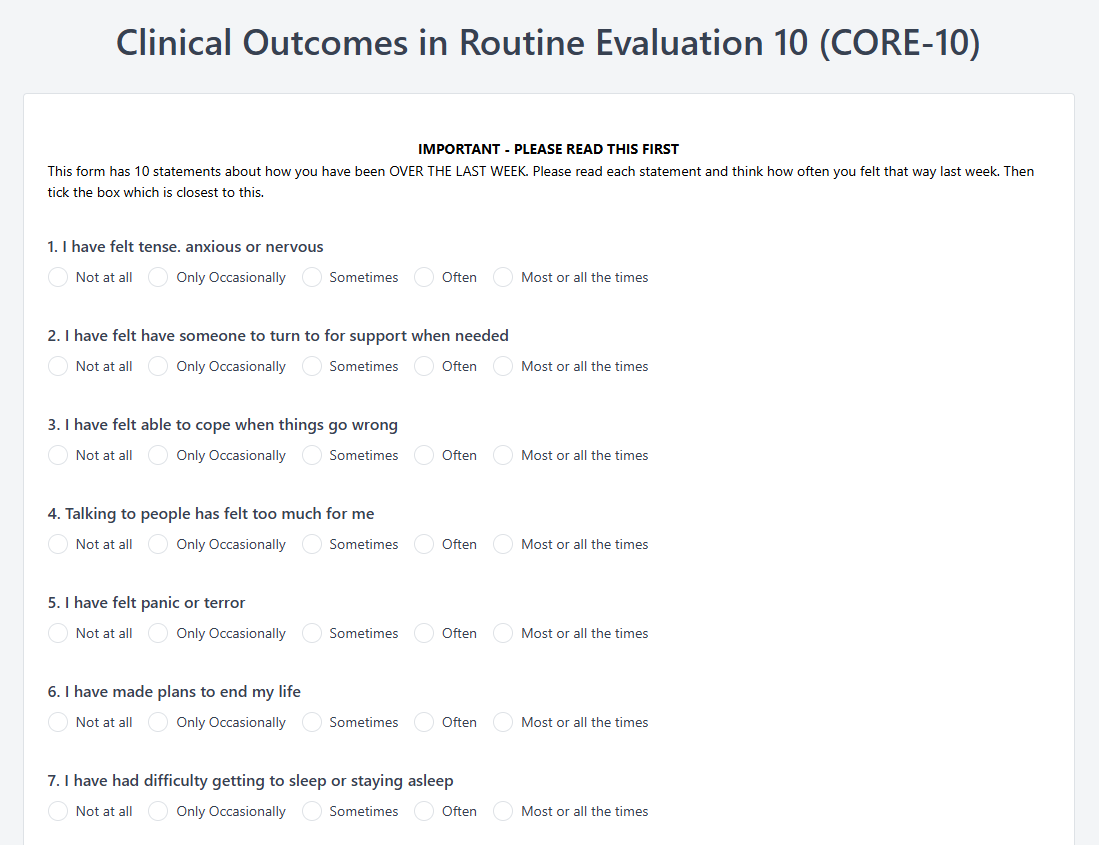

The Clinical Outcomes in Routine Evaluation 10 (CORE-10) is a 10-item self-report measure of common psychological distress developed by Barkham and colleagues in 2013 as a brief, session-by-session outcome tool for primary care and psychological therapies (Counselling and Psychotherapy Research, 13(1):3–13). It samples six problem/symptom items, three functioning items, and one risk item, producing a total score from 0 to 40. The clinical cutoff for general psychological distress is 11, with a reliable change index of 6 points. The CORE-10 has strong reliability and is widely used across IAPT and NHS mental health services. Zentake's digital CORE-10 auto-scores every submission and plots outcomes session by session.
Each of the 10 items is rated on a 5-point Likert scale from 0 ("not at all") to 4 ("most or all of the time") based on the past week. Sum the 10 items for a total score of 0 to 40. Interpretation, per Barkham et al. (2013):
Zentake automatically calculates the CORE-10 total, categorizes severity, and flags reliable change between sessions.
Step 1: Send the form before or at the start of each session via secure link. Zentake lets clinicians automate pre-session delivery by email or SMS.
Step 2: Client completes the 10 items in about 2 minutes on any device.
Step 3: Automatic scoring. Zentake tallies the total, categorizes distress severity, and flags the risk item if elevated.
Step 4: Review session-by-session trend. Zentake visualizes CORE-10 scores over time and highlights reliable change.
Step 5: Document in the chart. Scores store in the patient record and sync to connected EMRs for outcome reporting.
Scoring: Paper requires manual totalling each session; Zentake auto-scores instantly. Completion: Clients complete on phone or tablet before session, saving in-session time. Delivery: Automated email/SMS links vs. printing and handing out. Data Storage: Encrypted longitudinal record vs. loose paper. Longitudinal Tracking: Session-by-session trend charts built in. Security: HIPAA-compliant infrastructure. Integration: Scores flow to the EMR. Cost: Eliminates paper and transcription overhead.
What does the CORE-10 measure? The CORE-10 measures common psychological distress across anxiety, depression, trauma, physical symptoms, functioning, and risk. Zentake auto-scores and plots results session by session.
How do you score the CORE-10? Sum the 10 items, each rated 0–4, for a total of 0–40. A score of 11 or higher indicates clinical-range distress (Barkham et al., 2013).
How long does the CORE-10 take? Most clients complete the CORE-10 in about 2 minutes, making it ideal for routine session-by-session use.
Is the CORE-10 free to use? The CORE-10 is free for clinical use under the CORE System Trust's terms. Zentake charges only for the digital platform.
What population is the CORE-10 for? The CORE-10 is validated for adults seeking psychological therapy and for primary care mental health screening.
Who should administer the CORE-10? The CORE-10 is self-administered by clients; clinicians review and interpret scores. Zentake delivers it securely before each session.
What is a reliable change on the CORE-10? A change of 6 or more points represents statistically reliable improvement or deterioration (Barkham et al., 2013). Zentake flags reliable change automatically.
What CORE-10 score indicates depression? A cutoff of 13 has been proposed for depression, with sensitivity of .92 and specificity of .72.
Last updated: March 2026

The leading patient intake platform. HIPAA compliant forms for healthcare providers and organizations. Find out what you're missing!


